|
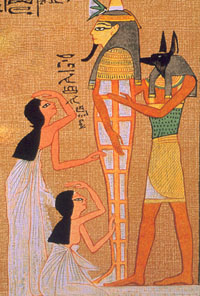
Inpw, as the Egyptians called him, is the patron of funerary arts, embalmers, and the protector of the necropolis. Early depictions of Anubis show him as a black jackal, reclining on a chest. During the New Kingdom, he took on a more anthropomorphic form, having the head of a black jackal, and the body of a man. The imy-wt, an animal pelt on a pole, was used to denote him. His association with the jackal probably came from the ancient Egyptians' observations of jackals prowling the cemetaries at night in search of scraps of flesh to eat. Anubis' color, black, reflects his association with death and resurrection. Originally the patron of the 17th Nome of Upper Egypt, Saka, or Cynopolis to the Greeks, Anubis was one of the first funerary gods. "Undertaker," and "Lord of the Sacred Land" were the few of many epithets of Anubis that indicated his association with funeral rites and death.
In the early Pyramid Texts of the Old Kingdom, Anubis is identified as a judge of the dead, the son of Bastet (the feline goddess) or Hesat (a cow goddess), and the father of Kebehut/Kebechet, the snake goddess who signifies purifying waters. It is during the Middle Kingdom that Osiris (Ausar) gradually usurped some of the characteristics of Anubis. Anubis' role as a god of death lessened in comparison to his association with funerary ritual and judgment, all due to the popularity of the Osirian cult. However, Anubis remained a judge in the Hall of Double Truths, the protector of tombs, and the guide of the deceased. In Anubis' role as a judge in the Hall of Double Truths, he presides of the Weighing of the Heart Ceremony. The feather of ma'at (truth) is placed on the end of a scale, while the ib, or heart, of the deceased is placed on the other end of the scale. Anubis records whether or not the heart is heavier, weighed down by sin, than the feather. If Anubis finds that the heart is indeed heavier, the demoness Ammit is allowed to swallow it. The cult of Osiris did help boost the popularity of Anubis in other ways. In the popular story of The Contendings of Horus and Seth, Anubis is the son of Nephthys (Nebt-Het) and Osiris or Seth. Plutarch reinforces the story that names Osiris as Anubis' father. Plutarch writes that Anubis was conceived out of an adulterous affair between Nephthys and Osiris, thus triggering Seth's rage and animosity towards his own brother.
The New Kingdom brought further elaboration on Anubis' role in epic battle between the Osirian family and Seth. When Nephthys gave birth to Anubis, she abondoned him. Isis (Aset) took pity upon Anubis and raised him as her own child. After Seth hacked Osiris' corpse into pieces, Anubis assisted Nephthys and Isis in finding his body. When they recovered all of the pieces, Anubis preserved the body and wrapped it in bandages, thus making Osiris the first mummy. Because Isis raised Anubis as a son, he is often equated with Isis' biological child, Horus. In Hut-Nesut, located in the 18th Nome of Upper Egypt (Nemty), there is a shrine to the composite god of Horus and Anubis. New Kingdom depictions of Anubis show him as a jackal headed man bending over a mummy, tending to the funerary process. Others illustrate him holding the upright mummy from behind during the Opening of the Mouth Ceremony (see above picture). During the Ptolemaic Dynasty, Anubis became a much more central figure in the Egyptian pantheon. The Greeks made him a god in the cosmos. Slightly later, after the Roman conquests, Anubis was hailed as the constant companion of Isis. This was a time when the cult of Isis and Osiris reached its height and infiltrated the traditional Roman and Greek pantheons, making Anubis a very important cult icon during this era.
|