| Copyright 2006 by The Haole Crab |
| Catalina white sea bass and yellowtail |
 |
 |
| Mahalo! I'd like to give a big mahalo (thanks) to Bill McIntyre for his hospitality. I couldn't have caught these fish without his help! Home |
 |
| It's funny. Spearfishermen in cold places long to visit warmer waters, and those in warm waters always seem to want to travel to tropical waters, but not me. I go the other way. Although I was born and raised on Maui and learned to spear in the warm, clear water there, I'm drawn to the cold and often murky kelp beds off the coast of California. The reason for this goes back to February of 1994, when I took second place at the spearfishing tournament held to celebrate the opening of Maui Sporting Goods' Oahu store. One of the prizes that I won was a copy of The Last of the Blue Water Hunters by Carlos Eyles. I've read it countless times since then, both for motivation and to connect with our spearfishing past, and it has had a significant impact on my development as a blue water hunter. Carlos' book tells the story of his return to Catalina Island and of the pursuit of "the most difficult of the Pacific pelagics to hunt" - the white sea bass. |
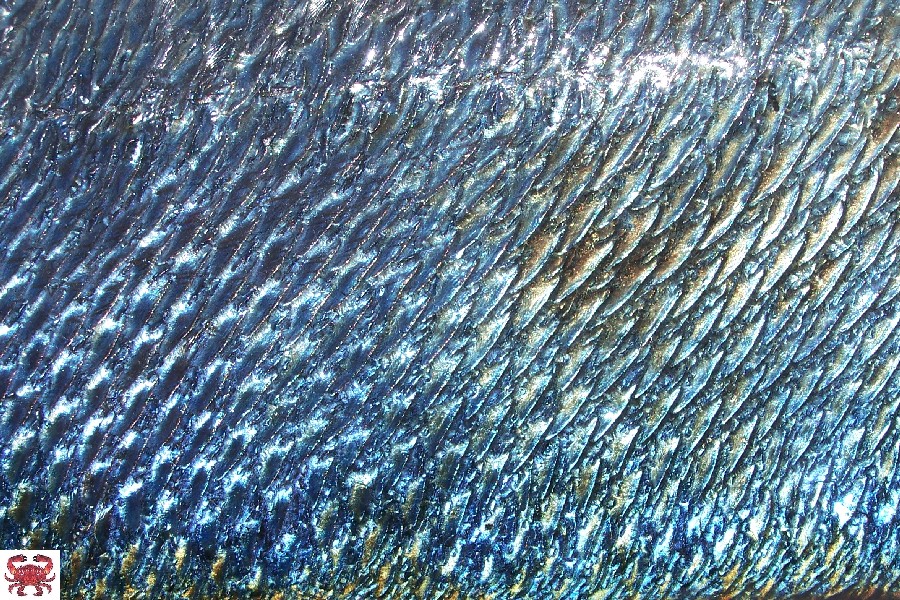
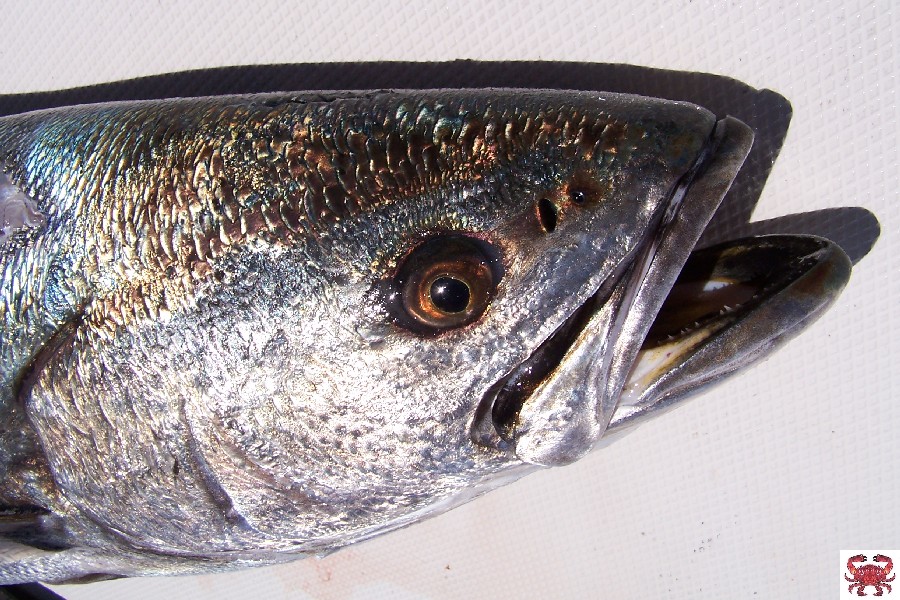
| "Generally, ocean predators can be temporarily tricked in some way, and a thorough knowledge of each species' particular traits will disclose their inclinations. The white sea bass is the exception: it cannot be tricked. It must be stalked in the untrackable waters outside the kelp beds. The white sea bass is one of nature's most stunning underwater creatures. Its color scheme begins with a fluorescent purple back that is mixed with moss green at the edges. These colors graduate to silver just above the lateral line, and continue down to a belly that is snow white. As extraordinary as these colors are, when seen from the surface they become absorbed in the lightless fathoms, blending perfectly with the hue of the depths, and rendering the fish almost invisible. However, to see a white sea bass swimming at eye level is to see a luminous ghost that has caught all of the available light in the filtered depths and refleced it back to the viewer. Unlike other free swimming big fish, which are fueled by untiring frenetic energy, the white sea bass moves with effortless grace, and gives the illusion of gliding through the water rather than swimming.... The white sea bass possess a sensitivity to the undersea world that is indeed mysterious. It is an extremely shy and wary creature that, upon sensing the slightest disturbance in the area, vanishes as quickly as vapor from a whale's blow. A fin splash on the surface, a slight noise from an anchored boat, a few bubbles escaping from a fin, even the infinitesimal sound of the human ear clearing through a pressure change can provoke flight. The white sea bass makes no grand exit in the tradition of its pelagic brothers; it simply disappears, nobody home." |
| -excerpts are from the chapter "White Sea Bass" in The Last of the Blue Water Hunters by Carlos Eyles |
 |
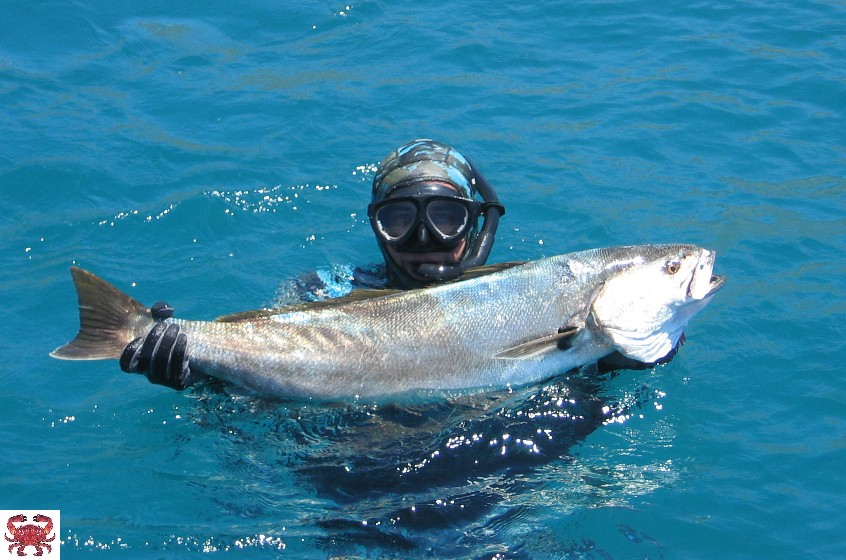
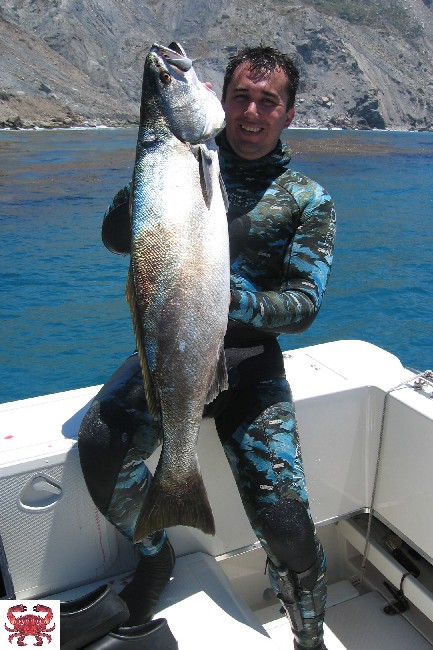
| The above passage made me wish just to see a white sea bass in the water, and over ten years later, on my second trip to Santa Catalina, I was fortunate enough to not only see, but to spear my first white sea bass. First white sea bass So far, the day had not gone that well. My dive partner, Bill McIntyre, and I didn't see any whites at Little Gibraltar, and I wasn't seeing any at our second stop, Johnson's Reef. The visibility had steadily decreased as well due to the rising swell. I dropped down to the bottom at 30 feet and laid there, letting my eyes adjust to the gloom. I cautiously cleared my ears and instantly heard the "BOOM" of a white sea bass tail cavitating as he spooked. I never even saw the fish. Later in the dive, I was trying to land a big calico by hiding on the bottom at 45 feet, when a white came rushing by in the distance to my left. In the time it took me to realize what he was, he had gone from a silhouette to just a yellow tail disappearing into the murk. I took a shot at where his body should have been and... nothing. Our third stop was at a really thick, large kelp bed. Bill opted to let me check the conditions, as the swell had come up even more. It was not too bad inside the bed however, and I started carefully slithering through the kelp. I went a ways without seeing much life, until I hit a small kelp room holding some bait. My body was back in the thicket, and I decided to wait in ambush. After about five minutes, a large white came barreling through the room from the left. He was right in front of me, but I saw him too late, and on top of that, my gun was pointing in the wrong direction. I couldn't work out a shot, and the fish disappeared into the kelp. I was bitterly disappointed and afraid that I had missed my one chance. Nonetheless, I worked the rest of the bed until I was so tired, cold, and seasick that I was forced to get out. Back at the boat, I warmed up and rested while we figured out what to do. We decided to try another bed, that was thinner and murkier, but that had been rumored to have been holding whites. I still wanted to rest, so Bill got in first, and within ten minutes, he had spotted a small school of whites. That motivated me, and I quickly geared up and got in. I made my way through the bed using the slightest of movements. When I finally spotted a white, he was alone and slowly swimming out from under a kelp frond. I very carefully and slowly lined up on him, pulled the trigger, and he was gone. He took the line from my reel at an amazing rate, and when I was down to my last five feet, I was forced to lock the drag and swim frantically after him. He eventually tangled up and the line went slack. I quickly followed the bright blue Mori line through the bed until I could reach my shooting line. The visibility on the bottom was so bad though, that I couldn't find the fish or my spear, and I spent several frantic dives searching. I didn't want to lose this fish! Finally, I spotted a flash of silver and grabbed my fish. He was already dead, so I relaxed and started cutting him out of the kelp, but it wasn't until I got him back to the boat that I started to believe that he was really mine. Bill was stoked that I had landed a fish, and we took a bunch of pictures. |
 |
 |
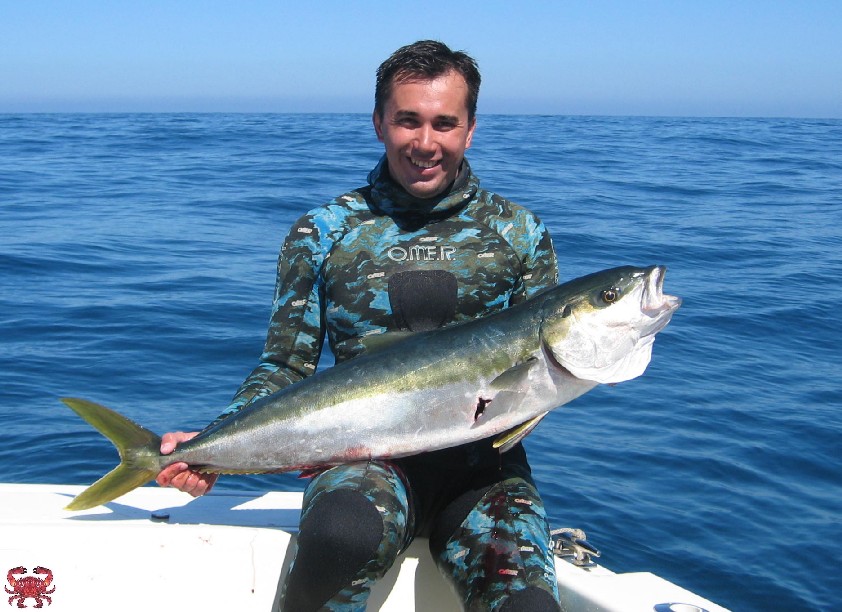
| First yellowtail We dove Little Harbor in the morning, but didn't see squat, so we decided to try for yellowtail at Farnsworth bank since there had been reports of divers getting fish there recently. Bill dropped me right on top of the high spot, and although the visibility wasn't good enough to see the bottom from the surface, when I dropped down to 15 feet, it popped into view. I had loaded my second band when a wall of yellowtail came muscling into view. There were between 30 and 40 fish in the school, and I dropped down to about 20 feet and grunted. The school turned around and headed back, and I stuck a solid shot in one (without loading the third band). The yellowtail took out about 40 feet of line in the time it took me to get back on the surface, and I was worried that he might tangle up on the bottom, so I put the brakes on him. We traded line back and forth as I carefully worked him up until I was finally able to grab the shaft and get a hold of his tail. |
 |
 |
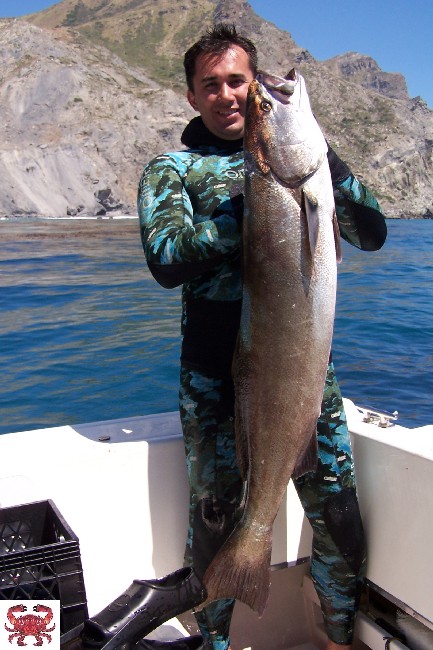
| Second white sea bass We were back at the same spot where I had gotten my first white. I had worked my way down the bed into an area where the kelp was rather stringy and where there were large open areas of water. The visibility was unique. On the surface, it was pretty clear, but about 20 feet down, there was what looked, literally, like a layer of milk. I was completely still and hanging next to an isolated bunch of kelp when a trio of large whites meandered out. I very slowly allowed my gun to drop in order to line up on the fish. I let the first fish pass, as he had already gone past the point where I could make a perfect shot. The second white moved into the spot where my gun was pointing, and I pulled the trigger. He disappeared from view, and the other two whites flinched and then slowly swam back into the shadow of the kelp. I slowly pulled up my line and the fish that I had shot appeared out of the milk; I had stoned him! I strung him up on my weight belt and started to head back to the boat. I hadn't gone 15 feet, when I spotted a group of large whites. I stopped and spent a good amount of time admiring how effortlessly they moved. One large fish even separated from the pack and came to look at me. I think he was intrigued by the fish on my weight belt. I was really grateful to be able to switch from hunter to observer and to have the chance to really appreciate what a free-swimming school of big whites looks like in the water. |
 |
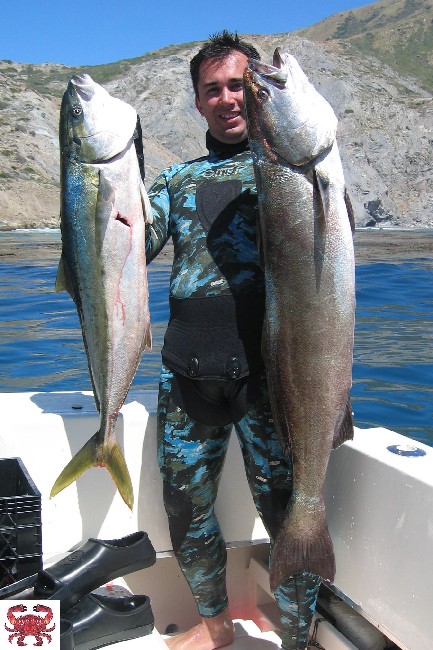 |
| A yellowtail and a white sea bass in the same day... a California double! |
| For wallpaper versions, click here. |
| For wallpaper versions, click here. |