Three-year-old Adamsville
girl battles rare cancer
By KIESHA JENKINS Staff Writer
CHRIS CROOK/Times
Recorder
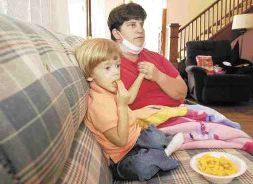
Hannah Moody, 3, has a snack while watching
television with her mother, Connie, in their Adamsville home.
Hannah has Wilm's Tumor Stage 4 Difuse Anaplasia, a rare form
of kidney cancer, and is currently getting treatment in
Columbus.
Wilms' Tumor
The cause of Wilms' Tumor is unknown. There are rarely any
symptoms associated with the disease. However, a large lump in
the stomach (swelling or a mass), stomach pain, fever, blood
in urine and high blood pressure can all be signs of Wilms'
Tumor.
There are known risk factors for the disease, most of which
cannot be controlled. Factors include age, race and genetic or
hereditary risks.
If you would like to donate to the Hannah Moody Fund, send
your contributions to:
Hannah Moody Fund
P.O. Box 444
Adamsville, OH 43802
For more information about Hannah Moody:
ADAMSVILLE -- Connie Moody discovered her youngest daughter had a
fever over Labor Day weekend. Moody took 3-year-old Hannah to the
pediatrician for a checkup. As part of the exam, Dr. Gerald Tiberio
performed a routine stomach examination. Something inside Hannah was
swollen.
Tiberio advised Moody to take Hannah to Children's Hospital in
Columbus for further examination and testing. There, she underwent a
CAT scan and doctors delivered the heart-wrenching news.
Hannah has cancer.
Hannah has Wilms' Tumor Stage 4 Difuse Anaplasia, a rare form of
kidney cancer, which begins to form in a fetus. This form of cancer
rarely shows any symptoms, and is only discovered once a tumor has
been identified.
Once the tumor has been found, doctors will perform additional
tests to find out if the cancer has spread to other parts of the
body.
Stage One is when the cancer is only present in one kidney, and
can be completely removed. Stage Two is when the cancer has spread
to areas near the kidney, including fat or soft tissue, blood
vessels or renal sinus. The cancer can still be completely removed
with surgery. Stage Three is when the cancer has spread to areas
near the kidney, but cannot be completely removed with surgery.
Stage Four is when the cancer has spread to organs further away from
the kidney, such as the lungs, liver, bone or brain. Stage Five is
when cancer cells are found in both kidneys.
Treatment for Wilms' Tumor includes surgery (removal the
cancerous cells), chemotherapy (using drugs to kill cancer cells)
and radiation (using high doses of X-rays to kill the cancer cells).
"It's a prenatal cancer," Moody said. "She's 3 now, and they just
found it."
Since August 31, Hannah has undergone six treatments of
chemotherapy, eight rounds of radiation, and two surgeries -- one to
install a catheter and the other to remove the infected kidney.
Unfortunately, before doctors removed the kidney, the cancer had
already spread to Hannah's bloodstream and infected her lungs. She
has been given a 40 percent chance of surviving for five or more
years.
Moody said that despite what Hannah has undergone, the little
girl is doing fairly well.
"She doesn't think that she's sick," Moody said. "But she's aware
of what's going on. She used to be really outgoing, but now she's
withdrawn. She's become afraid of the doctors."
Typically all forms of cancer result in a decreased number of
white blood cells. These cells aid the body in fighting off
infection. Hannah's white blood cell count fluctuates from healthy
levels to low levels. On days when her count is low, Hannah has to
stay indoors.
"She really can't go out and play," Moody said. "We all have to
stay inside the house, and we can't have any visitors."
Hannah's cancer has also gotten in the way of her schooling.
"She was supposed to start preschool this year," Moody explained.
"And she doesn't understand why she can't go."
On Oct. 17, Hannah went back to Children's Hospital for more
chemotherapy. She stayed there until the following Thursday.
Only 500 children a year in the United States are stricken with
Wilms' Tumor. Because of the rarity of the disease, doctors do not
do any testing in children.
"(Hannah) had a CAT scan, that's how we found (her tumor)," Moody
said. "But it's not good for kids to just get CAT scans."
Parents of children with Wilms' Tumor have a hard time finding
information about the disease.
"There aren't any support groups," Moody said. "I don't know any
other parents in the area whose kids are sick. It makes it really
hard."
Despite the lack of support groups, Moody said her friends and
family have been there for her and her family.
"A lot of people have been helping us out," Moody said.