 FRANK SINATRA
~ Old Blue Eyes~
"I feel sorry for
people who don't drink. When they wake up in the morning, that's the
best they're gonna feel all day" ~Frank Sinatra
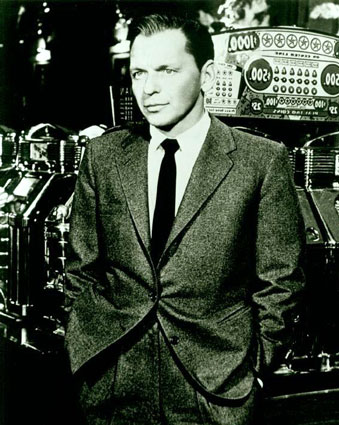 EARLY LIFE
Francis Albert Sinatra was born December
12, 1915 in Hoboken, New Jersey, to Martin, a tavern owner and part-time
prize fighter, and Natalie--known to all as "Dolly." Upon hearing the
recordings of Bing Crosby, Sinatra was inspired as a teenager to choose popular
singing as a vocation. He joined a local singing group, which, as the
Hoboken Four, won a talent competition in 1935 on the popular radio program
Major Bowe's Amateur Hour. The group toured the country that year,
but Sinatra was the only member with serious musical ambitions, and they
soon disbanded. For the next few years, Sinatra sang with local dance
bands and for remote radio broadcasts. In 1939, while singing and waiting
tables at the Rustic Cabin in Englewood Cliffs, New Jersey, he was discovered
and hired by trumpeter Harry James, who had recently quit the Benny Goodman
Orchestra to start his own band. Sinatra's reputation among industry
musicians grew swiftly, and James graciously freed Sinatra from his contract
when the singer received a more lucrative offer from bandleader Tommy Dorsey
in December 1939. By 1942, Sinatra's fame had eclipsed that of Dorsey,
and the singer yearned for a solo career. After months of bitter negotiations,
Sinatra left the Dorsey organization in late 1942; within weeks, he was
a cultural phenomenon. Near hysteria was generated by Sinatra's appearance
at New York's Paramount theatre in January 1943, and such throngs of screaming,
young female fans had not been seen since the days of Rudolph Valentino.
~adapted from Encyclopedia Brittanica
Online

CAREER 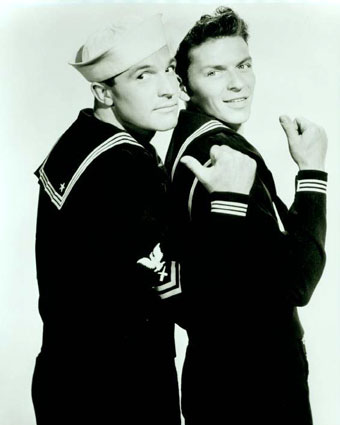
"Ol' Blue Eyes," the prodigiously
talented and equally controversial king of American popular song, created
almost as much excitement on the big screen as he did behind a microphone.
An untrained, instinctive actor, he developed into a powerful screen
performer; a lifelong maverick, he sought constant challenge when he could
have easily coasted. Sinatra made his first film appearance as a vocalist
with the Tommy Dorsey Band in 1941's Las Vegas Nights. Just
two years later a role was written especially for him in Higher and Higher in which he
more or less played himself. Sinatra's star rose steadily throught the
decade as he played light, likeable roles in a series of musical comedies,
including Anchors Aweigh (1945),
It Happened in Brooklyn (1947),
Take Me Out to the Ball Game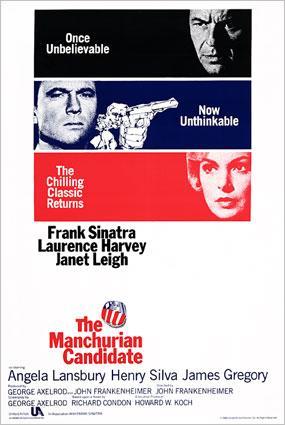 (1949), and On the Town
(1949), that displayed a winning personality and the ability to hoof--thanks
to coaching from his frequent co-star and friend, Gene Kelly.
(1949), and On the Town
(1949), that displayed a winning personality and the ability to hoof--thanks
to coaching from his frequent co-star and friend, Gene Kelly.
When Sinatra's vocal cords hemorrhaged in 1952, he was
dropped by talent agency MCA and had to beg to be cast in a nonsinging role
in the wartime drama From Here
to Eternity. His impressive performance as the pathetic, luckless
soldier Maggio earned him an Oscar and made him the comeback story of the
decade. Now a hot ticket in Hollywood, he tackled a number of ambitious
roles, including a would-be presidential assassin in Suddenly (1954) and a junkie
trying to put his life right in Otto Preminger's The Man With the Golden Arm
(1955), for which he was nomination for another Oscar. He reasserted
himself musically in Guys and
Dolls (1955), High Society
(1956) and Pal Joey (1957),
but continued to look for dramatic punch. Sinatra was eager to star
in the 1962 Cold War paranoia thriller The Manchurian Candidate that
was made only after Richard Condon's controversial novel was endorsed by
Sinatra's friend President John F. Kennedy.
~adapted from Leonard Maltin's Movie Encyclopedia
For a more complete list of Frank
Sinatra's films, check out his filmography at www.imdb.com!
FAMILY
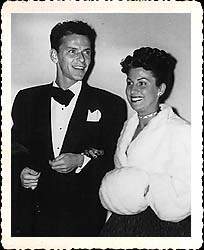
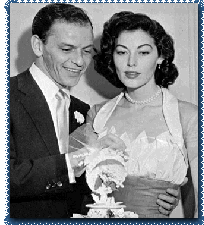 Sinatra married
his childhood sweetheart Nancy Barbato, in February, 1939. They had
three children: Nancy Sandra (1940), Franklin Wayne Emmanuel (Frank Jr., 1944),
and Christina (Tina, 1948).
Sinatra married
his childhood sweetheart Nancy Barbato, in February, 1939. They had
three children: Nancy Sandra (1940), Franklin Wayne Emmanuel (Frank Jr., 1944),
and Christina (Tina, 1948).
In 1949, Sinatra divorced Barbato, and his affair with Ava Gardner had become an
open scandal. Sinatra and Gardner married in 1951, but separated a few
years later and divorced in 1957. In 1966, Sinatra married the diminutive
actress Mia Farrow, when
he was 51 and she was 21. The couple divorced a little over a year
later, in 1967. He married Barbara Marx, the former wife of Zeppo Marx,
in 1976.
~adapted from information found at www.biography.com.