 CARY GRANT
 EARLY LIFE
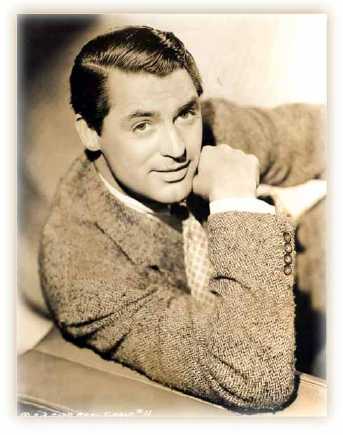
Cary Grant was born Archibald Alexander Leach on January
18, 1904, in Gloucestershire, England. To escape poverty and a fractious
family, Archie Leach ran away from home at age 13 to perform as a juggler
with the Bob Pender Troupe of comedians and acrobats. He made the
United States his home after the company's American tour of 1920, and for
the next several years he honed his performing skills
in such disparate pursuits as a barker at Coney Island, a stilt walker at
Steeplechase Park, and a straight man in vaudeville shows. His performances
throughout the country in numerous stage musicals and comedies during the
late 1920's and '30's led to a contract with Paramount Pictures in 1932.
Studio executives thought "Archie Leach" was an unsuitable name for
a leading man and rechristened the actor Cary Grant, a name he would legally
adopt in 1941.

CAREER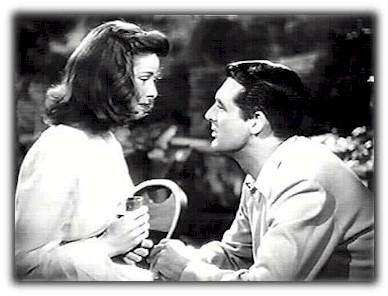
Grant first appeared in several
short films and low-budget features for Paramount, and he attracted some
attention with his role as a wealthy playboy in the Marlene Dietrich vehicle
Blonde Venus (1932). The
next year, Grant became a star when Mae West chose him for her
leading man in two of her most successful films, She Done Him Wrong and I'm No Angel. He hit his
stride in a string of sophisticated screwball comedies beginning with Topper (1937) in which he evolved
the debonair, witty, uninhibited screen persona that ultimately brought
him superstardom. The next several years saw Grant at his peak, alternating
classic comedies, like Bringing
Up 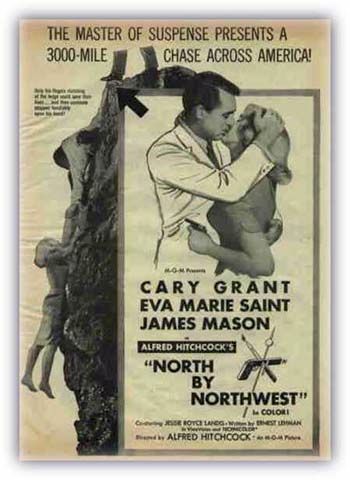 Baby and The Philadelphia
Story, with similarly well-remembered dramas, such as Only Angels Have Wings and Suspicion, the first of his
many films for director Alfred Hitchcock.
Baby and The Philadelphia
Story, with similarly well-remembered dramas, such as Only Angels Have Wings and Suspicion, the first of his
many films for director Alfred Hitchcock.
Grant's association with Alfred Hitchcock resulted
in some of the best work from both men. Grant gave a fascinating
and appropriately disturbing performance as a callous American agent who
uses the woman he loves, Ingrid Bergman, to his
own advantage in Notorious.
In the next decade, Grant appeared in Hitchcock's lighthearted and
stylish caper, To Catch a Thief
(1955); North by Northwest
was a career milestone for both Grant and Hitchcock and is regarded as a
masterful blend of suspense and humour.
Grant received Academy Award nominations twice--for
Penny Serenade and None but the Lonely Heart (1944)--and
received a honorary Oscar in 1970, but he and Edward G. Robinson
share the dubious distinction of being Hollywood's most highly regarded
actors never to have won Oscars for acting. One of the few stars for
whom the term "screen icon" is not mere hyperbole, Grant in 1999 ranked second
(next to Humphrey Bogart) on the American Film
Institute's list of the 100 greatest film stars of all time.
~Adapted from The Encyclopedia Britannica Online and
Leonard Maltin's
Movie Encyclopedia
For a more complete list of Cary Grant's films, check
out www.imdb.com!
FAMILY 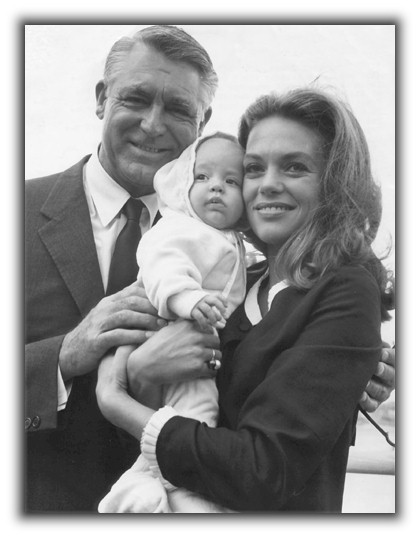
Grant was married
and divorced numerous times in his life. He married Virginia Cherrill
in 1933, and they divorced in 1935. From 1942-1945, he was married
to Woolworth heiress Barbara Hutton; and from 1949-1959, he was married to
actress Betsy Drake. During this period, Grant suffered a personal
crisis and, for a two-year period, he underwent controversial psychiatric
treatment with LSD, a psychedelic hallucinogenic drug. His marriage
to actress Dyan Cannon,
in July 1965, lasted three years, and they had one child together, Jennifer
Grant, born February 26, 1966. In 1981, Grant married Barbara Harris.
Grant and Harris were together until he died of a stroke on November
29, 1986.
Most biographers of Grant assert that he was conflicted
about his sexual orientation and spent most of his life in denial of his
bisexuality. As evidence, they cite Grant's recurring relationship
with actor Randolph Scott,
with whom he shared a house from 1933 on, when both were struggling actors,
and later, between Grant's marriages.
THE CARY GRANT ROSE
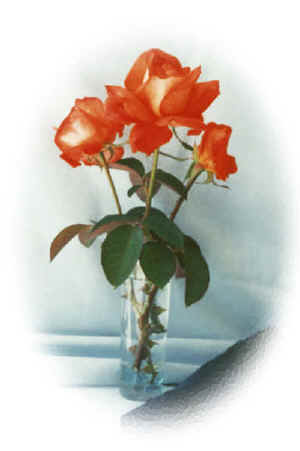 A beautiful long
stemmed rose whose color lies between red and orange with a fragrance that
fills the air even as the petals fall from the bloom may best describe this
lovely flower.
A beautiful long
stemmed rose whose color lies between red and orange with a fragrance that
fills the air even as the petals fall from the bloom may best describe this
lovely flower.
It is a hybrid plant that is sturdy and disease resistant.
The blooms, when fully opened, are most often as big as a man's fist.
The stems are so sturdy that they easily support the size of the bloom
with no difficulty. This plant sports large, sharp thorns, and it is
the wise gardener that cares for these flowers wearing good leather gloves.
This rose is easy to care for and with sufficient water and a little
fertilizer every seven to eight weeks they will reward you with lovely blooms
that may be cut and used inside the home.
The Cary Grant rose was commissioned by Grant's fifth
wife, Barbara Harris Grant, for her husband as a Valentine gift in February
of 1986, and were planted along the driveway of their home. Its bright
red-orange colour was a favourite colour of Cary Grant. This rose also
blooms in the Princess Grace memorial garden.
~photo (all photos) and information taken from The Ultimate
Cary Grant
Pages.