
Kyoto's Finest
Kinkaku-ji Temple
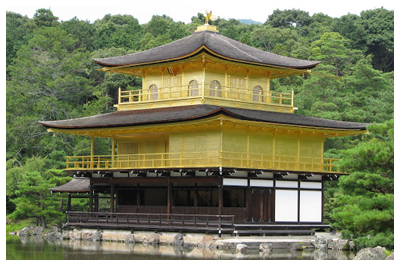
Kinkaku, or the golden pavilion, stands facing Kyoko-chi (mirror lake) pond.
Though the pavilion is not huge in size, people would be impressed at the first sight of brilliant golden walls of the building.
The pavilion and its reflection on the water as well as islets and trees weave into a beauty and create a peaceful atmosphere.
This Zen temple, Rokuon-ji, being frequently called Kinkaku-ji because of the golden pavilion, attracts many visitors all the year round.
Nijo-jo castle
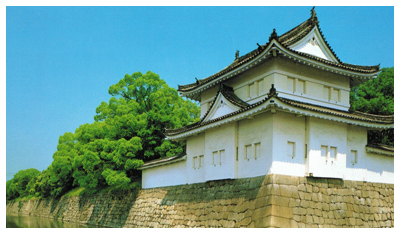
In the middle of the City, surrounded by a moat and enclosed by stone walls is Nijo-jo castle that is one of 17 World Cultural Heritage sites of Kyoto.
Primary attractions of Nijo-jo castle would be Ninomaru-Goten and gardens. Ninomaru-Goten, a national treasure, is a typical Buke-Fu Shoin-Zukuri (the shoin style of traditional residential architecture) of Azuchi-Momoyama era (1568-1603).
The architecture itself and shoheki-ga paintings in it are worth to see. Shoheki-ga were painted by KANO Tanyu and his company.
Photography is prohibited in the building so that no photos are displayed in this page.
Heian-jingu shrine
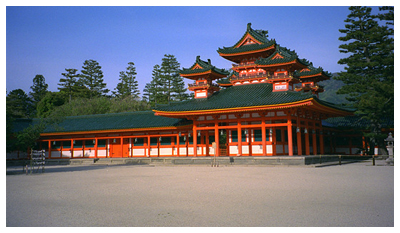
Heian-jingu shrine has colorful halls and beautiful gardens. Its main halls represent 5/8 scale replicas of the first Imperial Palace built in Heian-kyo (Kyoto) in 794 and convey the atmosphere of elegance of the Heian period (794-1185).
The shrine is surrounded by beautiful chisen-kaiyu-shiki (pond-stroll) gardens on three sides; Minami Shin-en (the south garden) on the west, Nishi Shin-en (the west garden) on the north-west, Naka Shin-en (the middle garden) on the north-east and Higashi shin-en (the east garden) on the east.