Those Who Step on Tiger's Tails
"Tora no O wo Fumu Otokotachi"
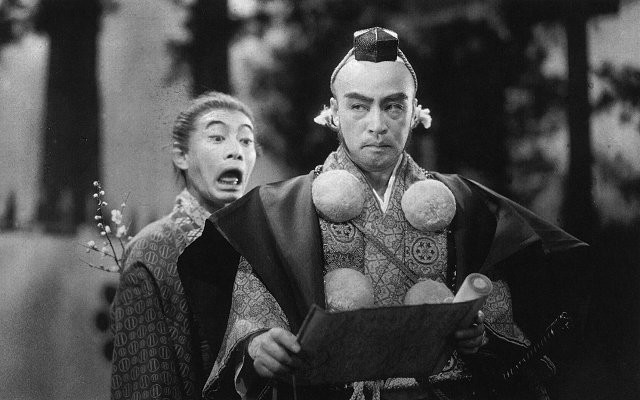
Benkei kind of reads a scroll asking for donations for the temple of Nara.� The comic peasant character in the background.� Notice the cherry blossom branch in his belt.
| Title: | Those Who Step on Tiger's Tails |
| Descriptor: | Supposedly this film had problems during its original release date because it hailed ancient Japanese culture, which� at the time of post war Japan was deemed as dangerous.� So although it was initially released in 1945, it was never circulated until 1950, and only with major editions.� The film is of Yoshitsune Minamoto (I'm placing the name backwards for you gainjins).� He was a great war general during the Heikei and Genji wars - of which he was decisive in winning for the Heikei.� BUT - his evil brother, Minamoto Yoritomo, (acutally, I really don't have the right to deem him evil - but for story telling purposes I am), orders the execution of his brother on grounds of disloyalty.� Helpless, Yoshitsune is forced to flee the land with a few of his faithful followers and a warrior priest named Benkei, who is famous in Kabuki plays and literature for his fighting style but more importantly, his loyalty to his master.� So this story tracks their escape to the neighboring lord's territory. |
| Date Watched: | July 1, 2001 (or somewhere around then) |
| Comments: | The movie takes on the form of a Noh drama, with the deep chanting and drumming.� Kurosawa is ingenious in molding the art of theater and movies together.� This story could be transferable to both genre's.� The story is of an exiled lord, a great lord at that, I could see the how people might have read rhetoric into the script.� Benkei's character is the most stunning, with his quick wit and undying loyalty.� The peasant character, however, is brilliantly placed for comic relief, but serves a more important role in brining the common audience closer to the untouchable characters that appear only in legend and myth. |