 |
| Hinbenburg |
|
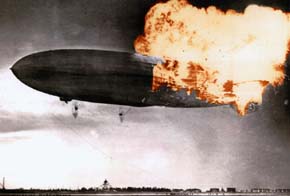 |
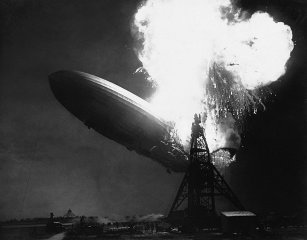
| The Hindenburg disaster took place on May 6, 1943 killing 35 of the 97 passengers on it's way from Nazi Germany to Lackhurst NJ. The Hindenburg Zeppelin was 803.8 feet in lenght the 135.1 feet in diameter. The Hindenburg aircraft was the largest to every fly. She carried hundreds of people thousands of miles and pioneered the first transatlanic air service. |
 |
 |
 |
| Today there is still a controversy of why the Hindenburg actually crashed. Some say it was sabotaged or that it was shot down. Others say it was the weather and relate it to a possible thunder strike which could have happened. There are many other theories about what happen but here I'm going to talk about how some claimed chemistry was to blame. The element H or Hydrogen which is highy flamable and lighter then air is what made the Zeppelin float. It contained 200,000 cubic meters of hydrogen in 16 cells. Daimler-Benz diesel engines enable the aircraft to go at a top speed of 82mph. |
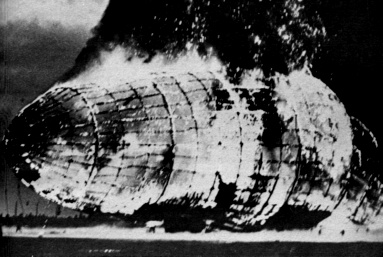
| Shown here is the burning sketiton of the Hindenberg once landed on the ground. |
| Back to the element hydrogen, If you are every interested in making hrydrogen go to this site to do a small experment with H2O and H I found an article presented by a woman named Jacquelyn Cochran Bokow, who followed the work of another named Addison Bain who said that it wasn't the hydrogen but the flamable material that made up the outside of the craft. |
| "Observations of the incident show evidence inconsistent with a hydrogen fire: (1) the Hindenburg did not explode, but burned very rapidly in omnidirectional patterns, (2) the 240-ton airship remained aloft and upright many seconds after the fire began, (3) falling pieces of the fabric were aflame and not self-extinguishing, and (4) the very bright color of the flames was characteristic of a forest fire, not a hydrogen fire (hydrogen makes no visible flame). Also no one smelled garlic, the scent of which had been added to the hydrogen to help detect a leak." http://www.hydrogenus.com/advocate/ad22zepp.htm |
 |
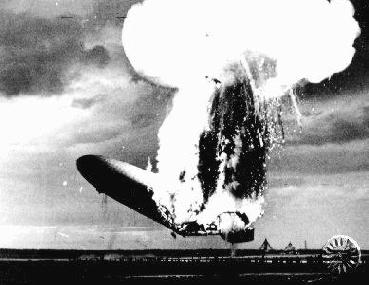
| This shows people running toward or away from the Hindenburg as it crashed to the ground. Listen to Herbert Morrison describe the crash. |
| To answer the truth of this accident was confirmed byBain's work. What was found out through tests of the old fabrics was that the fabric itself was made of many chemicals which made the fabric burn rapid even after 6 decades. Next was a test with high voltage electrical fields which was to recreate the fearful night. When this test was done and the fabric was in a postion like on the aircraft it ignited and disapeared in seconds. The fabric on the hindenburg was found to be made of a cotton substrate with an aluminized cellulose acetate butyrate depont. The describtion of the fire was listed in fact consistent with a large aluminum fire. Thus the evidence proves now that the fire was created by the fabric and not the gas that was inside of it. The disaster brought the end to using hydrogen in these aircrafts. What is interesting is that in 1936 when the zeppelin was built Helium was around. The problem was it was a very expensive element. Helium being much less flamable then hydrogen could have been used in the zeppelin. Helium is heavier then hydrogen therefore construction would have had to be different. But that doesn't matter because hydrogen did not create the disaster. |
| Bibliograghy |
| Any comments or suggestions are greatly appreciated. Please e-mail me. |
 |
| Click flag to go to Home page |
 |
| Looking to the future hydrogen is going to be a key to our daily lives more then we ever imagined. Hydrogen is a great source of energy and doesn't give off any pollution but what it does give off it water. Cars, trains and a possibility of airplanes could use this energy and the worlds pollutions would decrease by land slides. |