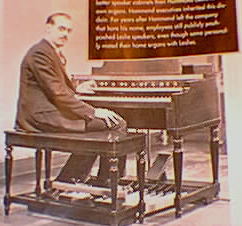
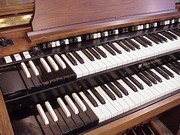
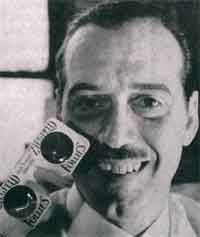
Hammond was not a musician; he did, however, see the great benefits of music, and was keen to find a way to allow home musicians to express themselves more. In 1933, therefore, he turned his attention to the development of an electric organ. He bought an old piano and began taking it to pieces until the only part that was left was the keyboard action. Using the keyboard as a controller, he was able to play around with various different ways of generating sound until he found the one that sounded best - the tonewheel generator. The company's assistant treasurer, W.L. Lahey, was the organist at a nearby church, and so Laurens brought him in to give feedback on the quality of the new instrument's sound. With all his previous manufacturing and engineering experience, designing clocks, the tonewheel generator was incredibly well engineered by the time the organ finally went into production. The quality of the system is apparent by the number of tonewheel organs still in existence.
Laurens filed his patent on January 19,1934. Luck played a major part at this point, as unemployment was up and so he was granted his patent with the hope that it would create many jobs in the area. During World War II Laurens was invited to show his technical skills in a new area. He helped design guided missile controls and was awarded patents for infrared and light sensing devices for bomb guidance and glide bomb controls. The glide bomb was the grandfather of today's guided missiles, carried by nuclear submarines. There is also a rumor that Hammond organs were placed on some submarines to provide entertainment. Hammond left his position as president of his company in 1955, to allow himself more time to concentrate on researching and developing new ideas. On February 12, 1960, at the age of 65, he retired, and withdrew completely from the music industry. At the time of his retirement in 1960, he held 90 patents: he would be granted another 20 before his death.
By the time Laurens Hammond died on July 3, 1973, there were over thirty manufacturers of electric or electronic organs. This figure would increase still further towards the end of the 1970s, as the demand for home organs grew to incredible proportions. Laurens Hammond had not just created a product with his Model A' tonewheel organ in 1934; he had created something that will live on for as long as people still want that sound. His name lives on through Hammond's continued determination to produce instruments that offer the very best in quality - Laurens Hammond may be no longer with us in body, but his spirit exists in every Hammond organ in the world. |