

Use this as a way to emerse yourself in dwarven nature. To become dwarven in knowledge.
Grab a pint and enjoy a good read.
Home
Forums
Hierarchy
Library
Lore
Application
Tech
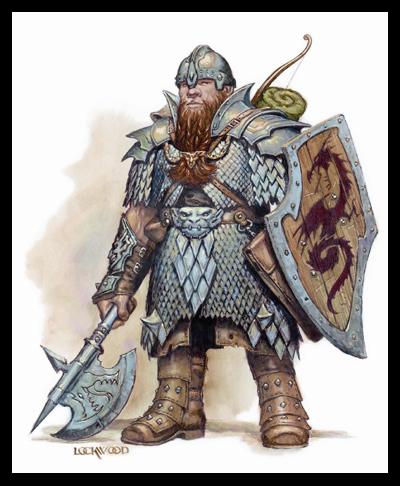
--A Dwarven Adventurer
Dwarves are slow to laugh or jest and suspicious of strangers, but they are generous to those few who earn their trust. Dwarves value gold, gems, jewelry, and art objects made with these precious materials, and they have been known to succumb to greed. They fight neither recklessly nor timidly, but with careful courage and tenacity. Their since of justice is strong, but at its worst it can turn into a thirst for vengeance. Among gnomes, who get along famously with dwarves, a mild oath is �If I�m lying, may I cross a dwarf.�
Dwarves stand only 4 to 4-1/2 feet tall, but they are so broad and compact that they are, on average, almost as heavy as humans. Dwarf men are slightly taller and noticeably heavier than dwarf women. Dwarves� skin is typically deep tan or light brown, and their eyes are dark. Their hair is usually black, gray, or brown, and worn long. Dwarf men value their beards highly and groom them very carefully. Dwarves favor simply styles for their hair, beards, and clothes. Dwarves are considered adults at about age 40, and they can live to be more than 400 years old.
Dwarves get along fine with gnomes, and passably with humans, half-elves, and halflings. Dwarves say, �The difference between an acquaintance and a friend is about a hundred years.� Humans, with their short life spans, have a hard time forging truly strong bonds with dwarves. The best dwarf-human friendship is often between a human and a dwarf who liked the human�s parents and grandparents. Dwarves fail to appreciate elves� subtlety and art, regarding elves are unpredictable, fickle and flighty. Still, elves and dwarves have, through the ages, found common cause in battles against orcs, goblins, and gnolls. Through many such joint campaigns, the elves have earned the dwarves� grudging respect. Dwarves mistrust half-orcs in general, and the feeling is mutual. Luckily, dwarves are fair-minded, and they grant individual half-orcs the opportunity to prove themselves.
Dwarves are usually lawful, and they tend toward good. Adventuring dwarves are less likely to fit the common mold, however, since they�re more likely to be those who did not fit perfectly into dwarven society.
Dwarven kingdoms usually lie deep beneath the stony faces of mountains, where the dwarves mine gems and precious metals and forge items of wonder. Trustworthy members of other races are welcome in such settlements, though some parts of these lands are off limits eve to them. Whatever wealthy the dwarves can�t find in their mountains, they gain through trade. Dwarves dislike water travel, so enterprising humans frequently handle trade in dwarven goods when travel is along a water route.
Dwarves in human lands are typically mercenaries, weaponsmiths, armorsmiths, jewelers, and artisans. Dwarf bodyguards are renowned for their courage and loyalty, and they are well rewarded for their virtues.
The god of the dwarves, Moradin, is lawful good. His titles include the Soul Forager, Dwarffather, the All-Father, and the Creator. Moradin forged the first dwarves out of metal and gems and breathed life into them. He governs the arts and sciences of the dwarves: smithing, metalworking, engineering, and war. The domains he is associated with are Earth, Good, Law, and Protection. His favored weapon is the warhammer.
Dwarves speak Dwarven, which has its own runic script. Dwarven literature is marked by comprehensive histories of kingdoms and wars through the millennia. The Dwarven alphabet is also used (with minor variations) for the Gnome, Giant, Goblin, Orc, and Terran languages. Dwarves often speak the languages of their friends (humans and gnomes) and their enemies. Some also learn Terran, the strange language of earth-based creatures such as xorns.
A dwarf�s name is granted to him by his clan elder, in accordance with tradition. Every proper dwarven name has been used and reused down through the generations. A dwarf�s name is not his own. It belongs to his clan. If he misuses it or brings shame to it, his clan will strip him of it. A dwarf stripped of his name is forbidden by dwarven law to use any dwarven name in its place.
A dwarf adventurer may be motivated by crusading zeal, a love of excitement, or simple greed. As long as his accomplishments bring honor to his clan, his deeds earn him respect and status. Defeating giants and claiming powerful magic weapons are sure ways for a dwarf to earn the respect of other dwarves
