 Pictures
Links
Back to homepage
Contact
Mac Hamish Products
Pictures
Links
Back to homepage
Contact
Mac Hamish Products
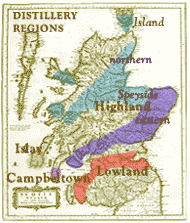
From its earliest days, whisky has been known for its curative and creative properties. It evolved into a unique cultural icon of the people who savoured it. It has charmed saints and tormented sinners. Each country, each distiller and blender, has made a distinct interpretation of this drink. Today whisky is enjoying yet another revival as a cultural icon in modern day cigar-and-whisky parlours worldwide. Let us now take a taste of the history and hallmark of this fascinating drink.While the exact origins are lost in the mists of time, it is generally accepted that the ancient Celts (and yes, that would include the Scots, Irish, Cornish and Welsh) knew how to distill grains at least as far back as 800 B.C. Given that they lacked the climate to grow the more fragile grapevines, their use of cereals such as barley and rye, both of which grew well in the northern European climate, was a logical choice. Those Celts viewed their fiery brew as a gift from their gods that literally brought the dead to life and warmed even the coldest spirit. In fact, in Celtic whisky is called "uisge beatha"�the water of life.he earliest record of distilling comes from an entry in the Exchequer Rolls in 1494 when one Friar John Corr obtained eight bolls of malt "wherewith to make aqua vitae" (water of life�obviously the earlier Celtic term "uisge beatha" could not be used by a man of the cloth). The good friar certainly knew what he was about, however, since the amount of malt involved would produce roughly 1500 bottles of whisky! Much like wine, Scotch whisky is identified by the region in which it is made. There are four regions in all: Highland, Lowland, Islay and Campbeltown. These last two were sometimes combined and some simply refer to Eastern and Western Malts. In more recent times, the Highland Region has been sub-divided into northern, eastern, Island, and a further sub-division, Speyside, has become a region onto itself. Medicinal purposes Distilling was first done in monasteries, to produce medicine. Irish records remark on this in the late 1100s, and the earliest Scottish record - in the Royal Exchequer Rolls of 1494 - is of the sale of 500 kgs (1, 120 lbs) of malt to one Friar John Corr 'wherewith to make aqua vitae'. In 1505 the Guild of Surgeon Barbers in Edinburgh was granted a monopoly in that town for the distillation of aqua vitae.
