The Magician
and
The Machine
The contribution of magician
Georges Méliès to Visual Effects
The Magician
and
The Machine
The contribution of magician
Georges Méliès to Visual Effects
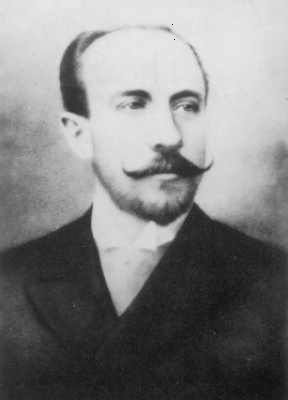
Georges Méliès was a magician looking for a medium, and one day in 1895 he found it. Méliès attended the first showing of the Lumeire brothers' new invention, the cinematographe. Méliès saw a great deal of potential in this new technology, and just over a year later he bought one of the new motion picture cameras. Three months after that, he began creating his own films. Though his first films were mostly documentary in nature, his creative genius soon began to show itself. Between 1896 and 1913, when most directors made movies in one take, he created masterpieces that unfolded in many.
Of the over 100 films created by Méliès, the most often discussed is certainly "Le Voyage dans la Lune(A Trip to the Moon)." In 1902 he wrote, directed and acted in it, among other duties. It was one of the first movies in history to tell a story of any kind, let alone one with a fantasy theme. Many say the real genius of Méliès occurred when he reached the lab. He would toil for hours, overlapping pieces of film and gluing them together. The results were nothing short of brilliant for their time. Cuts, dissolves, images being combined in truly magical ways. None of these leaps could have been made, however, without George Méliès' first creative break.
One day, so the legend goes, Méliès was filming city streets with his hand-cranked camera. His camera jammed, and it took a moment to fix, but soon Méliès began filming again. All this time, however, the camera never moved from it's mount. Several days later, he viewed the finished print. Since he had forgotten the accident with the camera, he was quite surprised to see a horseless carriage suddenly become a horse.
He soon made the connection that in the time that his camera had stopped as a result of the film jam, the carriage had moved down the road and the horse had taken it's place. Since both were moving at the same speed, it appeared that the carriage had instantly become a horse. This realization opened his mind to the possibilities that this new art form held, and the art of Visual Effects was born.
In the art of magic, the term "effect" is used to describe what the audience sees. There are said to be eight basic effects, Production, Vanish, Transposition, Transportation, Levitation, Suspension, Restoration and Penetration. All visual magic effects can be traced to these basic eight, and many of the eight are themselves combinations or sub-sets of the others. Lets go through seven of them, and examine Méliès' workings and some from recent history that utilize digital effects.
In a production, the effect on the audience is that things appear out of nowhere. A good example from "A Trip to the Moon" is when the space ship lands in the eye of the man in the moon. Méliès did this by first filming just the man in the moon. He then had the actor stop moving, and assistants rushed in to attach the space-ship model to the actor. Today, a production with a moving camera is usually achieved by creating a prop digitally. This involves either scanning the prop with a laser, or creating it from scratch. A good example is from the movie "Hollow Man." To make actor Kevin Bacon seem to be "dissolving" away, he was scanned to create a digital model of his exterior features. A digital model of his inner organs was then constructed on computer. To make him appear, the digital model was "dissolved", slowly revealing each part from the inside out. This part of the image was created entirely in the computer, then blended with the live-action shot of the set around the actor.
In a Vanish, the effect on the audience is that something that was there no longer is. A Vanish is basically a Production in reverse. An example from "A Trip to the Moon" is when the lead explorer (played by Méliès himself) hits a "moon creature" with his umbrella and it disappears as a puff of smoke. Méliès had the camera run while he began to swing his umbrella at the "moon creature". Then he froze as the camera was stopped, and the "moon creature" left the stage. The camera was then run again as Méliès hit nothing and reacted to a puff of smoke in the "moon creature's" place. In "Hollow Man" the reverse effect of the vanish was created in the computer. The same computer model was employed, and was slowly dissolved from the outside in. One of the challenges of using a computer model in either effect (production or vanish) is to "match-move" it to the actor. Put simply, match-moving is moving a computer model one part at a time to perfectly overlap the actor's performance on screen. This process is performed once per frame, for each of 24 frames per second. In a 10 second shot for instance, that means match-moving the model 240 times. This is a laborious, time consuming, expensive task which must be done by a highly skilled computer animator.
In a Transposition, two objects seem to switch places. A transposition is basically two Vanishes and two Productions. In part of a Transposition, one object seems to become another. This is called a Transformation. In "A Trip to the Moon", one scene has the astronomers' telescopes magically turn into chairs. Méliès had the actors wave their telescopes, then freeze as the cameras stopped and assistants replaced the telescopes with chairs. The cameras were resumed, and the effect was that the telescopes became chairs. One common use of computers in creating the illusion of a transformation is the digital "morph." This is a process where two images are manipulated so that one seems to fluidly become the other. The process involves moving parts of the picture from the first image to other parts in the second image. This is combined with a dissolve to make it appear that the object in the first image becomes the object in the second. A good example recently was used in the television show "The X-Files" when one actor visibly becomes another. One of the challenges faced was how to move only the parts of the image that include the actor and not move the background. This can be done by filming the actor(s) in front of a green or blue screen and adding them to the background later, but this again is time-consuming and much more expensive. Another challenge is deciding how complicated a mesh to use (how many key points to move in the image) while having the computer change the rest. Too few points means the effect may not look right. Selecting too many points causes the computer to take much longer to complete the effect.
In a Transportation, an object seems to move from one place to another. A Transportation is basically a Vanish followed by a Production. Méliès combined a vanish and a production in "A Trip to the Moon" to give the effect that the ship was propelled to the moon. The vanish of the ship was achieved on-stage by having the actors push the ship into the gun barrel. The camera was stopped as the ship set-piece was removed. The camera was then continued. The re-appearance of the ship in the eye of the man in the moon was discussed previously. A recent example is the transporter effect in "Star Trek." While the look of the effect has evolved from the original series to "Star Trek: Voyager," the most recent spin-off series, the process of creating the effect remains virtually identical. It involves shooting the actors to be transported on the set, then shooting the set without anyone on it. The two shots are then dissolved, creating the effect that the actors disappear, with a shimmering effect added on top of them as a seperate layer. To complete the illusion, the dissolve is reversed in a new location (set) to make the actors re-appear, while a similar "shimmer" is put on top of the image of the actor(s).
In a Levitation, an object or person appears to float in the air without support. In "A Trip to the Moon", one scene calls for actors sitting on stars, floating in the night sky. Méliès created this effect "in camera," without visual effects by flying the stars and actors on wires invisible to the camera. In the recent movie "Star Trek: First Contact," an extended scene called for actors to be weightless. This was accomplished by attaching the actors to wires, which moved them about the set. To guarantee the safety of the actors, very thick wires were used. These wires were easily visible in the shot as filmed, and rather than conceal them in front of the camera, the wires were removed digitally. This involves a process called roto-scoping in which a talented artist effectively paints out the wires by replacing the image of the wire with part of the image from an adjacent part of the frame. Again, this process is painstakingly done by hand for each frame of film in the entire sequence.
In a Suspension, an object appears to defy gravity. In "A Trip to the Moon" this effect occurs in the very last scene of the film. The scene called for an actor to grab the back of the ship, as it fell over the edge of a cliff. Again, Méliès created the illusion by suspending the actor and ship from wires. In the recent film "The Matrix," many scenes called for actors to be suspended in air, defying gravity. Most of these scenes were created by suspending actors on wires and then digitally removing them after. One of the challenges facing effects artists in this area is removing wires in shots that change perspective radically from scene to scene. "The Matrix" in particular was a challenge in this area as there were extended sequences in which the camera appears to rotate around the actors.
In a Restoration, an object appears to be destroyed, and later fixed. In "A Trip to the Moon" Méliès would have used similar techniques to those discussed. To "fix" an object, he merely had to replace the "broken" one with the "restored" one, taking care to stop the filming during the swap. In the movie "Terminator 2: Judgement Day," a scene calls for actor Robert Patrick to "melt" through a set of metal bars (this is also an example of a Penetration effect). To achieve this effect, the actor walked through nothing. A digital replacement of him was match moved to walk through a set of digital bars. As the digital model of the actor encountered the digital bars, the computer was instructed to "disturb" the 3-D model of the actor. One of the challenges faced by digital artists was to make the disturbance of the 3-D computer model convincing. Another was to make the digital model a convincing representation of the actor by reproducing him in enough visual detail. As well, they had to reproduce subtle nuances of movement specific to the actor.
As you can see, effects artists using computer technology face many more challenges than effects artists in the distant pre-digital film-making era. Arthur C. Clarke's famous 3rd law states that "any sufficiently advanced technology will appear as magic" to those who don't understand it. Dennis Berardi is a visual effects manager for Command Post/Toybox in Toronto [now owner of Mr. X] and an expert in the field of Digital Visual effects. He agrees with Clarke, and notes that "One of the big romances people have with our industry . . . is they don't know how we do what we do and they see it as magic." Méliès' movie technology was sufficiently advanced to appear as magic to his audiences, but movie magicians in the 21'st century will face challenges Méliès could never have contemplated.
Surprisingly though, the art of entertaining with magic has remained mostly unchanged. It seems almost unfathomable that magic should still amaze and delight audiences in an era of digital visual effects, in which anything is possible. When asked to comment on this phenomenon, Dennis Berardi explained that "In digital visual effects, we're handicapped by not being able to understand the 'vibe,' the emotional sense, the subtleties and nuances of the moment, we're having to guess at them. So I think that . . . effects that happen in front of the camera 'live' in real time have the benefit [of being] more significant to what's happening in the moment.
"'Sleight of hand' has an energy about it that is maybe more real than
what we do in digital post effects where we're trying to guestimate at
the 'vibe' and the energy and the nuances of the scene" says Berardi. While
digital effects artists may be more concerned with the technical end of
creating the illusion, the magician may be more interested in the establishing
of mood, ambiance, and creating wonder. George Méliès created
a good blend of both and his work is still relevant today to motivate us
to keep telling good stories, and to inspire us to dream of the impossible.
© 2000 all rights reserved
BIBLIOGRAPHY
http://www.teleport.com/~nhartman/bknet07.html
http://personalwebs.myriad.net/ratman/sfnovel.htm
http://www.deas.harvard.edu/~wfb/bill/future_past.html
http://www.nwlink.com/~erick/silentera/Melies/melies.html
Webster's Concise Encyclopedia ©1997 (Eureka's Encyclopedia CD-Rom)
"Magic with Everyday Objects" Schindler, George. ©1976