
Basic Rules Tutorial
To participate in the PBEM, we must all learn the rules and learn how to send said rules to one another. So enters the tutorial, a simulation of a few turns in a game between two different Orc and Goblin Lairs.
Setup
For the sake of this tutorial, it may help that you set up pieces yourself to get the hang of how things are going. For starters, set up 2 Room board sections with a fair distance between them (in reality, this distance is equal to the long side of two Passages and one Room). Place doorways on the sides facing the other board. The boards should appear like this:
As shown above, we have labelled the rooms for purposes of the tutorial. Room 1 is the "Lair" of Player 1, who will have a mostly-Goblin force. Room 2 is the "Lair" of Player 2, who will have a mostly-Orc force. The Lair is the most important room in a player's dungeon. If it is lost, so is the game.
Initial Purchases
For the sake of simplicity, we will not get into purchasing yet. We will assume that Player 1 has purchased 25 Goblin Boyz and a Goblin Big Boss, while Player 2 has 10 Orc Boyz and an Orc Big Boss. There is no need to place these on the board! These models are assumed to be in the respective player's Lair.
As each player only has one character (their Big Bosses), that character becomes the Primary Character! This special model represents the Lair's leader and, while he grants benefits in combat, his death can cause total ruin to battle plans! By the way, basic troops like Boyz are called Rank And File troops, or RNF. Every model is either a Character or RNF. Differences will be explained later.
Turns and Cycles
A "Cycle" in Dungeon ConQuest represents the period of time between purchases. It takes up 5 turns and at the start of a new cycle, purchases are made, along with several other Advanced topics that will be covered later.
Cycle 1, Turn 1
As there is no Purchases or Diplomacy to be made on the game's first turn, that means that it is time for the Exploration/Movement/Combat Rivals Phase!
Phase 3
Player 1
There's no sense in sitting around, waiting for the dust to settle, Player 1 is moving along! But wait! Exploration in a dungeon is dangerous, perhaps Player 1 should organize his troops?
Bands
To travel the dungeons, models must be arranged in groups called bands. Bands can be any number of models 30 and below, but must meet one of the following minimums:
1) Total value of Band is 1000+ Gold
2) Band consists of at least 6 models and one character.
Note also that all of the models must be on the same board section. Player 1 decides that 26 Goblins will not have much more of an impact than 20 Goblins, so only organizes a band of only 19 Boyz and the Big Boss. This Band is considered Band #1 for PBEM purposes. Forming a Band may be done at any time on your own turn. Once a band is formed, place a marker such as a model or chip on the board to represent the new Band.
PBEM Command: Form Band # (frm bnd#)
This is the first PBEM command you'll need to know. If you're feeling in a typing mood, please delight us with your prose as your command your minions. If not, please use the commands above. Feel free to select from either Form Band # (where number is the highest number not assigned to any of your Bands) or, if in a rush, "frm bnd#".
Whenever a new PBEM command is given, the command in brackets is the minimum amount of text the GM will accept.
Player 1, now equipped with a large band, Explores the next room with that band. He draws the next Dungeon card and reveals a passageway. So Passage 1 is placed on the board! Rolling a die, the player determines that only one doorway will appear in Passage 1, in one of the normal positions for a doorway in WHQ. Player 1 selects the side of the board that faces Room 2. The board now looks like this:

PBEM Command: Band # Explore N/S/W/E (bnd # ex n/s/w/e)
This command tells the GM or other players in a PBEM that a certain band has explored a door on the north/south/west or east side of the room. If there is no GM, it is also important to specify what card is drawn, however this is not nessesary in this scenario as there is a GM.
Bands can move 2 squares a turn between friendly boards and 1 between Unfriendly/Neutral boards. A Band cannot move 1 Board of Friendly followed by 1 of Unfriendly. Player 1 moves Band 1 into Passage 1 and immediately rolls for an Unexpected Event (this must happen whenever a new board section is entered), but the test fails (it succeeds on a roll of 1 or 2, not just 1). As he is not in combat with any Rivals, ie: Player 2, he sends his movement to the GM via email and waits for Player 2 to finish his move.
Player 2
All the time Player 1's forces have been moving, Player 2's have been moving as well. All actions in each phase are considered to be more or less simultaneous. His turn is relatively unremarkable, revealing the next board section (another Passage) with one door (facing Player 1) and no Unexpected Event. Player 2 ends the phase.
Phase 4
Player 1
Phase 4 is all about the stuff the bands are doing in their new locations, as well as Invasion Combat (if you're wondering, the reason the combats are split between phases is a relic of 1st Edition DCQ when a combat would begin and end in a single phase. However, it makes running a PBEM a bit more exciting and easier to run, with combat in nearly every phase instead of clumped in a single one).
Player 1 decides that he wants to take on the Orcs as soon as possible and does nothing this phase.
Player 2
The Orcs want blood! Player 2 declares and Invasion of Passage 2! Invasions are the process of rooting out the locals from a certain board section and claiming it as your own. It can only be done on sections bordering your own territory, and until the passages begin to branch it is a good idea to continue Invading every board section (Player 1 obviously wants a quick game). The first combat begins!
PBEM Command: Band # Invade (bnd # inv)
This command tells the GM that the specified Band will invade their current territory.
When Invading a neutral territory, the locals are forced out of hiding to defend themselves. The size of the opposition depends on the size of the attackers. In 2nd Edition DCQ, 10 Orc Boyz with no special equipment have a cost of 50 gold each, for a total cost of 500 gold. The Orc Big Boss costs 650 gold (for the sake of the tutorial, he has no magic items, nor does his goblin counterpart with Player 1). The total cost of the Band is 1150 Gold, which according to the DCQ random monster chart is a BL 2 Band. We roll on the old WHQ BL2 Monster table (because the new one for DCQ isn't ready yet) and we find out that Player 2 has just found 12 Giant Bats! Lay out the models like this:
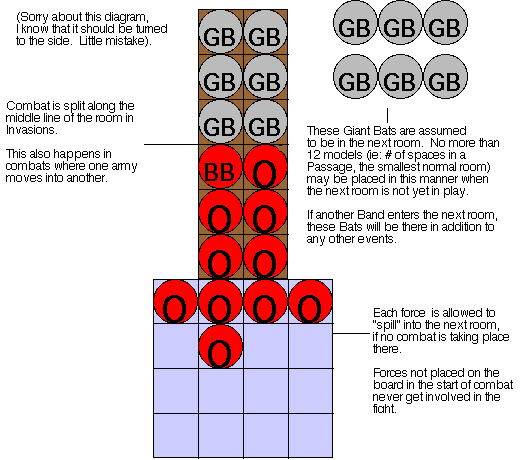
All right, done. Invasion combat is resolved in this phase as well, so let's go!
Combat 1
Phase 1
Phase 1 is where any players can choose to flee. Deciding they can easily handle 12 bats, the Orc player declines.
Phase 2
Phase 2 is a test for Panic if charged in the Flank or Rear. This may be a bit confusing for WHQ players, but that's all right as neither side has been attacked in the flank or rear - only the front.
Phase 3
Magical Ambush on the first turn only. Neither side has any magical ambushers, so we move on.
Phase 4
Spells are cast, except neither side has any. This is easy, right?
Phase 5
Normal Ambushes! The Giant Bats Fly to surround the Orcs and make their attacks! Go ahead, simulate this attack. Place all 12 bats as per normal Flying attacks and work it out! Remove all models that are killed by the attack.
Phase 6
Phase 6 is normal movement and has three parts for simplicity's sake. The highest Initiative monsters move first. 2nd Edition DCQ Giant Bats have Initiative 3. This is the same I as the Orc Big Boss from 2nd Edition, but one higher than the Orc Boyz. All of these models are assumed to attack at once - that is to say all of the bats and the Big Boss, assuming he has survived.
Normally, Phase 6 begins with all models of the highest initiative moving, then shooting, then attacking (must be in that order). So all of these models with Initiative 3 may now Move. The Big Boss is a character, so if he wants he CAN break from Pinning by taking an Initiative test at difficulty (Enemies Inititative + 1D6), but running's not really Orc-ish, is it? Anyways, move them around. I'll wait.
Done? Good. As none of them can shoot, move on to close combat. Everyone (with Inititative 3) attack! Oh, this is important - the Orc Big Boss can Deathblow! That changes things, doesn't it?
Now, realise this: every one of those attacks is assumed to be happening at once - so if any models with Inititative 3 are killed, they are still allowed to make their attack (the slower Initiative 2 Orc Boyz die without getting a chance to attack)! Go ahead, roll some dice. Once you're done, every model killed may now be removed. Put them to the side, where you can still see them.
Now attack with the Initiative 2 Orc Boyz. Move them first, then shoot if they have any missile attacks (they don't, I just don't want you to forget), then attack.
Let's recap:
- Highest Inititative goes first, all at the same time.
- Move, then shoot, then attack.
- All models of the same Inititative attack and shoot at once, so anyone that is killed can still attack. Models with lower Inititative must wait their turn and may not be able to attack at all!
- Continue until all models have moved or have been killed.
Note: Like in WHQ, you cannot Shoot and Attack, it's just neater if you seperate these two steps. If a model with Inititative 3 shoots and kills a model with Initiative 3, the slain model may still attack in melee.
Phase 7
Determine the winner. There is a crucial difference between DCQ and WHQ, and that is that the forces involved are not a large pack of overconfident monsters against a small band of half (the Barbarian and Dwarf)-drunk warriors. These are armies of creatures and they know when they are beat. To determine the winner, count up the number of wounds caused to each side. For every 10 wounds (ignore excess), a side gains a 'point'. The side with a greater unit strength as of this phase gains a point (to determine Unit Strength, see the table below). A player gains a point if the Battle Standard is present (he is not, he doesn't even exist). If a band is not engaged in the flank or rear by a group of foes with Unit Strength 5+, they gain 1-3 points for every 4 models they have after the first four. There is one point for attacking on either flank and two for the rear. So, in summary:
1 point for every wound inflicted
10 points if one force outnumbers ALL others in Unit Strength.
10 points for the presence of a Battle Standard on your side.
10 points if a Band has 8 models in a group together, 20 if they have 12, 30 if they have 16 (this
bonus cannot be claimed if said Band is engaged in the flank or rear).
10 points if a Band is attacking on a Flank of another.
20 points if a Band is attacking on the Rear of another.
So let us work out the status of our Orc versus Bat combat. Total up the wounds you've caused on each side (no model can be harmed more than it has wounds, so each dead Giant Bat is worth 1 point). Now round down to the nearest 10 for each side and divide by 10. For example, if the orcs killed 5 bats (1 wound each) and the bats killed 1 Orc (4 wounds in 2nd Edition) and caused 7 wounds throughout the unit (lucky rolling). As the bats have caused 11 wounds, they recieve 11 points. The Orcs (who have caused 5 wounds) get 5 points.
Next is Unit Strength. Unit Strength is determined as follows:
- All man-sized foot troops, RNF or character, have a Unit Strength of 1.
- Cavalry have a unit strength of 2: one for the rider and one for the mount.
- Chariots have a Unit Strength of 4.
- War Machines have a Unit Strength of 3.
- Ogre-Sized and larger models have a Unit Strength of 3.
- Large Monsters have a Unit Strength equal to their starting wounds divided by 10 (drop remainders).
So, calculate the Unit Strength of each side in your simulated game and figure out who is stronger. In our example, 7 bats have survived, giving the Bats a Unit Strength of 7 and the Orcs a unit strength of 10. The Orcs win and gain an additional 10 points. The score is now Orcs 15, Bats 11.
The Bats have split up and have been cut down, and so have lost any chance at "Rank Bonus" (ie: 8 models standing together = 1 point, etc). The orcs, howver, have 10 models in base contact with one another, so get an extra point! Orcs 3, Bats 1! BUT WAIT!!! Thanks to the Orc Big Boss, the number of bats at the front has been cut down to 2, but the rear still have 5! While the Orcs are allowed to turn around at the end of Combat, they are still facing towards the two orcs, and therefore are engaged in the Rear by a group of monsters with Unit Strength 5+! Points revoked! Orcs 15, Bats 11.
It gets worse. Since the bats are in the Rear, they get 20 bonus points! Orcs 15, Bats 31! The Bats win combat!
Phase 8
Test for Break tests. The loser now has to take a Leadership test (all 2nd Edition DCQ models have a Leadership value). As Ld averages between 7 and 8, we at the design team desided it was best to stick with the Warhammer method of Ld Tests instead of WHQ's. It's easy. Roll 2D6. If you get higher than your Ld, you fail! Test once for the entire losing Band, using the value found on the most troopers or the highest value held by a character (so, if a band has 14 Goblins (Ld 6) and 3 Orcs (Ld 7), the Goblins Ld 6 takes presidence, unless there is a character in the unit with higher Ld).
Break tests are a bit different than normal Ld tests. You have to add the results of combat, divided by 10 and rounding down, to the dice roll. In the example above situation, as the Bats won by 16 points, add one to the dice roll. Take the test now for your simulated combat.
In our example above, we test against the Big Boss' Ld of 8, adding one to our dice roll as state above. If we were to pass, we would move on to Phase 9, but for interest's sake let's say we fail. The Band is immidiately forced to break from combat and must test to flee as if voluntarily fleeing. The Bats will try and catch them.
The procedure is the same as volunarily fleeing: The entire band safely escapes (separating the bands and placing the fleeing band in a board section adjacent to where the bands clashed (that is, Passage 2)) if it wins an initiative test with it's most numerous RNF model's initiative +1D6 vs. the pursuers most numerous RNF's initiative +1D6. This die roll is modified according to the following factors:
+1 to the band with the highest valued character (planning and leadership is a factor even in retreat!)
+2 for the fleeing band if your band is fleeing in the first round of combat (voluntary fleeing ONLY).
+2 to flee from a friendly/controlled territory (know the area well, does not apply to neutral Bands)
+3 to a side if ALL the fleeing/pursuers have ethereal, flying or dodge special abilities
+2 to a side if ALL the fleeing/pursuers have Movement 7+ and do not already apply to the previous category (ie: a Dodging monster with Movement 8 gets +3, not +5).
-2 to flee from an enemies controlled territory (they'll run you into a dead end)
-1 to flee from a neutral territory (unsure of the way home, does not apply to neutral Bands)
In the case of a Voluntary Flight in Phase 1, a faliure means that the Band cannot use Ambush (Magic or Mundane) or Dodge in the turn they attempted to flee. Also, if they laterlose, all of their RNF are taken prisoner. In the case of trying to flee because of a Break Test (ie: in Phase 8), things are worse. If you fail to break, your Unit is WIPED OUT. The opponent, if not neutral, takes all of the RNF as prisoners and tests for Characters as usual.
For our example, we will assume that the Orcs made it back to base. Place their unit marker in Room 2 and place all of the bats in Passage 2. They will remain there until beaten off. Invasion has failed and must be started again.
Now, I know what you're saying: "My orcs crushed those bats! What happens then?" Well, it's simple. The Bats test to break. If they fail their Ld test (Ld 2), they test to flee. Should they make it, they vanish from the game and the Invasion moves on to stage two. Should they fail, they are cut down, all of them are taken prisoner and the Invasion moves on to stage 2. As the new winners, the Orcs would get gold, prisoners, treasure and possibly prisoners.
(Note: Technically, Giant Bats, Giant Spiders and Giant Rats cannot be taken prisoneras normal, instead they can only be used as a food offering to neutrals. But as long as you can see what would go on in a normal situation, all is well.)
Note: In the case of multiple Bands involved in a combat, the winner of EVERY combat must be determined, resulting possibly in many break tests.
Phase 9
Resolve Panic tests caused by the break. As the only nearby Band to the combat site is the band that just fled, no tests are taken.
Phase 10
If the fight is still going on, every model may move up to one square (models competing for a square roll off for it: whoever rolls higher takes the square). That completed, models that have not been placed may be moved on the board at the rear of each Band.
Phase 11
End of combat. Next turn, combat will continue until one side is wiped out or flees.
So combat is over: the Orcs are back in their lair with a whole collection of bats between them and the next room. Too bad for them, but they'll be back. The board now looks like this:

With combat over, we now move on to Phase 5 of the actual Turn.
Phase 5
Player 1
Phase 5 is quick and simple. First, roll for Unexpected Events if a player happens to be in a neutral territory and isn't fighting/hasn't fought this turn. Player 1 has a Band in Neutral territory, so rolls a D6. On a 1 or 2, they fail, and they roll a 2! Like in WHQ, events and encounters could result from Unexpected Events. Events are resolved immediately after these tests, but Player 1 rolls and encounter, which is resolved in Phase 6.
Player 2
Player 2 has no models in Neutral territory, so the phase ends.
Phase 6
Player 1
1 Ogre marches up to the goblin mass and demands explaination for this intrution on its territory. The Goblin leader decides to parlay and sents a trusted goblin to work things out ("'E's lunch, boyz!"). This is a special trait of evil races: if it will not cost them their Band status, an RNF trooper may be converted to a prisoner for purposes of negotiation, though he keeps his equipment. There are a number of modifiers that may be applied to negotations, but the Goblins have accounted for only one: the band is worth more twice that of the Ogre and as such they get +1. The player rolls a 3 and is very grateful to that +1 bonus as it brings him into a more benificial category. The Ogre walks away and Player 1 is at +1 for the next 3 Ogres he may negotiate with. Should a combat have occured, it would have been resolved immediately.
Player 2
Player 2 can do nothing in this phase as they have triggered no Neutral encounters.
That's the end of turn one! At the start of turn 2, the players would jump straight to Phase 3 and would continue to do so until then end of turn 5, when Cycle 1 ends. The turn after that they would go to Phase 1 instead, then would stop again until the start of the next cycle, all the while trying to tear the throats out of one another. Sounds like fun? Well, grab a army, it's time for Dungeon ConQuest!