Build a Guillotine, quick!
Parts List
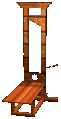
The place to start is with the 10' 4x4 boards. Lay them on a flat surface. Now cut the an 8' fence board using a table saw and guide into approximately 1 1/2" strips. These will be mounted using screws to the 4x4's. Lay the strips on the 4x4 about 6" from the top. Two strips are needed for each 4x4 and mounted flush to the outside edge on both sides of the 4x4 will create the slider guides for the blade. This groove should be atleast 1/2" wide and relatively straight. Fasten these down to each 4x4 with screws (drilling a pilot hole should be done as not to crack the wood).
With the strips in place, flip the 4x4's over so the strips face each other. Leave a 28" gap between the boards. Using the 34" long fence boards (give or take a bit since a 4x4 is actually 3 1/2"x 3 1/2", or the gap can be increase so that the ends of the fence board touches the outside of each 4x4) attach one with 4 screws at the top of the posts, and then another in the middle for support (not really required but strengthens the guillotine).
Next, using the 34" long fence boards left, trace a hole in the center of two boards placed long edge together (half a circle on each board). This hole should be large enough for a neck to fit in, not a real one hopefully. Cut this hole pattern out using a jig, scroll, or even bandsaw. Mount these with the middle (top of one, bottom of the other) approximately 15" up from the bottom of the 4x4's. The top one can be mounted using hinges of some sort if you wish to be able to open it, but if using it for a dummy its not really necessary.
Next, make a butt block by fastening 2 small pieces of 2x4 with the top of the pieces 12" up from the ground on each 4x4 on the opposite side of the fence board supports. Mount a 2x4 (you choose the length of the bench, mine was 2') to the small 2x4 supports using screws on a slight angle on one end, and the short pieces of 4x4 on the other. Add 2x4 crosspieces across (34" in length again) to strengthen the bench. The guillotine should now be capable of being tipped up and standing on its own. For display purposes either angle braces or stakes into the ground should be added for support (not shown in diagram).
The frame is done. Add one eyehook to the middle of the top cross piece (on the back). Add the other eyehook at an even level to one of the 4x4's (depending on which side you want the operator).
Cut the plywood to form a blade with a slight angle. Be sure to keep both ends of the blade pretty wide to prevent it from sliding out of the grooves. The blade should slide into the grooves that were created using the fence board strips. This part takes the longest, adjusting the blade to move up and down freely, but without falling out of the grooves. This may require some sanding, and possibly a little wax to the inside of the groove. Once you get the blade moving satisfactory, remove it from the grooves at the top. About 4" from the center (in both directions), and 3/4" down from the top of the blade drill two holes. These holes will be for your rope, must be even, and cut out according to the size of the rope you're using.
Lastly, tie the rope using a "V" knot such that the rope passes through both holes but ends up rising from the center of the blade. This knot will sturdy the rise and fall of the blade more than a single hole would. Run the other end of the rope through the eyehooks, and voila, you're ready to go. Test it a few times, and check for the ease of blade rising and falling. It may need more sanding.
You can paint it, and even scroll saw some cut-outs in the cross pieces to accent your guillotine so that its an original. Its up to you.
This whole project should take less than 3 hours if you have all the parts on hand. I completed mine in roughly 3 hours, using an old fence section to create that rustic look. I didn't add any extras to mine, but they may come in the future. It is yet to see any real action.
Good building, and happy haunting!

99 Picture Page