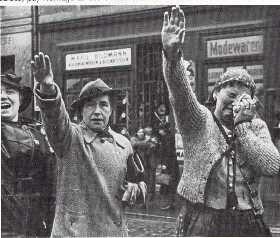
Unnoticed Change Laurence Sherwood The Nazification of Germany between the two world wars has attracted the interest of many historians and psychologists. In particular they question how a country noted for its culture, was capable of voting into power a party whose agenda was hardly a surprise. Hitler�s political and racist thinking was no secret; he had put his intentions into print in Mein Kampf, a roadmap to a German resurrection which would lead on to a glorious future, far from the humiliation many felt after the Versailles Treaty. His book sold over 5 million copies by the outbreak of the Second World War. Hitler came to power through democratic means and popular support. His party successfully returned 12 members to the Reichstag in 1928, 107 in 1930 and 230 in July 1932. The country which had given the world Bach, Beethoven and Goethe, cultural giants, were now prepared to place their faith in an obvious racist and warmonger. Hitler was eased into power by the dissatisfaction many in Germany felt after World War One. He was also aided by the lack of democratic tradition, and by the popular hostility to the Versailles Treaty which made Germany responsible for the war, and which had placed massive reparations on it as a consequence. The Republic, responsible for signing the Treaty was particularly loathed. Hyperinflation, leaving many resorting to barter just to exist was regarded as the consequence of paying the unjust reparations. The general resentment many felt lead to instability as the extreme right and left contended for power, often violently, in attempted coups. The political unrest was further heightened when the Great Depression left many without employment. The ordinary German believed that he had been betrayed by the politicians and was receptive to any ideology which would absolve them of the guilt that had been forced on them for the war, and which would offer a solution to their political and economic difficulties. Hitler must have thought �Come the moment, come the man,� as he surveyed the opportunity being presented to him. He was able to offer himself as a dynamic and capable leader who held the answers. He promised industrialists and landowners that he would remove the threat of communism. The middle classes were assured that the injustices of the Versailles Treaty, which had hit them financially, would be overturned. The working classes were promised employment and economic and social reforms which would favour them. The army was assured that its humiliation would be replaced with a new glory and a victorious future. Hitler relied on latent anti-Semitism, nationalism and racialism as vehicles for his policies. He sought to deliver the German people from their crisis by blaming the Jews for the problems they faced. They were the ones, he told his listeners, who were responsible for the war and German defeat; for the hated democracy which was so obviously failing and for communism and internationalism. "The Jews" ultimate goal is the denaturalization, the promiscuous bastardization of other peoples, the lowering of the racial level of the highest peoples as well as the domination of his racial mishmash through the extirpation of the folkish intelligentsia and its replacement by the members of his own people," he wrote. The solution he offered was to prevent the Jews from world domination by eliminating them together with Jewish Marxist Russia and the Slavic countries thereby gaining the Lebensraum which would introduce the Reich and prevent Germany from falling into even greater decay. Millions of ordinary Germans began to believe in �Aryan� policies. They saw themselves as the master race and this acceptance allowed the Nazis to persecute Jews, gypsies, the handicapped and anyone who was deemed unworthy of belonging to the new Reich of master men. Those who have an interest in studying what has become known as "the German problem" have attempted to distinguish between subjective guilt and civic responsibility (Jaspers, Arendt), and answer the question of just how culpable was the average German for the crimes committed in his name by the state. The phenomenon which produced Nazism is seen as unique, as being a distinctive set of circumstances which altered the moral mindset of the German people. Yet, just how unique was that shift? It is comforting to believe that it arose because of the political, economic and humiliating factors which dominated the German consciousness between the wars, and that such a universal exchange of an established morality for something wholly alien could not be repeated. It is my contention that not only is it possible, but that we, in the West at least, have undergone an unnoticed change, equivalent in its movement to that which the Germans experienced under Hitler. The change I am alluding to is Political Correctness which has initiated changes so deep and far reaching, that like Germany in the 1930s, we are now accepting a new morality and punishing those who do not adhere to its principles. It has been a steady incremental change inculcated over the past two or three decades, and one which has achieved a similar change in thinking, both at an individual level and also corporate. The means which Hitler employed to seed his policies were those called into service by the proponents of PC; the media, education, especially of the young and the crushing of any opposition. Only recently I watched a television programme in which a male character intimated to a female colleague that it was his son�s birthday and that someone had bought him a doll. He obviously disapproved of the gift. His colleague immediately vilified him as a �homophobe� and made him feel guilty because he had inadvertently let slip, what she considered, his antediluvian views on gender and sexuality. The significance was how rapidly and successfully the acceptance of homosexuality has moved from toleration to one of personal attack on those who do not subscribe to the new thinking on such matters. He was made to feel guilt, and then his thinking was corrected. The interesting element was not homosexuality or gender issues per se, but how deeply entrenched and universal the change in attitudes has been. Not too many years ago homosexuality was treated as criminal behaviour, a perversion or even mental illness, now it is those who fail to comply with PC who are the perverted. The change in thinking has been dramatic, and one similar to that which occurred in the 1920s and 1930s in Germany when the German people threw off their established moral code. This is not to suggest that PC and Nazism are in any way related, but to point out how minds and morality can change drastically in a relatively short span of time, and a new mindset not only emerge, but become the moral high ground. A similar shift can be noted in regard to views on abortion, a "crime" in the recent past, but now accepted as being something which is a woman�s right. The World Health Organization estimated that worldwide, about 50 million abortions were induced annually in the years circa 1990. Combining this estimate with others, WHO concluded that each year in this period, approximately 3.4% of women in the childbearing ages of 15 to 49 years had an abortion (the abortion rate), and 25% of all pregnancies ended in abortion (the abortion ratio). Yet again, morality has been turned on its head, and what was almost universally regarded as an abhorrent practice has now won wide acceptance. The intriguing factor being once again the complete disowning of the previous ethical and moral code by a diametrically opposite standard, which itself has now become the refreshed benchmark of our morality. Writing of Nazism, Chasseguet-Smirgel noted that �We are shocked to see how easily the superego can be swept aside, reason destroyed and thought placed in the service of the dehumanization of others" (Chasseguet-Smirgel 1987). Ignoring the "dehumanization of others," we too should be shocked to see how easily reason and mindsets can be so completely reversed on issues as prominent to our morality as abortion and homosexuality. The steady change in our thinking, unnoticed and unchallenged for the greater part, occurs when we are easily seduced by arguments which make their appeal to our sense of justice and fairness. Was it not just, it was argued, that the Jews should be made to bear the burden for defeat in the war and the economic devastation which many Germans were desperately having to live with. Many thought so and showed there agreement by voting in 230 deputies in July 1932. We also listened to fair sounding arguments about Political Correctness, and we too have exchanged what was once thought of as the morally acceptable for what was the morally unacceptable. Perhaps the problem is not the "German problem" after all, but one in which we all as human beings show that our certainties are at best frail, and that they can be rapidly overcome by those intent on doing so. We also should be aware of our vulnerability lest the next time, before we have truly taken account, we find that we are in thrall to a more sinister and malevolent seeding of ideas. |
 |