|
Biological
Armors
Overview
Recently, a specific
gastropod (snail) was discovered at the base of black-smoker chimney in Indian Ocean (25º19’S, 70º04’E). Different from the
regular snail, its foot is coved with scales. More interestingly, these
scales are composed of iron sulfide pyrite (FeS) and grigeite(Fe3S4).
This is the first time that iron sulfide was discovered within the skeletal
material of any animal. The living environment of the snail is extremely
harsh and characterized by high pressure (2,440 m deep), high temperature and
temperature gradient (superheated (~350ºC) sulfide-rich vent effluents mixed
with cold (2ºC) oxygen-rich sea water), highly acidic (PH<=2.8), high
toxic level of sulfides and heavy metals. Studies of the ultrastructure
and mechanical properties of this material will undoubtedly lead to
fascinating new insights into protection from mechanical attack (from potential
predators), large temperature and pressure differentials. Such studies will also
provide novel strategies for the design of man-made armors.

Fig. 1 Scalyfoot snail (adapted from Waren et al.,Science,
2003) and an ancient armor of Chinese soldiers.
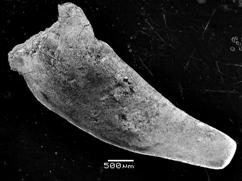 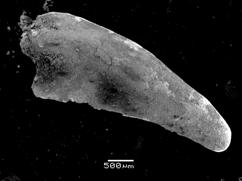
Fig. 2 SEM images of dermal sclerite, left is inner surface, right is outer surface.
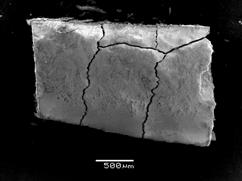 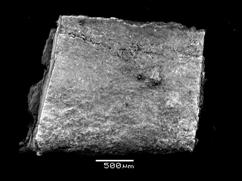
Fig. 3 SEM images of snail shell,
left is inner surface, right is outer surface.
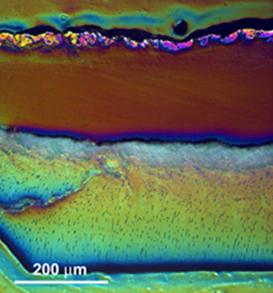 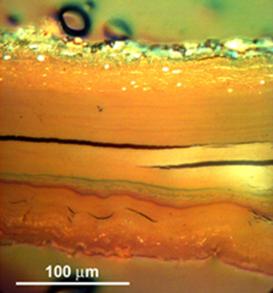
Fig. 4 Optimal images of the cross
sections of shell and dermal sclerite.
|