
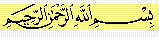

In the Name of Allah, most Compassionate, most
Merciful
Introduction To Islam
�������������������������������������������������
Islam and Muslims
�The word "Islam" is an
Arabic word which means "submission to the will of God". This
word comes from the same root as the Arabic word "salam", which
means "peace". As such, the religion of Islam teaches that in
order to achieve true peace of mind and surety of heart, one must submit
to God and live according to His Divinely revealed Law. The most
important truth that God revealed to mankind is that there is nothing
divine or worthy of being worshipped except for Almighty God, thus all
human beings should submit to Him. The word "Muslim" means one
who submits to the will of God, regardless of their race, nationality or
ethnic background. Being a Muslim entails willful submission and active
obedience to God, and living in accordance with His message. Some people
mistakenly believe that Islam is just a religion for Arabs, but nothing
could be further from the truth. Not only are there converts to Islam in
every corner of the world, especially in England and America, but by
taking a look at the Muslim World from Bosnia to Nigeria, and from
Indonesia to Morocco, one can clearly see that Muslims come from many
various races, ethnic groups and nationalities. It is also interesting
to note that in actuality, more than 80% of all Muslims are not Arabs -
there are more Muslims in Indonesia than in the whole Arab World! So
though even though it is true that most Arabs are Muslims, the large
majority of Muslims are not Arabs. However, anyone who submits
completely to God and worships Him alone is a Muslim.
Continuity of the Message
Islam is not a new
religion because "submission to the will of God", i.e. Islam, has
always been the only acceptable religion in the sight of God. For this
reason, Islam is the true "natural religion", and it is the same
eternal message revealed through the ages to all of God's prophets and
messengers. Muslims believe that all of God's prophets, which include
Abraham, Noah, Moses, Jesus and Muhammad, brought the same message of
Pure Monotheism. For this reason, the Prophet Muhammad was not the
founder of a new religion, as many people mistakenly think, but he was
the Final Prophet of Islam. By revealing His final message to Muhammad,
which is an eternal and universal message for all of mankind, God
finally fulfilled the covenant that He made with Abraham, who was one of
the earliest and greatest prophets. Suffice it to say that the way of
Islam is the same as the way of the prophet Abraham, because both the
Bible and the Qur'an portray Abraham as a towering example of someone
who submitted himself completely to God and worshipped Him without
intermediaries. Once this is realized, it should be clear that Islam has
the most continuous and universal message of any religion, because all
prophets and messengers were "Muslims", i.e. those who submitted
to God's will, and they preached "Islam", i.e. submission to the
will of Almighty God.
The Oneness of God
The foundation of the Islamic
faith is belief in the Oneness of Almighty God - the God of Abraham,
Noah, Moses and Jesus. Islam teaches that a pure belief in One God is
intuitive in human beings and thus fulfills the natural inclination of
the soul. As such, Islam's concept of God is straightforward,
unambiguous and easy to understand. Islam teaches that the hearts, minds
and souls of human beings are fitting receptacles for clear divine
revelation, and that God's revelations to man are not clouded by
self-contradictory mysteries or irrational ideas. As such, Islam teaches
that even though God cannot be fully comprehended and grasped by our
finite human minds, He also does not expect us to accept absurd or
demonstrably false beliefs about Him. According to the teachings of
Islam, Almighty God is absolutely One and His Oneness should never be
compromised by associating partners with Him - neither in worship nor in
belief. Due to this, Muslims are required to maintain a direct
relationship with God, and therefore all intermediaries are absolutely
forbidden. From the Islamic standpoint, believing in the Oneness of God
means to realize that all prayer and worship should be exclusively for
God, and that He alone deserves such titles as "Lord" and
"Savior". Some religions, even though they believe on "One
God", do not make all of their worship and prayers for Him alone.
Also, they also give the title of "Lord" to beings that are not
All-Knowing, All-Powerful and Un-Changing - even according to their own
scriptures. Suffice it to say that according to Islam, it is not enough
that people believe that "God is One", but they must actualize
this belief by proper conduct. In short, in the Islamic concept of God,
which is completely based on Divine Revelation, there is no ambiguity in
divinity - God is God and man is man. Since God is the only Creator and
continual Sustainer of the Universe, He is transcendent above His
creation - the Creator and the creature never mix. Islam teaches that
God has a unique nature and that He is free from gender, human
weaknesses and beyond anything which human beings can imagine. The
Qur'an teaches that the signs and proofs of God's wisdom, power and
existence are evident in the world around us. As such, God calls on man
to ponder over the creation in order to build a better understanding of
his Creator. Muslims believe that God is Loving, Compassionate and
Merciful, and that He is concerned with the daily affairs of human
beings. In this, Islam strikes a unique balance between false religious
and philosophical extremes. Some religions and philosophies portray God
as just an impersonal "Higher Power" who is uninterested, or
unaware, of the life of each individual human. Other religions tend to
give God human qualities and teach that He is present in His creation,
by being incarnate in someone, something - or even everything. In Islam,
however, Almighty God has clarified the truth by letting mankind know
that He is "Compassionate", "Merciful", "Loving"
and the "Answerer of Prayers". But He as also emphasized strongly
that "there is nothing like unto Him", and that He is high above
time, space and His creation. Finally, it should be mentioned that the
God that Muslims worship is the same God that Jews and Christians
worship - because there is only one God. It is unfortunate that some
people mistakenly believe that Muslims worship a different God than Jews
and Christians, and that "Allah" is just the "god of the
Arabs". This myth, which has been propagated by the enemies of
Islam, is completely false since the word "Allah" is simply the
Arabic name for Almighty God. It is the same word for God which is used
by Arabic-speaking Jews and Christians. However, it should be clarified
that even though Muslims worship the same God as Jews and Christian,
their concept of Him differs somewhat from the beliefs of other
religions - mainly because it is based completely on Divine Revelation
from God. For example, Muslims reject the Christian belief that God is a
Trinity, not only becaue the Qur'an rejects it, but also because if this
was God's true nature, He would have clearly revealed it to Abraham,
Noah, Jesus and all of the other prophets.
The Qur'an
The Arabic world "Al-Qur'an"
literally means "the recitation". When used in regards to Islam,
the word Qur'an means God's final message to mankind that was revealed
to the Prophet Muhammad. The Qu'ran, sometimes spelled Koran, is
the literal the word of God - as it clearly says time and time again.
Unlike other sacred scriptures, the Qur'an has been perfectly preserved
in both its words and meaning in a living language. The Qu'ran is a
living miracle in the Arabic language; and is know to be inimitable in
its style, form and spiritual impact. God's final revelation to mankind,
the Qur'an, was revealed to the Prophet Muhammad over a period of 23
years. The Qur'an, in contrast to many other religious books, was always
thought to be the Word of God by those who believed in it, i.e. it
wasn't something decreed by a religious council many years after being
written. Also, the Qu'ran was recited publicly in front of both the
Muslim and non-Muslim communities during the life of the Prophet
Muhammad. The entire Qur'an was also completely written down in lifetime
of the Prophet, and numerous companions of the Prophet memorized the
entire Qur'an word-for-word as it was revealed. So unlike other
scriptures, the Qur'an was always in the hands of the common believers,
it was always thought to be God's word and, due to wide-spread
memorization, it was perfectly preserved. In regards to the teachings of
the Qur'an - it is a universal scripture, and it is addressed to all of
mankind, and not to a particular tribe or "chosen people". The
message that it brings is nothing new, but the same message of all of
the prophets - submit to Almighty God and worship Him
alone. As such, God's revelation in the Qur'an focuses on
teaching human beings the importance of believing in the Unity of God
and framing their lives around the guidance which He has sent.
Additionally, the Qur'an contains the stories of the previous prophets,
such as Abraham, Noah, Moses and Jesus; as well as many commands and
prohibitions from God. In modern times in which so many people are
caught up in doubt, spiritual despair and "political
correctness", the Qur'anic teachings offer solutions to the
emptiness of our lives and the turmoil that is gripping the world today.
In short, the Qur'an is the book of guidance par
excellence.
The Prophet Muhammad
Unlike the founders of many
religious, the final prophet of Islam is a real documented and
historical figure. He lived in the full light of history, and the most
minute details of his life are known. Not only do Muslims have the
complete text of God's words that were revealed to Muhammad, but they
have also preserved his saying and teachings in what is called
"hadith" literature. This having been said, it should be
understood that Muslims believe that the Prophet Muhammad was only a man
chosen by God, and that he is not divine in any way. In order to avoid
the misguided wish to deify him, the Prophet Muhammad taught Muslims to
refer to him as "God's Messenger and His Slave". The mission of
the last and final prophet of God was to simply teach that "there is
nothing divine or worthy of being worshipped except for Almighty
God", as well as being a living example of God's revelation. In
simple terms, God sent the revelation to Muhammad, who in turn taught it
, preached it, lived it and put it into practice. In this way, Muhammad
was more that just a "prophet" in the sense of many of the
Biblical prophets, since he was also a statesman and ruler. He was a man
who lived a humble life in the service of God, and established an
all-encompassing religion and way of life by showing what it means to be
an ideal friend, husband, teacher, ruler, warrior and judge. For this
reason, Muslims follow him not for his own sake, but in obedience to
God, because Muhammad not only showed us how to deal with our fellow
human beings, but more importantly, he showed us how to relate to and
worship God, worship Him in the only way pleasing to Him. Like other
prophets, Muhammad faced a great deal of opposition and persecution
during his mission. However, he was always patient and just, and he
treated his enemies well. The results of his mission were very
successful, and even though his mission started in one of the most
backward and remotes places on earth, within a hundred years of the
death of Muhammad, Islam had spread from Spain to China. The Prophet
Muhammad was the greatest of all of God's prophets, not because he had
new doctrines or greater miracles, but because the results of his
mission have broght more human beings into the pure and proper belief in
the One True God than any other prophet.
The Islamic Way of Life
In the Holy Qur'an, God
teaches human beings that they were created in order to worship Him, and
that the basis of all true worship is God-consciousness. Since the
teachings of Islamic encompass all aspects of life and ethics,
God-consciousness is encouraged in all human affairs. Islam makes it
clear that all human acts are acts of worship if they are done for God
alone and in accordance to His Divine Law. As such, worship in Islam is
not limited to religious rituals. The teachings of Islam act as a mercy
and a healing for the human soul, and such qualities as humility,
sincerity, patience and charity are strongly encouraged. Additionally,
Islam condemns pride and self-righteousness, since Almighty God is the
only judge of human righteousness. The Islamic view of the nature of man
is also realistic and well-balanced. Human beings are not believed to be
inherently sinful, but are seen as equally capable of both good and
evil. Islam also teaches that faith and action go hand-in-hand. God has
given people free-will, and the measure of one's faith is one's deeds
and actions. However, human beings have also been created weak and
regularly fall into sin. This is the nature of the human being as
created by God in His Wisdom, and it is not inherently "corrupt"
or in need of repair. This is because the avenue of repentance of always
open to all human beings, and Almighty God loves the repentant sinner
more than one who does not sin at all. The true balance of an Islamic
life is established by having a healthy fear of God as well as a sincere
belief in His infinite Mercy. A life without fear of God leads to sin
and disobedience, while believing that we have sinned so much that God
will not possibly forgive us only leads to despair. In light of this,
Islam teaches that: only the misguided despair of the Mercy of their
Lord. Additionally, the Holy Qur'an, which was revealed to the
Prophet Muhammad, contains a great deal of teachings about the life
hereafter and the Day of Judgment. Due to this, Muslims believe that all
human beings will ultimately be judged by God for their beliefs and
actions in their earthly lives. In judging human beings, Almighty God
will be both Merciful and Just, and people will only be judged for what
they were capable of. Suffice it to say that Islam teaches that life is
a test, and that all human beings will be accountable before God. A
sincere belief in the life hereafter is key to leading a well-balanced
life and moral. Otherwise, life is viewed as an end in itself, which
causes human beings to become more selfish, materialistic and
immoral.
Islam for a Better Life
Islam teaches that true
happiness can only being obtained by living a life full of
God-consciousness and being satisfied with what God has given us.
Additionally, true "freedom" is freedom from being controlled by
our base human desires and being ruled by man-made ideologies. This
stands in stark contrast to the view of many people in the modern world,
who consider "freedom" to be the ability to satisfy all of their
desires without inhibition. The clear and comprehensive guidance of
Islam gives human-beings a well-defined purpose and direction in life.
In addition to being members of the human-brotherhood of Islam, its
well-balanced and practical teachings are a source of spiritual comfort,
guidance and morality. A direct and clear relationship with Almighty
God, as well as the sense of purpose and belonging that ones feels as a
Muslim, frees a person from the many worries of everyday life. In short,
the Islamic way of life is pure and wholesome. It builds self-discipline
and self-control thought regular prayer and fasting, and frees
human-beings from superstition and all sorts of racial, ethnic and
national prejudices. By accepting to live a God-conscious life, and
realizing that the only thing that distinguishes people in the sight of
God is their consciousness of Him, a person's true human dignity is
realized.
Jihad
If we take the linguistic meaning
of the word jihad we find that it relates to the exertion of efforts. The effort
is intended to accomplish a specific purpose, but the term jihad also implies
the presence of strong opposition or resistance. Thus, a pre-Islamic poet may
use the word jihad to describe his efforts to get his passion under his control
after the departure of his beloved with her tribe, leaving him alone without any
hope of reunion. His passion would be the source of resistance to his effort to
control himself and try to live a normal life. In its Islamic sense, the term
jihad, does not differ greatly in implying the exertion of effort and the
presence of resistance.
However, the purpose of jihad is
clearly defined as the furtherance of the cause of Allah. This means helping the
message of Islam spread and helping it being implemented properly in an Islamic
community. The sort of effort required in jihad differs according to
circumstances and to the particular situation in which a Muslim finds himself.
It could be a simple action, such as standing firm in defense of the cause of
Islam. This may require speaking out in public, against ignoring Islamic
principles, and writing articles or publishing books. It may also take the form
of reminding people of their Islamic duties and motivating them to conduct their
lives according to Islam. Its top and most noble form is to fight the enemies of
Islam in battle in order to foil their attempts to smother the call of Islam. It
is this form of fighting which always springs to people's minds when the term
jihad is mentioned. This is due to the fact that when a person fights, he
demonstrates practically his willingness to sacrifice his life for the cause of
Islam. His jihad no longer stops at making efforts which are not likely to cause
him any harm. Here he is exposing himself to risks of injury and death. Because
this form has been deeply rooted in people's concept of jihad, the word is
associated generally with exerting strenuous efforts which could endanger a
person's life. Hence, the term 'jihad' is often mistranslated as "holy war."
Perhaps it is appropriate to clarify at this point that there is nothing which
Islam describes as "holy war". The very description will suggest that Islam
approves of two types of war: one holy and the other unholy. This is certainly
untrue. If a war is fought for a just cause, such as lifting injustice or
freeing people from persecution, then it is a war which Islam approves of,
hence, it is jihad. A war against imperialism can be described as jihad if its
purpose is to free the Muslim community so that they may conduct their lives
according to Islam. A purely patriotic war to achieve national independence
cannot be described as jihad if its aim is to retain the secular system imposed
by the imperialists, but will simply replace its administrators by nationals. We
see that the purpose is of utmost importance. This is perfectly in line with
Islamic thinking, because Islam attaches the greatest importance to the
intention behind every action. The Prophet says: "Actions are but intentions."
This means that the value of any action is determined by the intention behind it
and the purpose for which it is done. The Prophet was asked about people
fighting the same war with the same army, but one of them is fighting simply
because he wants to be with his people against their enemy, another is fighting
for personal pride, and one fights simply because he is brave, and yet another
in order to maintain appearances: which of them can be described as fighting for
Allah's cause. His answer was most revealing: "He who fights in order to make
Allah's law supreme fights for Allah's cause." What this Hadith tells us is that
it is the propriety of purpose which determined the act of an individual, a
community or the state. In other words, the cause for which the war is being
fought must be approved by Islam, and the intention of every single fighter must
be the right one. In other words, it is possible that a campaign of jihad may be
joined by people who cannot be described as mujahed. As you realize, the term
mujahed means a person who makes the efforts to support Allah's cause. Some of
those who would join a campaign of jihad may have other purposes for doing so.
Therefore, they cannot earn the honor of being mujahed simply because they have
joined such a campaign. Let me give you a very clear example. The war of
liberation that the Muslim people of Afghanistan fought for over a decade was a
war which Islam approves. Therefore, it was a war of jihad. The fighters called
themselves Mujahedeen, and rightly so. However, in their ranks, there may have
been people who did not consider the establishment of Allah's law in a land of
Islam as their prime purpose. Those were not Mujahedeen despite the fact that
they were fighting with the Mujahedeen. A shaheed, which means martyr, is a
person who is killed as a result of the efforts he makes in support of Allah's
cause. Whether he is felled by an enemy bullet or assassinated or taken prisoner
and executed is immaterial. As long as the prime reason for killing him is the
effort he is making in support of Islam, then his death is martyrdom. He is a
shaheed and a shaheed is admitted into heaven without having to account for his
sins. Allah forgives him all sins that he may have committed previously. A
shaheed, however, need not be a fighter in the sense that he is a soldier taking
part in war. He is a mujahed as he is making an effort for jihad to make the
world of Islam triumphant. I will give you an example. The late Sayyid Qutb, one
of the top contemporary Islamic scholars, never fought war and never fired a
bullet. He, however, served and defended Islam in the way he knew best. He wrote
books and articles making the principles of Islam absolutely clear to modern
readers and wrote a commentary on the Qur'an which makes the meaning of its
verses easy to grasp. As a result, many young men, all over the Arab world and
beyond, turned to Islam advocating its cause, after having been previously
semi-ignorant of their faith. He used his powerful style to instill in people's
minds the thought that unless a community conducts all its affairs according to
Islamic law, it cannot be described as a Muslim community. This was a direct
challenge to the authorities in Egypt where Sayyid Qutb lived. At that time,
Egypt was writhing under a brutal dictatorship. Sayyid Qutb was arrested and
imprisoned for ten years, then released. One year later, he was imprisoned again
and his interrogators asked him mainly about his latest book, entitled
'Milestone.' When he was put to trial, his writing of that book was a central
issue. He was sentenced to death and executed in 1966. Sayyid Qutb was a mujahed
and a shaheed. I say so advisedly because the Prophet says: "The best form of
jihad is a declaration of the truth in front of a despotic ruler." He also says:
"The master of all martyrs is Hamza ibn Abdul Mutalib (the Prophet's uncle); and
a man who stands up to a tyrant, ordering him to do what is right and to desist
from doing what is wrong." That was exactly what Sayyid Qutb did and for which
he had to sacrifice his life. Nowadays, people tend to describe as shaheed or
martyr a person who is killed for any cause. They describe such people in a
variety of ways, saying he is a martyr of the fatherland, a martyr of
independence, a martyr of revolution, and so on and so forth. In Islam, there is
only one type of martyrs: those who lose their lives fighting for the cause of
Allah. We have to read the word "fighting" here in its broadest sense. The term
ghazi means a person who joins an expedition of jihad. It is more or less
synonymous with mujahed but much less frequently used. Allah rewards very
generously all those who join a campaign of jihad for His cause.
Click to see more about ISLAM