Connecting two machines to each other
Ethernet has two pairs of wires in a twisted pair setup: one pair for transmit and one for recieve.
When you connect a bunch of machines together using a hub, the hub relays all the information from all the Transmit pairs to all the Receive pairs. That is, each machine sees on its receive pairs the information sent on every machine's Transmit pairs. The hub logically connects all the Transmit pairs to all the Receive pairs. I say "logically" because this represents the information flow. You can't physically connect all these wires together because all the electrical signals would get messed up.
Now, if all you want to do is connect your trusty 386 to your friend's Powerbook, then you don't need to deal with all this crap. All you need, assuming both machines have an Ethernet RJ-45 connection, is a cross-over cable. The cross-over cable works only between two machines to connect one's transmit to the other's receive. It's like a hub with only two ports.You can
A is fairly easy. The hard part is remembering that it's not a conventional Ethernet cable.
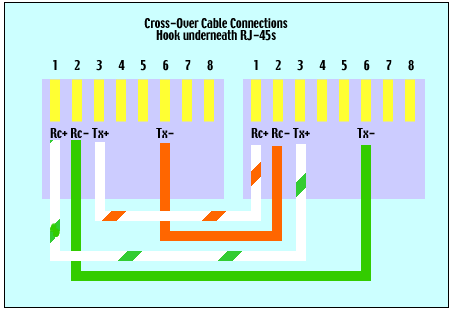
B isn't hard. Here's the connection diagram:
C is maybe best. You just take two RJ-45 sockets and wire them back to back, crossing over the orange and green pairs. Then you can use conventional, non-cross-over ethernet cables to connect each machine to the cross-over sockets.