
Space Space
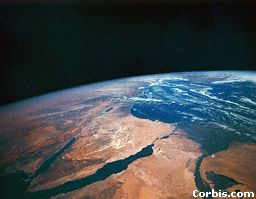
The Sinai Peninsula and the surrounding area, taken from the space shuttle. The split northern end of the Red Sea Rift is prominent, separating the Sinai Peninsula from Africa toward the camera and from Arabia in the distance. The Mediterranean Sea is in the background.
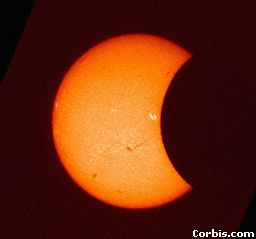
Annular eclipse on May 10, 1994. The moon is passing in between the Earth and the Sun, obscuring the central part of the sun. This leaves a ring of sunlight around the circumference at mid-eclipse. These eclipse pictures were taken in Learmonth, Australia, Holloman Air Force Base in New Mexico, or Boulder, Colorado. The Boulder telescope is a 5-inch telescope with an H-alpha filter and a CCD camera, and is operated by the Space Environment Laboratory. The Australia and New Mexico telescopes are part of the U.S. Air Force Solar Optical Observatory Network (SOON) system. This is a computer controlled solar telescope that monitors the sun in various wavelengths and can track several regions on the sun simultaneously. A television camera and digitizing equipment is used to capture the images.
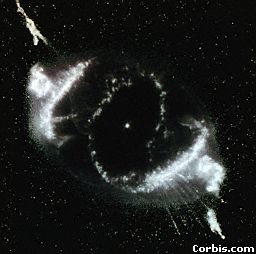
NGC 6543, also known as the Cat's Eye Nebula, 3,000 light years away in the constellation of Draco, seen in this view from the Hubble Space Telescope's Wide Field and Planetary Camera II.
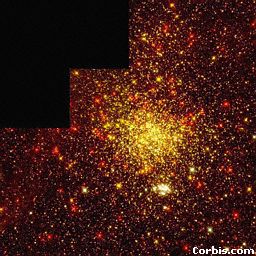
Hubble Space Telescope (HST) image showing rich detail, previously only seen in neighboring star birth regions, in a pair of star clusters 166,000 light-years away in the Large Magellanic Cloud (LMC), in the southern constellation Doradus. The field of view is 130 light-years across and was taken with the Wide Field Planetary Camera 2.
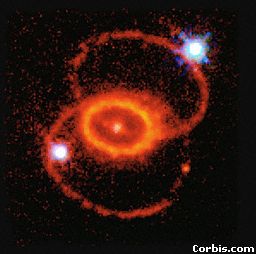
Rings, an unexpected development, appear around Supernova 1987A in this view from the Hubble Space Telescope's Wide Field and Planetary Camera II.
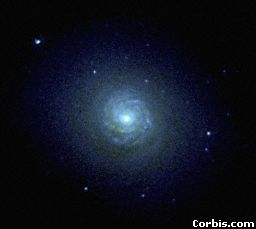
Hubble Space Telescope (HST) image of the core of the peculiar galaxy NGC 7252 reveals a striking "mini-spiral" disk of gas and stars, and about 40 exceptionally bright and young globular star clusters. The visible light image was taken with the Wide Field and Planetary Camera (WFPC) in PC mode, on October 10, 1992. The false-color image has been subject to computer image reconstruction. The strong spiral structure is 10,000 light-years across (7 arc seconds); the entire picture is 46,000 light-years across.
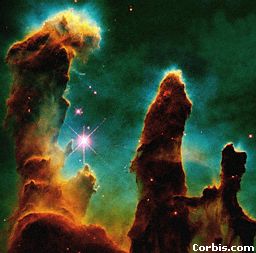
Stars are being born in the gaseous pillars of the nebula M 16 (the Eagle Nebula), 7,000 light-years from Earth, in this view from the Hubble Space Telescope's Wide Field and Planetary Camera II. The large pillar at left is a light-year long.
