

From 1877 until World War One
Between the World Wars
Post War to the WSC Revolution
The Professional Era to the New Millennium
The New Millennium and Beyond
Other Pages
Home Page
Article Archive
How the System Works
Frequently Asked Questions
Statistical Points of Interest
Current and Future Series Predictions
Links
Site Map
Information for Visiting Webmasters
Contact Us
Get Free e-mail ratings updates
Over the last decade within Australia, Stephen Rodger Waugh has moved from simply a Test cricketer to a national icon of legendary status.� Waugh epitomises the national character that Australians relate to - never giving in to an opponent; always fighting to save a game regardless of the odds; tenaciousness; gritty determination; a fair go for mates; when the game is over having a drink with your opponents; and leaving on the field what occurs on the field.
Debate over the coming years mayl centre on the effect his announcement had upon his team mates over the course of the series.� Top level cricketers do not need distractions.� The retirement of a player of Waugh's stature would have been an obvious distraction.� The utter look of anguish on Langer and Hayden's faces upon their dismissal in the final innings in Sydney was very telling - they wanted to send Waugh out a winner but could not.
Waugh began his Test career on Boxing Day 1995 in Melbourne against India and admitted in his retirement speech that he did not expect to play a second Test after that effort.� However, Australian cricket at that time was near its worst ever level in history and allowances were made for a kid bursting with talent.� Australia's rating that that time was 1036 points and they held fourth position in the ratings - and falling.�
Within a year, Australia's rating had plummeted to 1018 points, which was the lowest Australian rating since April 1899.� Australia was ranked second last in the world, only new comers Sri Lanka were ranked below them.� Slow improvements occurred until the watershed tour of England in 1989.� For Waugh, a maiden Test century finally occurred as England suddenly found they could not get him out until the second half of the tour.� As a result, Waugh left England with a Bradmanesque series average of 126.5 runs per innings.
A period of instability followed and Waugh was dropped for his twin brother and then reselected again. By the time of Allan Border's retirement in March 1994, Waugh was a permanent fixture in the Australian batting line up.� Australia had resuscitated their rating to 1122 points and held second place, a long way behind a slowly declining first placed West Indies on 1188 points.� Mark Taylor's captaincy saw victory in the Caribbean in 1995, largely thanks to an indomitable batting display by Waugh.� Waugh's 200 in the Kingston Test after joining his twin Mark at the crease at 3 for 73, was the deciding factor.� In all four Tests, Waugh made 429 runs at an average of 107.25.� He also faced an estimated 500 bouncers during those four Tests.
Taylor took the Australians to first place in the ratings in January 1996.� Except for a short six-month interruption by a West Indian team fighting a battle to stay at the top that they would eventually lose, the Australians held onto first place and continued to improve their rating.� When Taylor retired, Australia was ranked first with a rating of 1149 points and a lead over second placed West Indies of 31 points.
The Australian Cricket Board appointed Waugh, the hair apparent and one-day captain of two years as Australia's fortieth Test captain in early 1999.� Waugh's first task was to tour the Caribbean for a four Test series.� Waugh did what Taylor and Border could not - he won his first Test as captain.� However, the Australians lost the next two Tests and won the final Test to draw the series.�
On to Sri Lanka and a defining moment in his career as captain.� After colliding in the field with Gillespie's knee, which spread Waugh's nose half way across his face, Waugh found himself lying in hospital wondering if this was the end of his Test career, his captaincy.� Waugh realised, starkly, that he had not achieved what he had wanted and that he could so easily lose his chance to keep playing.
Australia lost the first Test without Waugh and Gillespie and then drew two rain affected Tests to lose the series.� Australia's rating plummeted to 1124 points, which was their lowest point since March 1995.� More importantly, South Africa had risen to be only the fourth team in history to hold first place in the ratings.
Waugh's approach changed completely after the collision.� Gone was the facial hair growing competitions within the team that occurred early in Sri Lanka.� It was down to business.�
In what would be Ian Healy's final Test, Australia defeated Zimbabwe at Harare by ten wickets.� Zimbabwe was the last rated team at the time, just two points behind eighth placed Sri Lanka.� However, it was the start of something special.� Three Test victories against third placed Pakistan, another three against fifth placed India took the Australians to seven consecutive victories.� Warwick Armstrong's Australian side from the 1920s had nine.� Australia's rating had rocketed up to 1165 points and they had regained the number one position from South Africa.� Australia had now raised their rating to the levels last held in 1977 prior to the Packer Cricket split.
Three more victories against seventh placed New Zealand left Viv Richards' West Indian all time world record of eleven consecutive victories.� Australia's rating was up to 1178 points, the highest since August 1963 in Benaud's last series.
Fittingly, it was against West Indies that the world record was broken.� Australia won all five Tests in Australia in 2000-01 to take the record to 15.� The Australian rating climbed to 1214 points, only the fourth team to break 1200 points.� Hassett's Australians peaked at 1217 points in January 1952, again after a series against West Indies.� Only Richards' West Indians had been above that rating, peaking at 1236 points in April 1986.
Australia won the first Test in India to take the world record for consecutive victories to 16.� However, after electing to enforce the follow on in the second Test, Australia became the third team in history to lose a Test after exercising that option.� India went on to win the series 2-1.� Australia's rating fell back to 1195, but still 35 points above second placed South Africa.� A precedent had been struck in the Indian series, if the opposition was going to beat Australia, they would generally have to set new records or match rare ones to do so.
Waugh's final tour of England saw the Australians won 4-1, with the loss when a leg injury kept Waugh out of the team for the fourth Test.� England set their record for the highest final innings total to win that fourth Test.� Australia's rating rose to 1205 points.
A rain-interrupted series against New Zealand saw three draws in succession before Australia faced their toughest task.� Waugh's team faced two three-Test series against the second best team in the world, South Africa.� Australia won the all three Tests in the home leg before going to South Africa and winning the first two and dropping the final Test.� Australia's rating was 1216 points, only one short of Hassett's mark.
Australia then went to Sri Lanka and Sharjah for three neutral venue Tests against Pakistan and won all three.� Their rating shot up to 1230 points to set an Australian record.� Only Richards on 1236 was ahead of them.
In Waugh's final Ashes series, Australia won the first four Tests before losing the final Test at Sydney.� That effort took their rating to 1236 points, equal with Richards.� Waugh was now the only link between the current tem and a losing Ashes team - back in 1986-87.� Australia had won seven consecutive Ashes series.
Eventually, after a 3-1 win in the Caribbean, 2-0 in northern Australia against Bangladesh and 2-0 against Zimbabwe, Australia reached the all time highest rating of 1241 points.
Waugh has taken the Australian team from being a very good Test team to being the best Test team in history and legendary status.� Waugh's Australians hold seven of the top ten ratings by any nation.� Waugh will be remembered not just for his on field exploits, but for the one on one work with players like Langer and Hayden who blossomed under his tutelage.� He will also be remembered as a captain who made Test cricket interesting to an much increased audience.
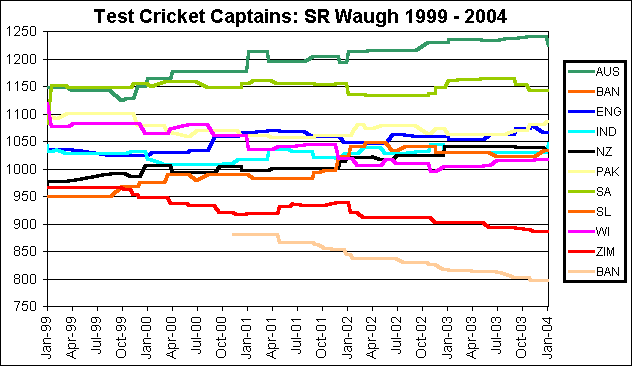
As the graph above shows, Waugh now leaves the scene to his successor, Ricky Ponting, with Australia on 1225 points, the eighth highest rating by any team in history.� Only time will tell if Ponting can take his team higher again, or if they will continue to hover below that mark or slide back to the rest of the field.
If the West Indian example is anything to go by, Ritchie Richardson was never able to eclipse Viv Richard's record, despite having ostensibly the same team. Can Ponting make a different future?
The latest Test cricket ratings are: 1. Australia (1225); 2. South Africa (1143); 3. Pakistan (1087); 4. England (1067); 5. India (1046); 6. New Zealand (1034); 7. Sri Lanka (1033); 8. West Indies (1017); 9. Zimbabwe (887); 10. Bangladesh (797).

