Subject:. Plains....................................... Unit: Social Studies grade 7......................................................
Lesson Title: Choker and Bracelet....................................................................................................
Date:................................................................... Time:...................................................................
Teacher’s Name: Barbara Derrick........................ Student Level: grade 7
INTRODUCTION
Motivation: Show the sample .......................................................................................................
.............. Show a authentic “breastplate”...................................................................................
.............. Compare the two samples, and talk about the hair pipe, bead and leather history........
REVIEW [5 minutes]
Questions: Has anyone made a beaded choker before? [bracelet]...............................................
.............. Has anyone made other Native projects before? If so, what did you make?.................
.............. Have you seen a breastplate before? Where?.............................................................
.............. Can you tell me what a breastplate would have been worn for in the past?..................
OVERVIEWObjectives: The student will learn the name of the beads, the differences between commercial and
Home tanned hide.........................................................................................................
The student will learn the origin of the choker, and the value of the choker.
.............. The student will be able to assemble a choker [bracelet].............................................
Subheading Goes Here
PRESENTATION [10 minutes]
Content:
1. History of Hair Pipe Bead
.............. There is archaeological evidence that has proven Native people used long, tubular beads of bone, shell, copper, and stone before the time of Columbus.
.............. The term “hair pipe’ came from the fur traders who supplied the Woodland and Plain Indians with the long conch shell ornaments for hair. Then tubular glass beads became popular among the Native people, perhaps because of the large array of colors.
2. Fur Trade
A North West Company trader, Alexander Mackenzie, crossed Canada to the Pacific Ocean in 1793. All of these explorers, as well as David Thompson and the Lewis and Clark Expedition, carried glass beads for presents and as a medium of exchange in dealing with the American Indians. [Mountain Man]
Bead prices varied with location, demand, and how bad Indians wanted a particular bead. When trading for beaver pelts, the Hudson's Bay Company used a standard value based on made beaver...a made beaver was stretched, dried, and ready for shipment. Records from early trading posts show a made beaver was worth: six Hudson's Bay beads; three light blue Padre (Crow) beads; two larger transparent blue beads. [Mountain Man]
Seed Beads:
Seed beads like those used on this deer skin bag reached the plains Indians in the mid-1840s.
The larger Crow and Pony beads were carried by Lewis and Clark and other early explorers. Crow and Pony beads were hung from, or attached to clothing and horse gear. [Mountain Man]
Did you know? During the fur trade…”Formerly four deer-skins was the price of a large conch shell bead, about the length and thickness of a man’s forefinger; which they fixed to the crown of their head, as an high ornament – so greatly they valued them.” [Adair, 1775, p.170.]
3. Historical Use of the Breastplate:
~ hair pipe beads were placed closed together to protect the wearer from flying shards or perhaps
An arrow
~ Acted as armour
4. Hair Pipe Breastplate
According to the John C. Ewers photographs indicated that 37 Plains tribes from 1867 to 1910 wore the Breastplates. One Woodland tribe ~ the Ojibway was photographed wearing one in 1911.
Pg 66 Crow Indians were not interested in the hair pipe breastplates. It has just been recent that young Crow Indians have worn these ornaments in the grass dance.
Men of the Blackfoot tribe showed little interest as well. The breastplates were worn in grass dance and other social dances. By the turn of the century [1900] The Hair pipe breastplate had been adopted the Indians of the Plateau tribes west of the Rockies by [demonstrated by photographs at the Smithsonian Institute]
4. Choker
“…no other illustrations of this ornament of hair pipes depicting its use prior to 1880”
“…the range of variation extends from 2 rows of 10 pipes to 4 rows of 37 pipes each.”
[Author states breastplate was not standardized]
Dentalium was supplied by fur traders, who referred to these shells as “Iroquois Beads”.
Other Jewelry [for other projects]
Hair-Pipe Ear Pendants
.............. “The less elaborate form of hair pipe ornaments were little worn during the reservation period. [Oglala, Pine Ridge]
.............. “At the Omaha Exposition of 1898 hair-pipe ear pendents were worn by 6 men – 2 Omaha, 1 Winnebago, Tonkawa, and 2 Santa Clara Pueblo Indians”.
Did you know? During the fur trade long hairpipes were 15 cents each, and the shorter ones were 10 cents each.
.............. The demand for hair pipes dwindled by the time WWI arrived.
.............. During Buffalo Bill’s Wild West Show there were 65 Sioux performers. Each had a breastplate.
.............. The Kiowa say that a well-made breastplate was then considered equal in value to a horse.
Hair Pipe Hair Ornaments
The wearing of hair pipe hair ornaments appears to have become nearly obsolete by 1880.
Hair Pipe Bandoliers
“Indian men also adopted the hair pipe necklace of several strands to use as a bandolier extending over one shoulder and under the opposite arm.”
Hair Pipe Necklaces
“In contrast with the breastplate, which was always a man’s ornament, the necklace of hair pipes continued to be worn by both men and women in the period 1880-1910. Of the tribes of Plains Indians known to have worn hair pipe necklaces in earlier days; photographic sources illustrate their use by Cheyenne, Crow, Kiowa, Mandan, Oglala, Osage, and Sauk and Fox after 1880. Among all these tribes except the Oglala the necklace is shown as a woman’s ornament”.
“My Assiniboin field data indicates that the hair pipe necklace was adopted by Assiniboin women prior to 1885, and from them it was diffused to the Piegan in Montana and Blood in Alberta through trade and/or gift about 1892”.
Method: LECTURE/DEMONSTRATION
Resources:
Smithsonian Institution Bureau American Ethnol. Hair Pipes in Plains Indian Adornment ~ A Study in Indian and White Ingenuity. John C. Ewers, 1957. Smithsonian Institution Libraries Electronic Edition. 18 Dec. 2007 http://www.sil.si.ed/DigitalCollection/BAE/Bulletin164/tptoc.htm
Man Indian Fur Trade Beads ~Mountain Man. Afton, Wyoming: O. Ned Eddins, n.d. 19 Dec. 2007 http://www.thefurtrapper.com/trade_beads.htm
EXERCISE [55 minutes]
Materials:.......................................................................................................................................
.............. 1. Tie a knot.....................................................................................................................
.............. 2. If splitting sinew ~ see and then do
Procedure:......................................................................................................................................
.............. 1. Insert needle into top ink mark on leather circle
.............. 2. Place the first row of bead directions on the white board
.............. ... a. Do first row together
.................. b. Place spacer on together
.................. c. Complete choker pattern by repeating Row #1
.............. 3. Demonstrate baseball stitch on the first leather tab
.............. 4. Students baseball stitch second leather tab on their own.
SUMMARY
Questions:......................................................................................................................................
...............1. There are [2] kinds of leather, what are they? And what are their differences?
.............. 2. What is the name of this bead?
.............. 3. What did the choker originate from?
.............. 4. And what was this item used for?
.............. 5. Where did leather come from?
.............. 6. What was the purpose of smoking home tanned leather?
.............. 7. How old are the leather jackets in the museums?
.............. 8. When did glass beads become popular?
EVALUATION
Quality Control discussed during the procedure
All students will go home with a finished choker or bracelet
MATERIALS AND SUPPLIES LIST
PROJECT: Choker or Bracelet
MODULE: Native Arts ~ Social Studies
For Choker
MATERIALS [Consumable] Tools
............. [16] Tube beads 1” inch............................... ...Glover’s needle size 5..............................
............. [64] ‘A’ Crow beads...................................... Fabric Scissors..........................................
............. [32] ‘B’ Crow beads...................................... Rotary Cutter...........................................
Leather: [3] spacers – 11/2” inches............................... Self Healing Board...................................
............. [2] tab ends – 11/2” inch circles.................. ...Ruler.........................................................
............. [2] leather lacing – ¼” x 6” inch.................. ....Plastic Bead Vial......................................
Sinew split in: [3] 24” inch............................................ Leather Punch..........................................
....................................................................................
....................................................................................
.................................................................................... Miscellaneous.........................................
.................................................................................... Sample.....................................................
.................................................................................... Container for beads.................................
.................................................................................... Pattern.....................................................
.................................................................................... Instructions...............................................
.................................................................................... Lesson Plan...............................................
....................................................................................
For Bracelet......................................
........................................................................... .........
............. [36] plastic Crow beads ~color ‘A’...............
............. [3 ] 1” inch hair pipe beads or....................
............. Spaghetti bead ~ color ‘B’....................
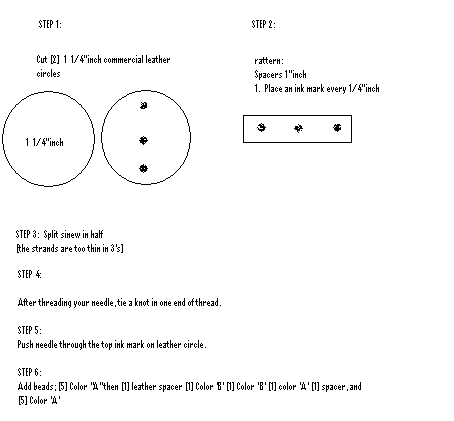
............. [2 ] leather circles ~ 11/4” inches...............
............. [2 ] leather spacers ~ 11/4” inches.............
PROCEDURE
BRACELET.....................................................................................................................................
QUALITY CONTROL
1. No ink marks
2. No visible knots or loose threads
3. Uniform length and width of spacers and lacing
4. Consistent pattern
5. beads taut not too tight or loose
6. Hide strips are cut evenly
7. Baseball stitch is correct even spacing of stitches (depth and width)
8. Tab ends match (same size and shape)
9. spacers are trimmed evenly with beads (corners rounded optional).....................................
......................................................................................................................................................
BRACELET
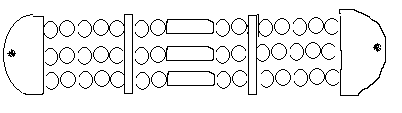
CHOKER

 BACK
BACK