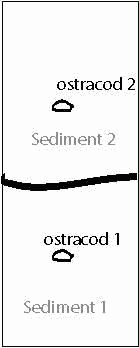
cartoon explaining the situation of the sample
Bioavailibility of lead in ostracods:
Previous results on others animals. Particularly the crustaceans
The metal sediment concentrations are not obligatory relevant, correlated with those of the waters of their deposit. For example, adsorption on organic material lead to an enrichment of metals in sediments. Indeed sediment deposition (and thus of metals) depend on hydrological fluctuating conditions. Finally sediments are not relevant of the available metals concentration (for example free metals) and thus don´t show directly the toxicity, the bioavailibility of metals in waters.
Studies have already measured metals in animals tissues (for invertebrates:(Rabitsch 1994; Rainbow 1995; Rainbow 1995; Ritterhoff and Zauke 1997). The different conclusions of this studies are:
the metal incorporation is specific to the metal
the metal incorporation is specific to the specie.
These two conditions and the fact that we can´t find always the specie require statisitic treatments (for example covariance between 2 species).
generally the incorporation is different between the tissues
generally different with the life of the animal.
Sampling must be absolutely monospecific, monosexual and monoage if possible.
The incorporation of metals in crustaceans is different between the species. Some crustaceans ( as the decapod Palaemon elegans) have constant metal concentration in their body in spite of an increase of metal concentration in water. Others like barnacles, amphipods and crabs show an increase of metal in the tissues with an increase of the metal in the waters.
The change in th salinity have a great influence on the complexation of metals with inorganic compounds. Thus the free metal (Cd, Zn) concentrations increase when the salinity decrease. The incorporation of the metal by decapod increase also when the salinity decrease.
There is no lead isotopes studies for aquatic animals like foraminifers or ostracods surely because of the quantity of material required for isotopes studies. But ostracods are already studied as statistic environmental bio-indicators. For example for metal pollution in a region particularly polluted since phoenician times see (Ruiz, Gonzalez-Regalado et al. 2000).
|
Case n° |
Conc. Sed. 1 |
Conc. Ostracod 1 |
Isotope Ratio Sed 1 |
Isotope Ratio Ostracod 1 |
Conc. Sed. 2 |
Conc. Ostracod 2 |
Isotope Ratio Sed 2 |
Isotope Ratio Ostracod 2 |
|
1 |
i |
í |
r |
´r |
|
|
|
|
|
2 |
i |
í |
r |
r |
|
|
|
|
|
3 |
i |
í |
r |
r |
i |
í |
r |
r |
|
4 |
i |
í |
r |
r |
i |
´j |
r |
r |
|
5 |
i |
í |
r |
r |
j |
´j |
r |
r |
|
6 |
i |
í |
r |
r |
j |
´j |
´r |
´r |
|
7 |
i |
í |
r |
r |
j |
í |
´r |
´r |
Differents cases of metal incorporation in sediments and ostracods
Case 1: Allochtonous ostracods or the measure in sediments is greatly influenced by the isotopic ratio of detritic apports ( in this case you could use the background concentration and ratio to know the real isotope ratio of the lead incorporated to the sediment from the water.
Case 2: Logical case with identical isotopic ratios.
Case 3: No change between two sampling.
Case 4: Change in the conditions of life of ostracods
Case 5: idem but with change in the conditions of life correlated with a change in sedimentation.
Case 6: contamination or stop of the contamination between two samples admitting that ostracods are good bioindicators.
Case 7: ostracods are not good bio-indicators
cartoon explaining the situation of the sample
Biblio.
Rabitsch, W. B. (1994). "Metal accumulation in arthropods near a lead/zinc smelter in arnoldstein, Austria. I." Environnmental pollution 90(2): 221-237.
Rainbow, P. S. (1995). "Biomonitoring of Heavy Metal Availibility in the Marine Environnement." Marine Pollution Bulletin 31(4-12): 183-192.
Rainbow, P. S. (1995). "Physiology, Physiochemistry and Metal Uptake- A Crustacean Perspective." Marine Pollution Bulletin 31(1-3): 55-59.
Ritterhoff, J. and G.-P. Zauke (1997). "Trace metals in field samples of zooplankton from the Farm Strait and the Greenland Sea." The Science of The Total Environnment 199: 255-270.
Ruiz, F., M. L. Gonzalez-Regalado, et al. (2000). "Comparative ecological analysis of the ostracods faunas from low- and high-polluted southwestern Spanish estuaries: a multivariate approach." Marine Micropaleontology 40: 345-376.