
|
|
|
|
|
|
|
|||||
| Former Prime Minister Michael Manley was elected on a non-IMF platform in 1976. He was forced to sign Jamaica's first loan agreement with the IMF in 1977 due to lack of viable alternatives-- a global pattern common throughout the Third World. At present Jamaica owes over $4.5 billion to the IMF, the World Bank and the Inter-American Development Bank (IADB) among other international lending agencies yet the meaningful development that these loans have "promised" has yet to manifest. In actuality the amount of foreign exchange that must be generated to meet interest payments and the structural adjustment policies which have been imposed with the loans have had a negative impact on the lives of the vast majority. The country is paying out increasingly more than it receives in total financial resources, and if benchmark conditionalities are not met, the structural adjustment program is made more stringent with each re negotiation. To improve balance of payments, devaluation (which raises the cost of foreign exchange), high interest rates (which raise the cost of credit), and wage guidelines (which effectively reduce the price of local labor) are prescribed. The IMF assumes that the combination of increased interest rates and cutbacks in government spending will shift resources from domestic consumption to private investment. It is further assumed that keeping the price of labor down will be an incentive for increasing employment and production. Increased unemployment, sweeping corruption, higher illiteracy, increased violence, prohibitive food costs, dilapidated hospitals, increased disparity between rich and poor characterize only part of the present day economic crisis. | |||||
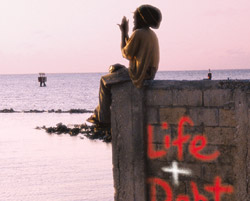
| Life & Debt aims to clarify the impact that IMF economic policies have on the day-to-day lives of the people they are said to benefit. The voting rights within the IMF are roughly proportionate to the contributions paid in by member nations. The breakdown of the democratic process becomes clear as the Jamaican people are removed from participation in the decisions that truly affect their lives. The IMF promotes an agenda of monetary austerity, currency devaluation, and lowering wages. The goal is to reduce inflation by balancing a nation's loan repayments and imports with its export earnings. The result is usually a recession. The World Bank takes a longer run perspective. It aims for structural adjustment, which means trying to transform a borrower nation's economy into a free- market economy. It typically proposes market deregulation, sometimes accompanied by new lending from the World Bank and private lenders. These policies are supposed to benefit Third World economies by integrating them into the global market. What actually happens is that Third World people suffer, while commercial banks in the North collect a great deal of interest. In Jamaica, only 5 percent of total money borrowed since 1977 has been able to stay inside the country. | |||||