
Good evening, all. Last night I decided on a whim to tune in to Outside The Lines Nightly on ESPN, and the topic last night was an interesting one, chronicling the ups and downs of the career of Tony Saunders, a former MLB pitcher.
World-Series Champion Florida Marlins. The early years of his career showed a lot of promise for the young man. Then, on May 26, 1999, he threw a single pitch that would change his life forever. He wound up and released, and he ball flew wildly into the backstop. Saunders collapsed in excruciating pain. Doctors determined that Saunders, a left-hander, had somehow snapped his humerus bone, which is the second
strongest bone in the body, running from the shoulder to the elbow. After nearly a year of rehabilitation and cautious progress, Saunders was pitching again. In mid summer 2000, Saunders, who was playing minor league ball and pitching well again, hit another heartbreaking road block. Pitching in a minor league game, a pitch flew wildly into the backstop, and Saunders collapsed in the same excruciating pain. He had again broken his humerus bone, a mere 15 months after breaking it the first time. Two days later, he announced his retirement from the game of baseball.
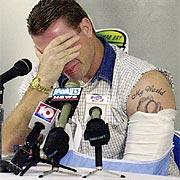
(AP Photo)
Looking back on my article from a couple days ago on heroes, I realize that here is a hero, a guy that has defied all odds, two year-plus-long periods of painful rehabilitation, and the painful memories of two separate incidents of a broken pitching arm. I would like to say now that I think this is the mark of a true hero, and I would like to wish him the best, and I would also like to wish him the best on behalf of Derek, who I'm sure agrees with me here. Best of luck, Tony.
Cheyne
*********************
Alright, since I've been gone awhile I have a double article for tonight, and furthermore, we may post the first Argumentative Face-Off in the history of GuysJawing within the next day or so. Patrick suggested a good topic, but you'll have to wait to find out just what that is.
The first part of my article tonight addresses Olympic basketball, and the US' feeble attempts to keep the best players in the nation on the court. With a heartbreaking loss last time around, something has to change, and the solution is clear. Look to the NCAA.
Imagine, one year ago, having a team representing our nation, the United States, that included Luol Deng, JJ Redick, Dee Brown, Devin Harris, possibly Dwayne Wade, possibly Carmelo Anthony, and possibly LeBron James. You may look here and see a group of inexperienced basketball players, but I see a group of young men who want to play basketball for the sake of playing basketball. Instead we sent over a group of guys like Carlos Boozer, who was basically the last guy to sign up except for myself and Derek, and I think the two of us could have given the US a better shot. The fact is, NBA players are in it for the money too often, and seeing the Dream Team dominate in '92 in Barcelona has our hopes too high, especially when those hopes are put on the shoulders of NBA players. Think back to the Dream Team and you see a group of people playing basketball for the sake of playing basketball: Jordan, Bird, Pippen, Kemp, etc. I would guarantee that if you rounded up 15 college guys and gave them the opportunity to represent the United States, the greatest country in the world, in the Olympics, 14 would immediately sign up, no questions asked.
Something to think about for 2008...
And now, part two.
Soccer crazies make up roughly 98% of the population in Spain these days, the remaining 2% being Americans who moved there. I will admit it though, I do not see soccer as the most exciting sport in the world, although the rest of the world does. My cousin, who lived in Spain for over a year, soon learned that the country shuts down on the day of a big match, such as Barcelona against Real Madrid. And Spain isn't the only country like this; Italy, England, France, they all shut down when their team is facing off with another team. Soccer riots frequently result in deaths. Deaths over a sporting match to some people suggests insanity, and to others, dedication.
And although I don't see it, soccer must be exciting to fill a stadium that has a 180,000 seat capacity, plus have people packed in the streets around the stadium just to catch the sound of the action. Back to the dedication, it's not uncommon to see families not speak to each other for days if they support opposing sides in a big match. Most importantly of all, apparently the craze is spreading stateside, as a good friend of mine tells me that the Mexico - USA match is supposed to be "very big" this time around.
Maybe I'll watch.
Cheyne
****************