Learn the
Art of Filipino Stick, Blade, and Empty-hand Combat!
Filipino
Self-Defense Lessons
Based
on the Cabales and Inayan Methods of Escrima
Serrada and
Kadena de Mano
Eskrima
A highly effective, often
brutal, Martial Art from the Phillipines.
Unlike most martial arts,
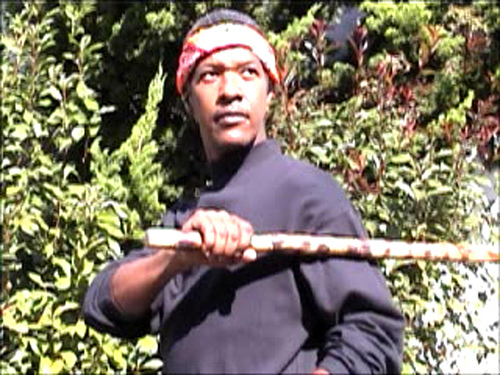
Escrima training begins with weapons, traditionally an 18”-24”
rattan stick, progressing to knives,m and finally empty-hands
combat.
Guro
Garry Bowlds
30-year
practitioner and teacher of the Cabales
and Inayan styles of Serrada
Escrima under Suro Mike Inay from 1976-1985. Also studied Shotokan
Karate, Tae Kwon Do, Silat, Thai Boxing, Wing Chun, Judo,
Jiu-jitsu, and Fencing
All
workshops, intensives and long-term study courses 70.Q
per hour.
20%
discount when
paid in advance ( min. 4 hrs)
50%
discount for
indigenous Guatamalans
Location:
Panajachel,
Guatemala
Available
for workshops
Specially designed for
the needs and busy schedules of the traveler. Available as one,
two, or four hour workshops, or multi-day intensives.
Private
or group lessons
Workshops
Self
Defense for Women
An empty-hand defense workshop created specifically for women
covering the application of grab releases, joint and body locks,
strikes, and take-downs. Based on the Filipino art of Kadena de
Mano.
Empty-hand
and Knife Defense
A more aggressive version of the above
workshop covering the same techniques, based on the Filipino
martial art of Kadena de Mano, using a wooden knife as the primary
training tool.
Filipino
Martial Arts Intensives
Cabales/Inayan
Serrada Eskrima
This is a longer, more in-depth
course in Filipino Martial Arts (FMA) designed to give the student
a firm foundation in the FMA which covers stick, knive and
empty-hand training in a short period of time.
Available from 1-day, 8-hour
intensives to one month, 1-2 hrs per day courses of study. Tailor
to fit your needs or travel schedule.
Long-Term
Course of Study
This
course is available for local
residents interested in a more
traditonal study into the Filipino martial arts. Each lesson is
one hour long, once or twice a week.
The
Filipino Martial Arts from rec.martial-arts
FAQ
Kali, Escrima, and Arnis are all terms for the native fighting
arts of the Philippines, specifically the arts that use weapons.
'Arnis' and 'Escrima' (or 'Eskrima') are words rooted in Spanish,
while 'Kali' shows up in various pre-Spanish Philipino dialects.
Some authorities say that Arnis is a term used in the northern
parts of Luzon Island, Escrima or Eskrima is used more commonly in
the middle parts of the Philippines, such as Cebu City, and Kali is
used in the southern island of Mindanao. Some of those who say that
Kali is the term for the southern styles claim that, since Mindanao
was never conquered by the Spanish to the extent that the rest of the
Philippines was, Kali more closely resembles the original pre-Spanish
arts of the area, and is more "complete" (covers more
combative possibilities).
There are also some who claim that the word Kali is part of a
modern attempt to marginalize the Spanish (and other European)
influence on Filipino martial arts, and some go so far as to refer to
Kali as a "Filipino-American" style.
However, most people tend to say that the words don't matter -
every village, and often every master, has a distinct style, and
that's what the important thing is - "do you study Illustrisimo,
Caballero, or Cabales style?" Not "do you study escrima or
kali?"
Origin:
The Phillipines
History:
Filipino martial arts are the result of the interaction of Spanish
and possibly Italian and other European styles of sword-fighting (cut
and thrust rather than fencing, probably) with the native arts that
existed at the time. Although the European influence is probably
mostly Spanish, there is some evidence of Italian and possibly other
European mercenaries present in the Phillippines, and they probably
used (and possibly taught) their own native fighting styles.
The most popular legend concerning the Filipino arts is that Datu
(Chief) Lapu Lapu killed the Spanish explorer Ferdinand Magellan in
personal combat.
Description:
There are many different styles of Filipino martial arts, but
general categories can be drawn along the lines of range. Largo Mano
styles tend to prefer staying at long distance from their opponents,
and using well-timed and placed strikes to the hands of their
opponents to disarm them. Corto or Serrada styles are the opposite,
tending to crowd into their opponents, where the opponent will
hopefully be uncomfortable and unprepared, while the Serrada
practitioner, by virtue of his practice, will feel at home at this
range. Other styles prefer the medio, or middle range, which is
between Largo Mano and Serrada. There are also styles, such as Lameco
Escrima, that address all three ranges. The name Lameco even comes
from these ranges; (La)rgo Mano, (Me)dio, and (Co)rto.
The different Filipino styles typically cover some (or all) of the
following areas: 1 Single Stick (or long blade) 2 Double long
weapon 3 Long & Short (sword & dagger, e.g.) 4 Single dagger
5 Double Dagger 6 Palm Stick/Double-end Dagger 7 Empty Hands
(punching, kicking, grappling) 8 Spear/Staff, long weapons
(two-handed) 9 Flexible weapons (whip, sarong, etc.) 10 Throwing
weapons 11 Projectile weapons (bows, blowguns) 12 Healing arts
A further distinction that some people make is that some Filipino
styles are, at their heart, blade arts, while others are designed to
work with sticks. There are some arts, such as Sayoc Kali, that focus
on the knife almost exclusively, while there are others, such as some
lineages of Balintawak Eskrima, that focus almost entirely on the
single stick. This focus in certain lineages or styles may be the
origin of the notion that Kali is more "complete" than
Arnis or Escrima. However, this is a matter of some contention.
A distinctive feature of all of these Filipino arts is their use
of geometry. In strikes/defenses and movement, lines and angles are
very important. In addition, the independent use of the hands, or
hands and feet, to do two different things at the same time, is a
high-level skill sought after a fair amount of experience.
Training:
Filipino styles normally classify attacks not by their weapon, or
their delivery style, but by the direction of their energy - for
example, a strike to the head is usually analyzed in terms of "a
high lateral strike." A punch to the gut is treated much the
same as a straight knife thrust to that region would be. Students
learn how to deal with the energy of the attack, and then apply that
knowledge to the slight variations that come with different lengths
and types of weapons.
Filipino arts place great emphasis on footwork, mobility, and body
positioning. The same concepts (of angles of attack, deflections,
traps, passes, etc.) are applied to similar situations at different
ranges, making the understanding of ranges and how to bridge them
very important. The Filipinos make extensive use of geometric shapes,
superimposing them on a combat situation, and movement patterns, to
teach fighters to use their position and their movement to best
advantage. Some styles emphasize line-cutting (a la Wing Chun), while
some are very circular (like Aikido). Some like to stay at long
range, some will move inside as soon as possible. These differences
are hotly debated, as are most things, but they all work differently
for different people.
Most Filipino arts stress the importance of disarming an opponent
in combat. This is not usually done gently, or by using a complex
disarm (although these are taught), but by "destroying" the
hand holding the attacking weapon using your weapon (break the hand,
and the stick will fall.) This is often referred to as "de-fanging
the snake", since a poisonous snake that has no fangs cannot
harm you.
Sub-Styles:
Latosa Escrima, Serrada Escrima, Dumog, Panandiakman, Panantukan,
Sikaran, Balintawak Eskrima, Modern Arnis, Garimot Arnis,
Inosanto/LaCoste Kali, Sayoc Kali, Doce Pares, Pekiti-Tirsia Kali,
many more.