


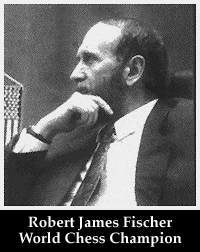

Bobby Fischer was born on March 9, 1943 in Chicago, Illinois to Regina Wender Fischer Pustan (born in Switzerland of Jewish parents on March 31, 1913) and Hans-Gerhardt Fischer. His father was a German bio-physicist from Berlin and his mother was a riveter in a defense plant at the time. She later became a grade school teacher, a registered nurse, a physician (she first entered medical school in the Moscow in 1933 but did not complete her medical degree), and completed a Ph.D in hematology. She went on to doing pro bono medical work for the poor in Cental America and South America.
In 1945 Hans-Gerhardt Fischer leaves the Fischer family and divorces Regina. Bobby Fischer never met his father. Regina had custody of Bobby and his older sister, Joan Fischer Targ (born in Moscow in 1938 and died on June 2, 1998 in Portala Valley, California of a cerebral hemorrhage).
In 1948 they moved to Mobile, Arizona.
In 1949 they moved to Brooklyn, New York where Regina worked as an elementary school teacher and nurse at Prospect Heights Hospital in Brooklyn. Regina moved to Brooklyn (500 Lincoln Place) to get her master's degree in nursing.
In May 1949, Bobby 9 (age 6) and Joan (age 11) learned how to play chess from instructions found in a chess set that Joan bought at a candy store below their apartment. Bobby saw his first chess book a month later. For over a year Bobby played chess on his own.
On November 14, 1950 his mother sent a postcard to the chess column of the Brooklyn Eagle, edited by Herman Helms, looking for chess opponents for Bobby. He replied and suggested that Bobby go to a chess exhibition at the Grand Army Plaza Library.
On January 17, 1951 Bobby played a game against master Max Pavey (1918-1957) who was giving a simultaneous exhibition. Bobby lost in 15 minutes. Max Pavey's 1950 USCF rating was 2442 (#15 in the US). Watching in the crowd was Carmine Nigro, Secretary and President of the Brooklyn Chess Club. After the game, Carmine went up to Bobby and invited him to join his club. Carmine Nigro had been an accomplished band leader in the 1940s and was a stockbroker before becoming a teaching golf pro.
A few weeks later Bobby joined the Brooklyn Chess Club, headed by Carmine Nigro. Bobby showed up and played chess at the Brooklyn Chess Club almost every Friday night. Bobby later started playing chess at Nigro's house on the weekends and often went with him to play chess at Washington Square Park. Carmine Nigro was Bobby Fischer's only chess instructor.
In 1952 Bobby played in his first chess tournament at the Nigro home, winning his match.
In 1953 Bobby was playing at the Brooklyn Central YMCA. In February 1953, Bobby played in his first organized tournament, the Brooklyn Chess Club championship, and tied for 3rd-5th place.
In 1954 Bobby was playing a lot of chess at the Brooklyn Chess Club and Brooklyn YMCA. He was exposed to international chess when he watched the USA-USSR chess match every day at the Hotel Roosevelt in Manhattan. In December, 1954 he again took 3rd-5th place at the Brooklyn Chess Club.
In 1955 Bobby score 4 1/2 - 3 1/2 in a Washington Square Park Swiss tournament. In May he scored 3 points (out of 7) in the U.S. Amateur Championship in Lake Mohegan, New York. Carmine Nigro took him to the event. Fischer only wanted to watch, but was persuaded to play by Nigro. He joined the Manhattan chess club in June, 1955 and soon won the class C championship and the class B championship. In July he won 2 games, drew 6 games, and lost 2 games at the U.S. Junior Championship in Lincoln, Nebraska. He took 3rd place in the U.S. Junior Speed Championship.
In January 1956, Bobby won the class B prize of the Greater New York City Open. He was a member of the New Jersey Log Cabin Chess Club. In March 1956, Bobby travelled with the Log Cabin Chess Club to Cuba and even gave a simultaneous exhibition at the Capablanca Chess Club. His U.S. Chess Federation rating was published at 1726. In April he won the class A championship at the Manhattan Chess Club. In May he played in the U.S. Amateur Championship in Ashbury Park, New Jersey, winning 3 games, drawing 2, and losing 1 game. At 13, he was the youngest player in the event. In June he joined the Hawthorne Chess Club, which was at the home of Jack Collins. Fischer's chess instructor, Carmin Nigro, moved to Miami to become a professional golf instructor. In July he took first place at the U.S. Junior Championship in Philadelphia with 8 wins, 1 draw, and 1 loss. His USCF rating in the event was 1830. At 13 years and 4 months, he was the youngest player to win the U.S. Junior Championship. He won a typewriter for his efforts. A few weeks later he played in the 57th U.S. Open in Oklahoma City, winning 5 games, drawing 7 games and tied for 4th-8th place. In September he tied for 8th place at the Canadian Open in Montreal. In October he took 8th place in the Rosenwald tournament in New York. His win against David Byrne won the brilliancy prize and has been called the game of the century. In November he tied for 2nd-5th place in the Eastern States Open in Washington, D.C. In December Bobby won the rapid transit play at the Manhattan Chess Club and took 4th place in the Manhattan Chess Club Championship.
In March 1957, Bobby played two games against former world champion Max Euwe in New York, drawing one and losing one. In April he won the New York Metropolitan Chess League. In July he tied for 6th place at the New Western Open in Milwaukee, Wisconsin. A few days later he played in the U.S. Junior Championship in San Francisco and took first place and another typewriter. He also won the U.S. Junior Speed Championship. In August he tied for 1st-2nd at the 58th U.S. Open in Cleveland and won $750. His official USCF rating put him at 2231, making him the youngest player in the United States with a master's rating at that time, at age 14 years and 5 months. In September he won the New Jersey Open championship. In December he won the North Central Open in Milwaukee.
On January 10, 1958 Bobby Fischer at age 14 years and 9 months won the 1957/58 U.S. Championship and Zonal with 8 wins, 5 draws and no losses. His USCF rating climbed to 2626. Except for Santa Monica 1966, Bobby Fischer would win every U.S. tournament he played in. In May he appeared on the television show I'VE GOT A SECRET and stumped the panel (his secret was that he was U.S. chess champion). In August he took 5th-6th at the Portoroz Interzonal and gained the Grandmaster title. At the same time he became the world's youngest Candidate for the world championship at age 15 years, 6 months.
In 1958, with the help of John. W. Collins, Bobby wrote "Bobby Fischer's Games of Chess."
In January 1959, Bobby Fischer again won the U.S. Championship with 6 wins and 5 draws. He attended Erasmus High School in Brooklyn with Barbera (later changed to Barbra) Streisand and they were good friends. Bobby later dropped out of school to become a professional chess player. Fischer's academic records indicated an I.Q. of 180 with an incredibly retentive memory.
In April 1959 he took 3rd-4th at Mar del Plata, Argentina. In May he took 3rd-4th at Zurich, Switzerland behind Tal and Gligoric, with 8 wins, 5 draws, and 2 losses. In September he took 5th-6th at the Bled/Zagrev/Belgrade Candidates tournament, won by Mikhail Tal. Fischer's USCF rating was 2636, behind Reshevsky's 2693 rating.
In January 1960, Fischer again won the U.S. Championship with 7 wins, 4 draws, and no losses. In April he tied for 1st-2nd with Boris Spassky at Mar del Plata, Argentina. He did poorly in Buenos Aires in August, then took first place at Reykjavik, Iceland in October. In November he played board 1 for the United States at the Chess Olympiad in Leipzig, winning 10 games, drawing 6, and losing 2. His USCF rating was 2641.
In January 1961, Bobby again won the U.S. Championship with 7 wins, 4 draws, and no losses. In July he started a match with Sam Reshevsky and tied it with 2 wins, 7 draws, and 2 losses before negotiations broke down to continue the match over the playing schedule and time of the start of each game. In August Bobby gave a controversial interview with Ralph Ginzburg for HARPERS magazine. In October, he took 2nd at the Alekhine Memorial in Bled, Yugoslavia, behind Tal. Fischer led the USCF rating list with 2660.
In 1962 Bobby joined the Worldwide Church of God. In March he won the Interzonal in Stockholm with 13 wins, 9 draws, and no losses. This was the first interzonal that a Soviet player did not take first place. In May he took 4th place at the Curacao Candidates tournament, won by Petrosian. He later accused the Russians of cheating in this event and that interview was published in SPORTS ILLUSTRATED. In October he played Board 1 for the United States at the Chess Olympiad in Varna, Germany and scored 8 wins, 6 draws, and 3 losses. His USCF rating was 2687.
In January 1963, Bobby won the U.S. Championship with 6 wins, 4 draws, and 1 loss (to Edmar Mednis). He announced he was boycotting FIDE tournaments until the Russians stopped fixing chess. In July he won the Western Open in Bay City, Michigan. In September he won the New York State Open with a perfect score of 7 wins, no draws, no losses. In November he was to play 400 opponents at once in an exhibition, but was postponed because of President Kennedy's assasination and a fire at the Astor hotel where the event was to have taken place. His USCF rating was 2685.
On January 1, 1964, Bobby Fischer won the U.S. Championship with a perfect score of 11 wins. He than began a nationwide simultaneous exhibition for the rest of the year. The first international rating list was published by Arpad Elo in 1964. The top two players were Fischer and Petrosian at 2690. His USCF rating was 2734.
In 1965 Frank Brady publishes Profile of a Prodigy, a biography of Bobby Fischer. Fisher never talks to Brady again.
In August 1965, Bobby participated in the 4th Capablanca Memorial in Cuba by playing through a teletype machine at the Marshall Chess Club in New York. He tied for 2nd-4th with 12 wins, 6 draws, and 3 losses. The United States did not have diplomatic relations with Cuba, and the State Department would not authorize him to travel to Havana. Fischer thus had to play by teletype and the Cuban government paid for the services.
In December he won the U.S. Chess Championship with 8 wins, 1 draw, and 2 losses. Fischer's USCF rating climbed to 2734.
In July 1966, Bobby took 2nd place at the Piatigorsky Cup in Santa Monica, behind Spassky. Over 1,000 people watched his game with Boris Spassky, the largest audience for a chess game in U.S. history. In November he played Board 1 for the U.S. at the 17th Chess Olympiad in Havana, scoring 14 wins, 2 draws, and 1 loss. In December he won the U.S. Championship with 8 wins, 3 draws, and no losses. This was his 8th U.S. Championship title.
In 1966, Bobby's mother started her medical school degree in the Freidrich Schiller University in East Germany. She completed her medical degree two years later, at the age of 55.
In April 1967, Fischer took 1st place at Monaco. In August he won at Skopje, Yugoslavia. In October he participated in the Sousse Interzonal, but withdrew after leading the event with 7 wins and 3 draws. His USCF rating was 2762.
In 1968 Bobby moved to Los Angeles and followed the Worldwide Church of God. In July he took 1st place at Netanya, Israel. In September he took 1st place at Vinkovci, Yugoslavia.
In 1969 Bobby finished his book, MY 60 MEMORABLE GAMES. He played Board 1 in a New York Metropolitan League and won.
In April 1970, he played Board 2 in the USSR vs REST OF THE WORLD match in Belgrade, beating Petrosian with 2 wins and 2 draws. He then went on to Herceg Novi, Yugoslavia and won the unofficial world 5-minute championship with 17 wins, 4 draws, and 1 loss. After the tournament he called off from memory all of the moves from his 22 games, involving over 1,000 moves. In May he took 1st at Rovinj/Zagreb. In August he took 1st place at Buenos Aires. In September he played Board 1 for the U.S. at the 19th Olympiad in Siegen, Switzerland. In November, Pal Benko gave up his spot at the Palma de Mallorca Interzonal so that Fischer could play. Bobby won the event with 15 wins, 7 draws, and 1 loss. Fischer won the chess oscar for 1970, 1971, and 1972.
In June 1971, Bobby Fischer defeated Mark Taimanov with 6 wins, no draws, no losses in the Candidates quarterfinals in Vancouver, Canada. In July he defeated Bent Larsen also with a perfect 6-0 score in the Candidates semi-final in Denver, Colorado. His performance rating was 3060. In August Bobby won the Manhattan Chess Club 5-minute blitz with 21 wins and 1 draw. In September, Bobby defeated Tigran Petrosian with 5 wins, 3 draws, and 1 loss in Buenos Aires for the Candidates finals. He now became challenger for the world championship. His USCF rating was at its peak of 2825.
In January 1972 Bobby appeared on the Dick Cavett show and talked about chess.
On July 11, 1972 he began his match with Boris Spassky in Reykjavik, Iceland for the world championship. On September 1, 1972 Bobby became world champion after winning 7 games, drawing 11 games, and losing 3 games (one on forfeit). Fischer received $160,00 for his efforts and another $40,000 in royalties. President Nixon sent him a telegram congratulating him for his fine efforts.
In 1972 Frank Brady write a new edition of Profile of a Prodigy.
Bobby Fischer's last published USCF rating was 2810. His FIDE rating was 2785.
In 1973 Bobby moved to Los Angeles. His mother Regina sent him her Social Security checks to survive on.
On April 3, 1975 Bobby Fischer forfeited his title as world chess champion to Anatoly Karpov without playing a single chess game since winning the world championship. Fischer had been living in an apartment in South Pasadena owned by the Worldwide Church of God since the world championship.
In 1977 Bobby played three games against the MIT Greenblatt computer program. He turned down $250,000 to play one chess game at Caesar's Palace in Las Vegas and $3 million to play in a tournament in the Philippines.
In 1978 Bobby Fischer filed a $3.2 million lawsuit against the publishers of a magazine critical of the Worldwide Church of God. He claimed the writers taped his conversations without his consent. He then accused the church of reneging on their promise to finance the lawsuit.
On May 26, 1981, Fischer was arrested in Pasadena under suspicion of a bank robber. He was stopped by a police officer who said he fit the description of a bank robber. Fischer refused to answer some questions as he was arrested.
In 1982 Fischer published, "I WAS TORTURED IN THE PASADENA JAILHOUSE." He used the pseudonym Robert James.
In 1984 Bobby Fischer wrote to the editors of the Encyclopedia Judaica requesting his name be removed from their encyclopedia. He claimed he was not a Jew and had never been circumcised.
In 1987 the House of Representatives passed House Resolution Bill 545 recognizing Bobby Fischer as the world chess champion.
In 1988 Bobby patented the Fischer digital chess clock which adds 2 minutes per move.
In 1991 Bill Wall delivered to Bobby Fischer, via Joan Targ, a large number of chess magazines and chess books provided to him by International Master John Donaldson and some members of the Palo Alto Chess Club. Every issue of Inside Chess by Yasser Seirawan was included.
On August 21, 1992 the Department of the Treasury ordered Bobby Fischer to cease and desist his activities in the planning of a chess match in Yugoslavia. He was subject to the prohibitions under Executive Order 12810, signed by George Bush on June 5, 1992, imposing sanctions against Serbia and Montenegro.
On September 1, 1992, Bobby Fischer came out of his 20 year retirement and gave a press conference in Yugoslavia. He pulled out an order from the U.S. Treasury Department warning him that he would be violating U.N. sanctions if he played chess in Yugoslavia. He spit on the order and now faces 10 years in prison and a $250,000 fine if he returns to the U.S. In addition, he most forfeit his $3.65 million to the U.S. Treasury and forefeit 10% of any match royalties earned. On September 30, Bobby Fischer began his re-match with Boris Spassky in Sveti Stefan (Montenagro), Yugoslavia. The match was organized by banker Jedzimir Vasiljevic. On November 11, Fischer won the match with 10 wins, 5 losses, and 15 draws. He received $3.65 million for his winnings and Spassky received $1.5 million. The match used the new Bobby Fischer chess clock. Fischer's 2nd during the match was Eugene Torre of the Philippines.
On December 15, 1992 the State Department indicted Bobby Fischer for violating Title 50, US Code 1701, 1702, and 1705 and Executive Order 12810. The crime was performing a contract in support of a commercial project in a banned country (Federal Republic of Yugoslavia). He was ordered to be arrested by any U.S. Marshall or any authorized agent.
In 1993 the movie, "Searching for Bobby Fischer," was released.
In 1996 Bobby travelled to Argentina to promote his random chess (Fischerandomchess), where you set up the pieces in a random manner. This would take away the book knowledge of regular chess.
The President of FIDE offered Fischer $100,000 and a piece of land in the Kalmyk Republic in redress for copyright violations by former Soviet publishers.
On July 27, 1997 Bobby Fischer's mother died in Palo Alto, California. She was 84.
On June 2, 1998, Bobby Fischer's only sister, Joan Fischer Targ, died of a cerebral hemorrhage at the age of 60. She lived in Portola Valley, California and was married to Stanford physicist Russell Targ.
In 1998 all of Bobby Fischer's valuables and belongings kept at the Bekins Moving and Storage Company in Pasadena, California were sold when the storage bill was not paid by Bob Ellsworth of Pasadena, who was supposed to pay his bills.
On January 13, 1999 Fischer granted a live radio interview to a radio station in Budapest, Hungary. It was the first of over 20 radio interviews he would make in the next 3 years. On January 14, 1999 Fischer granted an interview to Baguio Radio in the Philippines. He accused the Jewish community of conspiring against him and denied the holocaust of the Nazis. He has since made 9 interviews over the radio.
Fischer was living in Budapest in the 1990s. He has been frequented by the Polgar family and Grandmaster Peter Leko.
In 2000 Fischer traveled to the Philippines and stayed with Phillipine Grandmaster Eugene Torre.
On September 11, 2001, Bobby Fischer spoke on Philippine radio (Radio Bomba) while in Japan, applauding the New York terrorist and Pentagon attacks. On October 28, 2001 the US Chess Federation put out a newsletter disassociating itself from the remarks of Fischer about the terrorist actions and threatening to revoke his USCF membership.
In 2002, it was reported that Bobby Fischer was living in Japan working on a new chess clock. He had peviously visited Germany, Hungary, Hing Kong, and the Philippines.
In May, 2002 Frank Dudley Berry, Jr posts an Internet article in ChessCafe entitled, "Was Fischer's mother a Communist Spy?" He implies that Bobby Fisher's mother was a comunist spy and that his father may have been a leading German spy.