Past questions and answers
I hope you can help me. I have a Tennesee Walking Horse who was ridden English by his previous owners. When I bought him, I bought his bridle too. I ride him with my Western saddle, and his English bridle. We have done well together for years. I want to get a new saddle, with a matching Western bridle. Are nosebands and cavessons the same thing? What can I use with his new bridle? I'm afraid not to use what he is used to, because I don't want any problems with him. Any help would be appreciated.
Thanks,
Urban Cowgirl
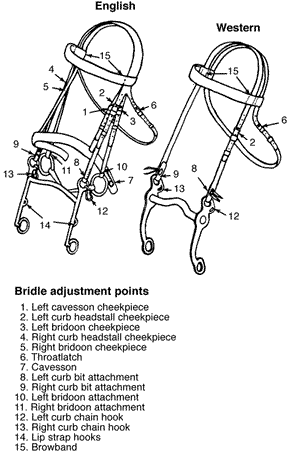
Nosebands and cavessons are pretty much the same thing, but maybe not exactly. A noseband is anything that goes over or around the horse's nose. A cavesson is a specific type of noseband, intended to keep the horse's mouth closed.
Cavessons are required in English classes at horse shows, and forbidden in Western classes. If you are a trail rider, that is not important.
A cavesson actually has little to do with control. Once in a while, a horse will open his mouth to escape the bit. In this case, a cavesson will aid in control, but the rider really needs to find out why the horse is so uncomfortable that he is gaping.
It is always a good idea to try out any new equipment in a contained area (like a riding ring) just in case there are any problems or adjustments to be made.
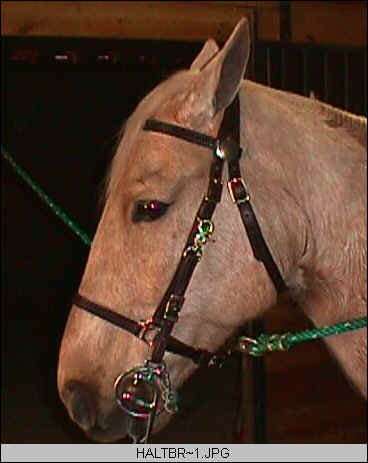
The most important thing about a bridle is how it fits. The bit should be the right width for the mouth, with a comfortable mouthpiece. The headstall must be ajusted to the right length so the bit sits comfortably in the right spot in the mouth. The browband should be wide enough to avoid pinching the ears, and the throatlatch needs to be loose enough to let us breathe! IF there is a cavesson, it needs to be adjusted high enough on the nose to avoid cutting off air, and low enough to avoid rubbing the cheek bones. Two finger widths below the cheekbones is about right in most cases.
My suggestion is to put the old bridle on, and look carefully at the adjustments. Then, put the old bit on the new bridle, and adjust it so it looks the same. Chances are, your horse will be perfectly happy with his new duds!

I have a 10 year old QH mare, and I'm having trouble getting her into the trailer. I've tried tempting her with grain, turning her in circles if she won't go in, tapping her with a whip, snapping the whip behind her, tying her to the trailer, and pulling. Nothing works. I got her in once, a few weeks ago, but not since. She injured her legs when she was shipped to Minnesota from Montana by her previous owner, so I think she is afraid she will be hurt again. I don't own my own trailer, so I can only practice when others will let me use their trailers. I'm almost ready to give up. What can I do?
Thanks,
Stranded
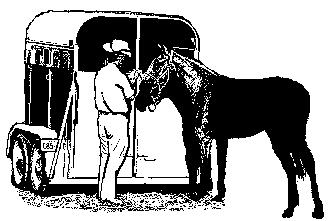
Do what you can to make the trailer less scary. Is the roof high enough? There should be some clearance for the ears at normal head height. The horse should not have to duck. Is the inside light or dark? If you owned your own trailer, I would suggest painting it a light color inside. As it is, open all the doors and windows that you can to make it as bright and open as possible.
Is there a divider? A solid divider, that goes all the way to the floor can make it hard to stay upright. Many of us need to spread our legs out to brace in the trailer. Take the partition OUT if you can, or if it swings, swing the rear end out as far as you can. A partial partition can be a good thing, keeping each horse in his own space, but you need all the room you can get while teaching your horse that trailers aren't so bad.
Food in the trailer is a good thing. However, if she is really scared, she will be too afraid to eat. When he starts munching his hay in the trailer, you'll know she is starting to relax.
What about a friend? Is there a quiet friendly horse to set a good example? Some horses are less afraid if another horse is already in the trailer, and happy about it.
Finally, lets talk about your driving. Once she is in the trailer, how do you drive? Do you start and stop slowly and smoothly? Do you corner easily? Do you slow down a LOT on rough roads? A rough ride can make a horse reluctant to get back in!
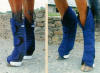
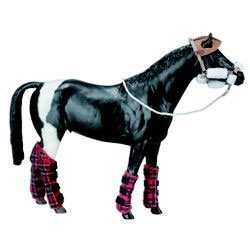
Let's talk protection here too. A horse that bangs her head isn't going to want to go near that low ceiling. Head bumpers are a good investment for head tossers, and a safety precaution for any horse. Shipping boots are some of the best protection you can give your horse. Legs have no muscle or fat to pad them, so a little padding can go along way towards preventing trailer injuries. A lot of people use blankets or sheets in trailers. They can be useful if the trailer is drafty, but are really not neccessary.
Start away from the trailer. Will your horse walk forward with you without you pulling on her? Can you lead her over a sheet of plywood on the ground or a tarp? What about under a low doorway? Will she move forward when she is touched on the hip with a whip or at a clucking sound alone?
Practice until you can do all these things.
Now, tie her to the back of the trailer, with the door shut and let her see you put her grain inside the front of the trailer. Go and clean stalls or something for about 20 minutes, and just let her stand there and look at it.
When you come back, lead her away from the trailer, and do a quick review on the leading basics, especially moving forward on cue. If you have help, have them open the back of the trailer. Fix it so it won't swing shut. You won't be shutting it today.
Lead your horse up to the back of the trailer with CONFIDENCE. Many horses step right up at this point. If she wants to stop, that's ok. Now, the rules.
1)Horses do not go backwards unless asked.
2)Horses ALWAYS look into the trailer.
3) Horses always move forward when asked (but sometimes it is only 1/4 inch).
4) We have ALL DAY.
Whenever the horse stops, let her stand and look for at least 5 minutes. Use a watch, it's a lot longer than you think. Let her sniff the trailer if she wants to, but no grazing. The goodies are IN the trailer. Cluck, or touch with the whip to ask her to move forward. Remember, any amount is ok. You may have to tap a leg to get it to move forward. Wait. . then ask again. It may take hours. When you get one foot in the trailer, give her a small treat and ask her to back out. Start over. It will go faster this time. When she goes right up and puts one foot in, start to ask for two feet before you treat and back her out. At some point, she will get tired of all the malarky, and jump in to eat the grain. Let her have some, then back out and try again. Do not try closing the door, until she will jump in and stand still until you tell her to back out.
This method takes time, but in the end, you will have a horse that loads politely on command, and is relaxed in the trailer.

We have an 8 year old mare that we are training to be ridden. She had a couple of bad experiences with trainers when she was younger, also she is the Alpha of our herd. Lately, she has become more cooperative,so we decided to try again. She is cooperative in the round pen, and we have been able to ride her there. We took her into a pasture to ride and she would not cooperate at all. She went forward, but only with lots of coaxing. Mostly, she just wanted to graze. She used to live in this pasture. We would really like to ride her. Any suggestions?
Afoot
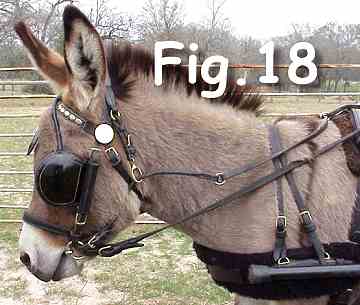
Now, suddenly, people want her do DO things. People want her to walk right past all this good grass, without stopping to snack.
The good news is that she isn't violent, no bucking or kicking. The bad news is that you're not getting very far on a horse that won't move.
The first thing to do, is to explain the new rules to her. Working in a round pen is a good start. What about walking through the same pasture, on a lead rope. . without stopping for a snack?
Train voice cues. You can do this on a lead rope. Say walk, in a clear tone. You want her to step out on the word, not wait for you to walk. You can use a dressage or driving whip to tap her hindquarters to show her what you want. When she steps forward, say "yes" or "good" and hand her a bit of carrot. You can use a clicker instead of the marker word if you wish. Then say whoa, and stop. Again, mark and reward the behavior. You can also do this exercise on a lunge line, but you need to get out on the grass as soon as the horse understands the cues. Once this is going well, put a rider up, and repeat the exercise, on bare ground or the round pen first, then in the pasture. The third step is to have the rider cue, and reward. Step 4 is to take the lead rope off, and gradually fade the walker.
You can use the same steps with trotting, or you can wait until the walk is solid to add the trot.
Take your time with these steps, they will help her adjust to the new rules of her life.
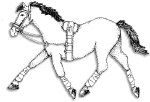
I work horses a lot in long lines. You can line a horse in a round pen, and be sure to teach the horse voice commands. A horse should know walk, trot, and whoa, at least, before leaving the round pen. I also like a horse to go onto the bit fairly consistantly, and turning and stopping reliably from the lines.
You can take a horse out of the round pen in the lines too. Work the horse on grass. Walk around the pasture, in the lines. If you can't keep her head up, you can use side reins, or a check rein until she learns that work time, and grazing time are not the same thing.
When you have reliable ground driving, on grass, and in your fields, then you can go back to riding.
Other things that may help your mare.
1) Pony her from another horse. The good example often has a positive effect.
2) Ride in company with other horses. Horses are herd animals, and will often cooperate on the monkey see, monkey do principle.
3) Find a riding ring to ride in. Using an area larger than a round pen, but not a grass pasture may be a good intermediate step.
4) Learn to untrack a horse. If she stops, and won't move, instead of more kicks, use a low, leading rein to turn the horse a couple of steps. Often, once those first few steps are taken, the horse will just keep walking.

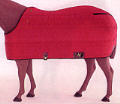
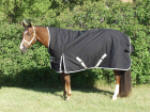
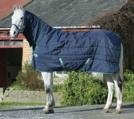
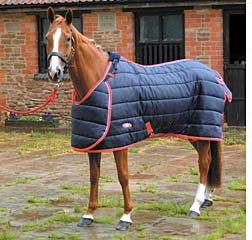
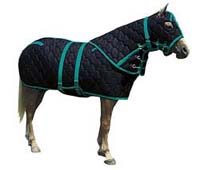
Our new horse had his new blanket only one day before he ripped it up. I want to get him the right kind, one that will be comfortable and safe for him. What should I look for?
Shivering
Now, about comfort, fit is the key. Blankets are sized in 2 inch increments, except for some of the European styles, which come in 3 inch increments. Measure your horse, from the center of his chest around his side, to his tail. This is his basic size. If he is more than 1/2 inch larger than a size, get the next bigger one. Some brands tend to run big, and others tend to run small. You can try a new blanket on a clean horse by covering him with a sheet and putting the blanket on over that.
Things to look for. First, and most critical, does it bind at the shoulders? If it does, it may be too small, which you will see, or too large, causing it to shift and bind. Is the neck opening the correct size? Some are designed to sit in front of the withers, others are cut back to sit behind the withers. A blanket neck edge should never sit ON the withers, this will hurt. Next check the length of the back. It should come to the base of the tail, or less than one inch over the tail, not including a tail flap if it has one. Many blankets have darts, and shaped backs to make them fit better. This is great if your horse is the same shape as the blanket, if not, they may be in the wrong places for your horse. If so, try another brand, as manufacturers tend to use the same pattern for most of their blankets.
Consider the drop. This is how far the blanket falls down the side of your horse. A very round horse will need a longer drop than a very narrow horse, simply because his barrel takes up some of the fabric. The American cut is what most of us are used to seeing. A European cut blanket has a longer drop. It is also usually less fitted, and often does not have a seam along the back.
Bindings and leg straps need to fit too. Surcingles should be adjusted so that you can get your hand in flat, under the surcingle. This keeps us from getting a leg caught in it, but allow some give as we move or lie down. Leg straps should have some play in them, but not hang down near the hock. A leg strap caught over a hock is really annoying, and an invitation to kick. I like my leg straps linked, one through the other so they do not rub on my sensitive inner thighs.
Finally, be sure not to over blanket. If we get hot, we will try to take the blanket off, and maybe get tangled in it. If we can't get it off, we will get sweaty, and damp, and then chilled.
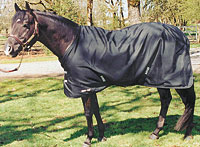
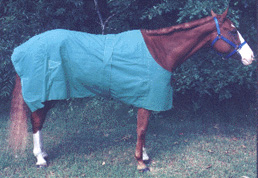
First, we have a stable sheet. In the winter, you might use one of these to keep the horse clean but it provides effectively no warmth by itself. The reason is that the sheet flattens the coat, destroying the natural insulation. They are useful to use as a base layer, if you layer blankets, as they wash easily, or to put over a blanket liner to hold it in place.
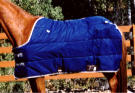
Second, we have a stable blanket. Lots of people use these. They are terriffic if your hors is mainly stabled, and goes out alone or in a small group only a few hours a day. They are usually not waterproof, nor are they generally sturdy enough to take the wear and tear caused by lots of horseplay.
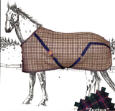
Third, we come to the turnout rug. They are traditionally made of waxed or oiled canvas, but modern turnout rugs are often Cordura or Gore-tex. They are much sturdier, and waterproofed. They come in a variety of weights with different amounts of insulation. The unlined versions may be listed as turnout sheets. Horses living outside with a shelter, or turned out in large groups will do better in a turnout rug.
Most blankets are designed to have the neck edge in front of the withers. These often are padded with fleece over the top of the neck. Some, mainly those designed for pleasure type horses, have cutbacks, to spare the mane the small amount of rubbing. Some also come with adjustable necks, which are very helpful, especially on a horse with a long shoulder.
Blankets come with different chests too. The traditional blanket has one or two buckles, or t- closures. These are somewhat adjustable, but can break, slip, or bind. Many blankets are now made with closed fronts. These blankets are less drafty, but less adjustable, and must go on and off over the head. Some horses find this frightening. Finally, there are the new systems, such as the Hug closure. This one wraps across the chest and fastens on the side with elastic set into the closure. This is warm, adjustable, and flexible for the horse.
Many blankets are now being made with high necks. Some come halfway up the neck, and some go all the way to the poll. This eliminates the need for a hood, but may be more than you need.
Surcingles come in the straight variety, either one or two. One may be a hidden surcingle, on the inside of the blanket. Crossed surcingles make blankets a bit more stable. You can also get a belly wrap blanket which wraps around the horse and fastens with velcro. These are good as long as his friends don't start playing with the velcro!