Review of Wrigley No. 103 for Mark Williams
25 October, 2004
By Mark A. Kane, Luthier
Mark Williams asked me to evaluate the playing qualities and overall fit and finish of a guitar he recently purchased. It is a Jason Wrigley steel string acoustic, No. 103, approximately dreadnought-sized. Mark paid $2350.00 for this guitar; therefore my evaluation is based on comparisons of other guitars in this price range.
Overall fit and finish.
Let me state from the beginning that, to borrow a phrase from baseball,
“I call ‘em as I see ‘em”. I will be brutally
honest here. With respect to the overall fit and finish, if a new Santa
Cruz or Collings is rated a 10, and a Seagull is a 5, this guitar rates
a 2. I give it a 2 only because there is something masquerading as a finish
on it, as opposed to bare wood. However, to call it a “finish”
by any standard a guitar is judged by, is painting a rather rosy picture.
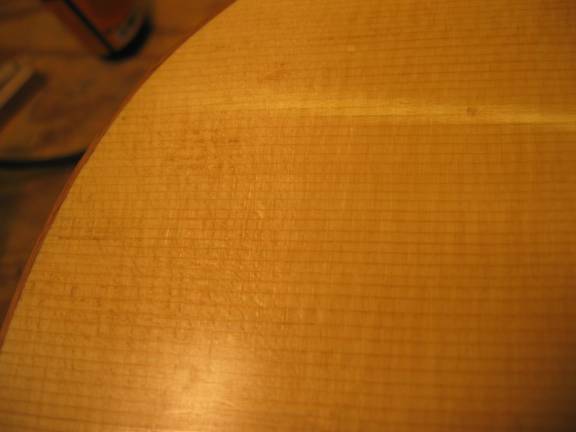
The finish is somewhat glossy in most places, punctuated by areas of dullness,
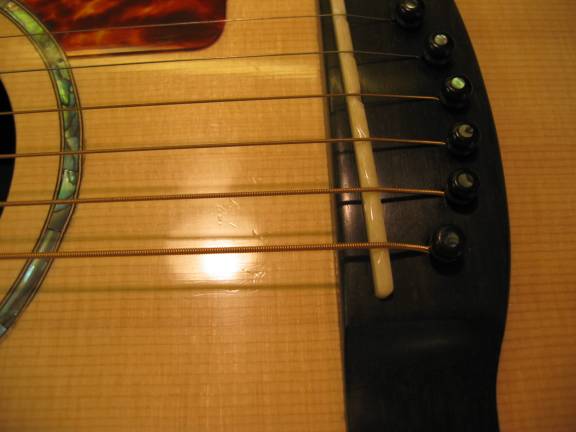
sanding scratches and steel wool marks. The top is covered with dents
and dings, and scratches abound. There are simply too many to count.
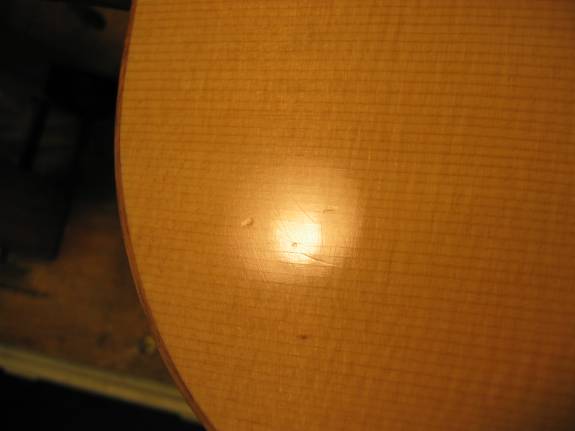
Voids and impurities are rampant. There are what appear to be dark smudges or dirt under the finish.
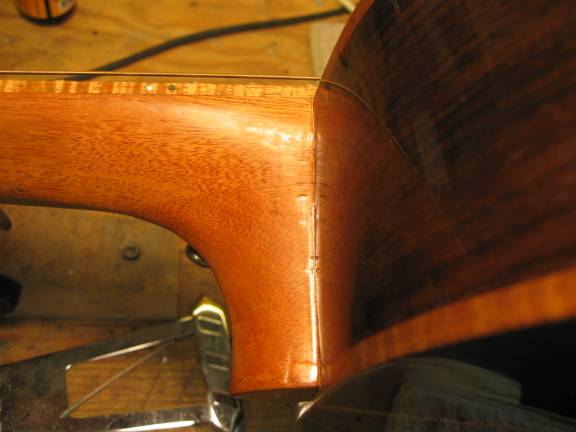
This photo of the neck heel shows to good effect the orange-peely, rather dull nature of the finish on the neck.
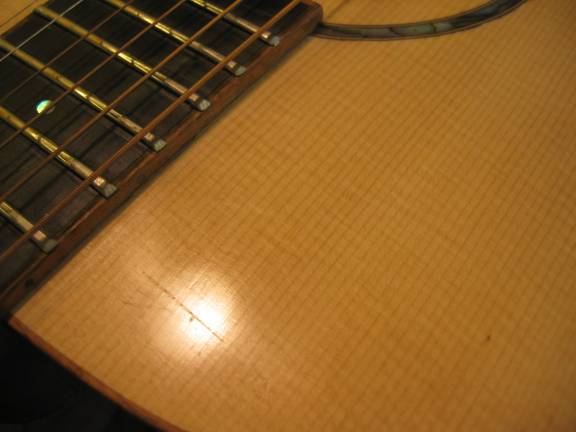
It may be difficult to see in the pictures, but one can discern the many
grades of sandpaper that were used on this guitar, either in finishing
the wood or in sanding the finish.
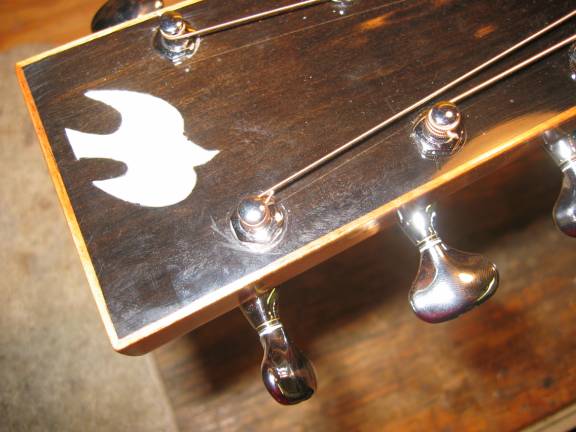
This photo illustrates the poor quality of the finish of the headstock
face.
Playability.
By almost any standard, and certainly by the standard of other guitars
in its price range, this guitar is unplayable. This is the result of exceedingly
poor neck construction, maybe the worst I have ever seen. I recently had
a guitar in my shop that was purchased in Paracho Mexico for $40.00 with
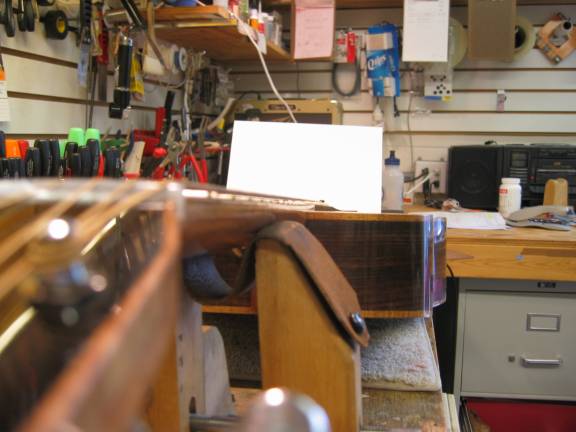
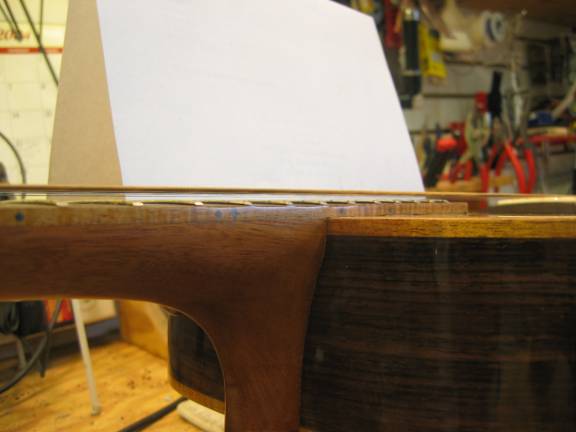
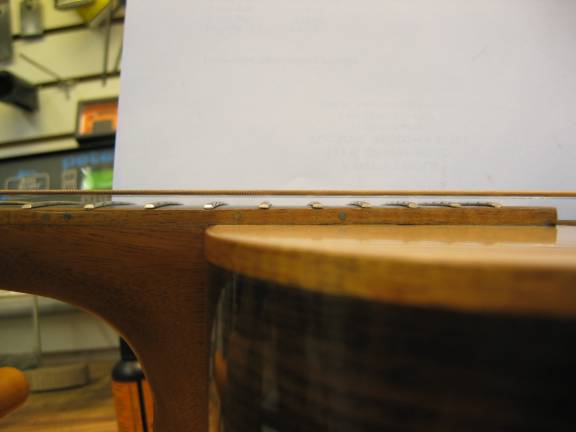
a far superior neck. Look closely at the following pictures and notice
the undulation in the fingerboard. Starting at the nut and moving up,
the neck on Wrigley No. 103 exhibits a slight backbow at frets #3-4, dips
down through around #10, curves back up around #12 or 13 and reaches a
plateau at #16-17. A real roller coaster. The difference between the highest
frets and the lowest is around .050”
Further, the nut is cut with excessive clearance under each string, ranging
from .007” under the high E and B, to .012” under the G and
D, then back down to .009” under the A and low E. Open chords are
not easily played. The action, measured at #12 is 3/32” on the treble
side and 7/64” on the bass. One would get the impression that at
this height the guitar would play very cleanly but this is not the case.
Buzzing is rampant starting around #8 or 9, as the strings rattle freely
against the upper frets. The relief in the neck is somewhat difficult
to ascertain because of the backbow around #3, but it measures around
.025”at #7. This is the setup as delivered to the customer.
Adjusting the truss rod only changes where the guitar buzzes and rattles.
The frets (Dunlop 6000, .118”w X .058”h) are another story
altogether. Some frets have file marks all over them, most are popping
up at the ends, and all are uneven with respect to height. Some are crowned
while others are filed flat on top.
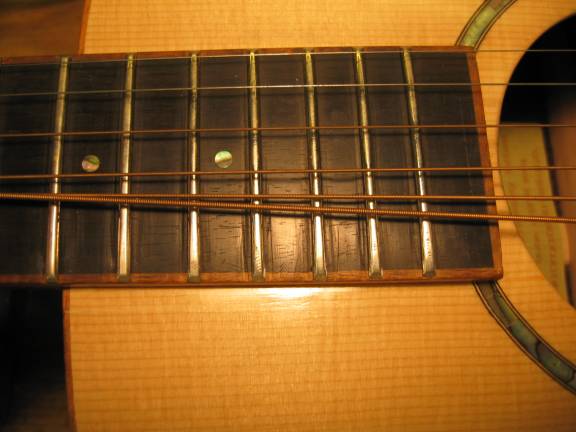
The fingerboard is gouged from filing on both sides of each fret along the entire length of the fingerboard, and the inlays are seriously off-center.
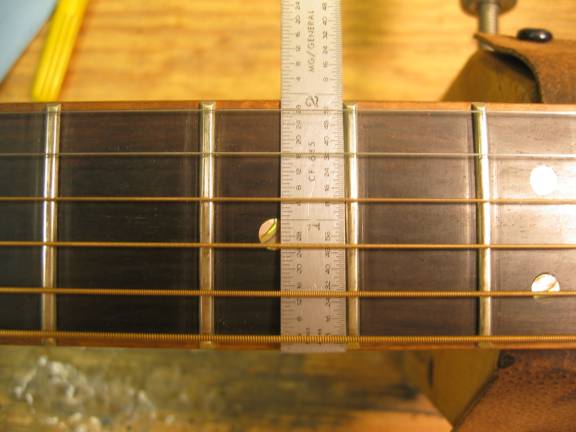
The guitar plays inconsistently sharp up the neck. The intonation, as measured using a Peterson AutoStrobe 490 and a Signalflex contact mic, is as follows: low E +3 cent, A +3, D +2, G +3, B +6, high E +5. Other factors contributing to the poor intonation are the varied shapes of the fret tops, excessive relief, etc.
On the plus side, the interior components (bracing, bridgeplate etc.) seem to be well made and, except for a shim under the neck block, appear to be well thought out and soundly constructed.
Conclusion.
One of the services I am asked to perform as a luthier is to evaluate
guitars for purchase, either by an individual, or often times for the
store I am associated with. I played guitar professionally for 20 years
and have been a professional luthier for almost 10 years and consider
myself an able judge of a guitars’ merits and flaws. With that said,
the Rigley No. 103 does not measure up to ANY guitar in its price range.
I dare say it is among the poorest examples of any guitar I have ever
seen offered for sale at any price. When I was informed as to the purchase
price I was thunderstruck. That anyone could ever think of charging $2350.00
for this guitar is astounding. The poor finish, the crude neck construction,
a complete lack of playability, and overall shabby quality of this instrument
is difficult to express. In the face of all this, there can be no discussion
of the guitars’ tone. It is irrelevant given everything else.
Mark A. Kane