
The London Monument.
The monument was built to commemorate the great fire of London in 1666. The architect of the monument is most commonly stated to be Christopher Wren. Freemasonry claims Christopher Wren as one of their own although this matter seems to be rather confused.
However, as the Encyclopaedia Britannica states, Robert Hooke was a more likely candidate responsible for the monuments design and construction.
The story of the fire is interesting in itself and, ironically, the story has a specific connection with Freemasonry.
The fire started on Sunday September 2 accidentally in the house of the kings baker in pudding lane. The flames were encouraged by a strong east wind and the flames spread and raged until the Tuesday. On the Wednesday the fire relaxed and was extinguished on the Thursday.
On the Thursday evening the fire re-occurred at the Temple. In response, houses and buildings were destroyed by gunpowder thus blocking the fires path and allowing it to be extinguished.
The Temple Church was a creation of the Knight Templars and dates to the late 12th century. It has often been restored. Within the crypt of the church the Templars are said to have carried out their secret initiation ceremonies.
Within a few days of the fire, Christopher Wren, Robert Hooke and John Evelyn were presenting proposals to the king for the rebuilding of the city.
Wrens most famous work was the design and erection of St Pauls Cathedral and the numerous churches which surround it. Wrens plan for the monument was apparently rejected. It was stated to have included an interior telescope and carved flames issuing from the exterior of the monument. On top of the monument was to be a phoenix or a statue of the king.
Hooke was designated city surveyor. In this capacity the design and construction of the monument can be more likely regarded as belonging to him.
The Monuments Relief by Cibber.
‘The Monument still stands in the city of London, though the structure was long ago purged of its inscription wrongly attributing the Great Fire of 1666 to the “treachery and malice of the Popish faction...in order to their carrying on their horrid plot for extirpating the Protestant religion and old English liberty, and introducing Popery and slavery.” ’ Encyclopaedia Britannica.
Other sources add the words ‘but the popish frenzy, which wrought such horrors, is not yet quenched.’ These were supposedly added to the monument around 1681and not completely removed until 1830.
Considering that the fire was re-started at the Temple church one would have thought it more likely to be attributed it to a conspiracy of the people of the ‘usual faith’ and sympathetic to the old Templars.
While the anti catholic inscription may have been removed, the relief itself has an anti-Catholic flavour and a little bit more besides.
Part of the reason for this may be that the sculptor C.G.Cibber was stated to have been imprisoned for the running up and non-payment of debts. He worked upon the relief while on daytime parole. Therefore, perhaps the sculptor had a personal axe to grind.
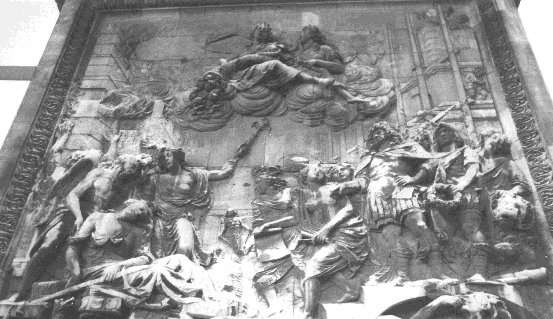 |
The relief was carved in 1674. The monument itself was constructed from 1675 to 1678.
It is supposed to represent a female depiction of London which has fallen and sits in ruins being supported by Time, stated to be the elderly male angel. The king of the day benevolently assists and guides in its construction dressed in a Roman habit. Overhead, plenty awaits to provide sustenance. Beneath the king, envy lies eating a heart which is probably a reference to the ‘sacred heart’ of Jesus according to the Catholic faith.
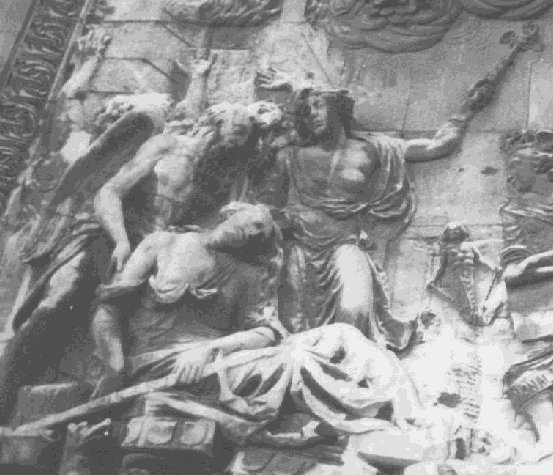
Behind the fallen female are depictions of burning buildings. Behind the king are depictions of new construction.
The fallen female is being assisted by two figures. One represents an elderly male angel attributed as being Time. The other is a bare breasted woman. In her hand she holds a representation of a caduceus, raising this towards heaven. The caduceus has at its top the usual wings but also the figure of a hand which contains the representation of an eye within its palm. The caduceus was a hermetic symbol which was given to the deity Hermes in his capacity as leader of souls to the underworld.
The king of the day was Charles the second. He was a member of the English Church but upon his deathbed received the last rites of a Roman Catholic. He is dressed in the garb of a roman soldier, implying Catholicism. It may be reference to his personal Catholic persuasion. However it is more likely that he was used as a vehicle to represent Catholicism itself on the relief.
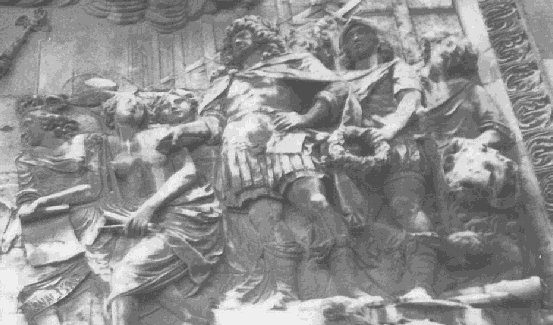
He points to the fallen London holding a scroll. This has been broken off in the above image. Most likely, it may have been broken off intentionally such that the King appears to be pointing to the fallen female. The pointing finger is a common artistic symbol which has been used over many centuries and is usually directed towards the direction of the perceived ‘god’ or to reflect the allegiance of the artist or convey a specific message. Essentially it is supposed to be representative of the finger of God.
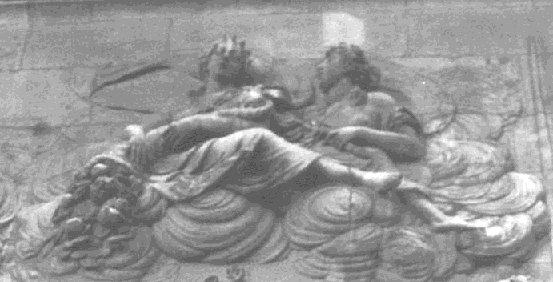
‘Heaven’ and a predominantly female character, stated to be plenty, pours forth fruit from a cornucopia or horn of plenty.
The relief displays a hidden message.
The sketch upon which the relief is based shows the king smiling and portrays him in a completely different light to that of the relief itself.
Rather than being a beneficent character, the king is presented as being rather stern faced at the prospect of the fallen London regaining its foothold.
Further more, if the mural is closely analysed the king is actually urinating down the inside of his right leg.

Obviously such a reaction is generally considered to be one of fear.
The written anti-Catholic inscriptions which were included upon the monument represented a battle between two opposing religious faiths. Protestant and Catholic although both were and are Christian.
Yet the relief represents much more.
It utilises numerous aspects that are associated with the ancient religions. Indeed it has been stated that it was specifically commissioned to do so and include images which were ‘hieroglifick’.
Yet in so doing it depicts dualism.
Not between Protestant and Catholic because the symbols employed in the relief are not entirely Christian.
It represents dualism between the ultimate, extreme Protestant and Christianity.
The Ancient vs. the Christian.
Hence the reason for the urination. Not in reaction to Protestantism.
It is a satirical reaction to the prospect of a risen and ancient London. A place where the ancient faith could flourish in secret and the predominantly female Babylon would be ‘like’ God in heaven. Notice that the heavenly female figure partially exposes both legs and her right shoulder is bare. Two aspects which are used in the biblical description of Babylon in Isaiah 47. It should also be remembered that the cornucopia can trace its roots back to Ishtar, predominant goddess of the Babylonians although it has been adopted by Judaic and Christian sculpture. As such it can be considered to have a dualistic meaning.
