
Tam o Shanter and Babylon in Stone.
The following pictures are taken from a building which bears a name that is very similar to the biblical Belial, one of the names of the devil. The only reason the name and address is not presented here is that the owners may or may not appreciate the significance of its furniture. Therefore, it is not considered necessary or fair to attract attention to a building which does not openly proclaim a Masonic connection.
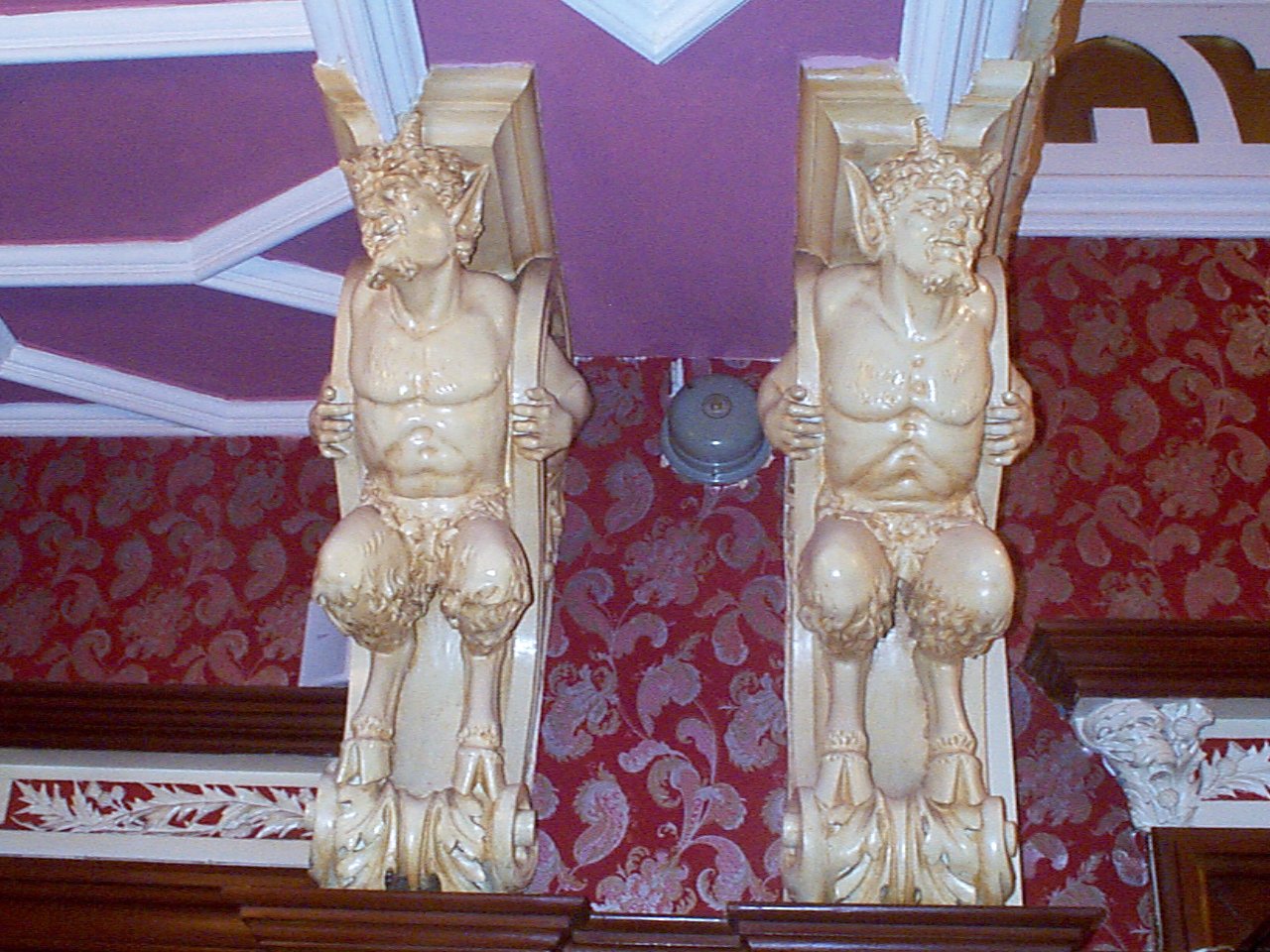

The information which I was given concerning the carvings explains that they relate to the poem Tam O’ Shanter written by Robert Burns. However, the carvings are such that they display much more than this and they are consistent with the theme of this article.
The poem is lengthy and concerns a story about a man, Tam O Shanter who has been drinking all day in the pub. He decides to return home, passing by an old haunted church at midnight. He sees a group of witches and warlocks in dance, with the devil present as a large, black, shaggy dog playing the bagpipes. Tam O Shanter can be seen looking through the left window.
The women are hags except one who dances particularly vigourously such that the character losses his reason and shouts out ‘Weel done, Cutty Sark’ or well done skimpy dress.
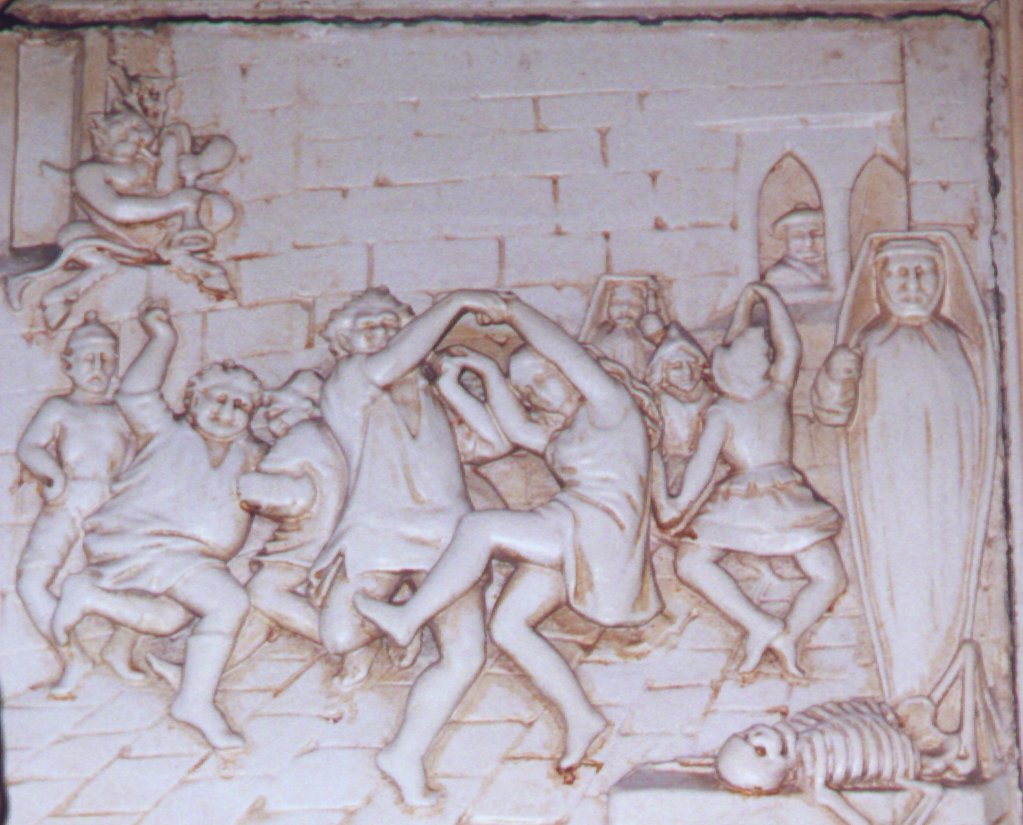
The witches and warlocks hearing this give chase crying ‘Catch the thief!’, seeking to take him to hell, but the character knows that they cannot cross a running stream and therefore, relying on the speed of his horse, he heads towards a bridge. The skimpily clad witch manages to capture the tail of the horse, leaving it with a stump, before Tam O Shanter manages to escape over the bridge.
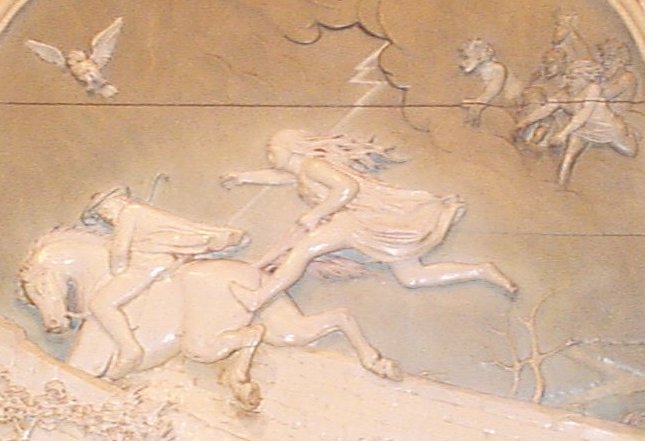
The decorations depict aspects of the poem which clearly describe a flight from evil.
The use of the words ‘catch the thief’ are particularly interesting. The implication is that by simply viewing the proceedings he is considered to have stolen something. However the description of a thief is particularly relevant to Freemasonry via the Royal Arch degree and the vision of the flying scroll associated with Zorobabel. It refers to the immoral imitation and spin doctoring of Biblical text. It refers to the accusatory biblical mechanism of the devil - the curse of the earth. In this case it appears that the meaning of a thief itself in biblical text has been reversed. Some one who sees something which is not intended to be seen. The witches and warlocks were dancing in a church as opposed to any other building which is a form of immoral imitation and mockery. Also, witchcraft is directly associated with Babylon.
Freemasonry has claimed the poet Robert Burns for their own, this should be expected. In this instance it seems to be a certainty, unlike many others they adopt. However, as this stanza from one of his poems demonstrates, he may not have been a completely compliant Freemason. [Translation]
Address to the Deil[Devil] (1785)
When masons’ mystic word an’ grip
In storms an’ tempests raise you up
Some cock or cat your rage maun[must] stop
Or strange to tell!
The youngest brither[brother] ye wad[would] whip
Aff[off] straught[straight] to hell.
The reference to a cock or cat may be a reference to the coat of arms of families with very prominent links to Freemasonry. The coat of arms of the owners of Rosslyn Chapel, for example, consists of a cock, and the family has many prominent links with Freemasonry, even being the alleged protectors of Freemasonry at one time. The cat is slightly more elusive as numerous families use the lion, which is not surprising as the lion rampant is the Scottish emblem. However, it should also be remembered that the devil is described as a roaring lion in the bible.
The use of a lion in coats of arms does not necessarily relate to the devil because Jesus is also described as the Lion of Judah in Revelations.
Back to the hotel. Upon first glance and in association with the numerous depictions of the devil the decorations represent an obvious Satanic theme. However upon closer inspection there is an underlying message which would probably only be recognised by some one with a little bit of biblical knowledge.
For example, there are two opposing figures represented on each side of the fireplace. One carries the horn of plenty (associated with the ancient Astarte, Ishtar, Fortuna etc) and the other carries a bundle of ‘wheat’ upon her back and cradles an amount of ‘wheat’ already harvested.
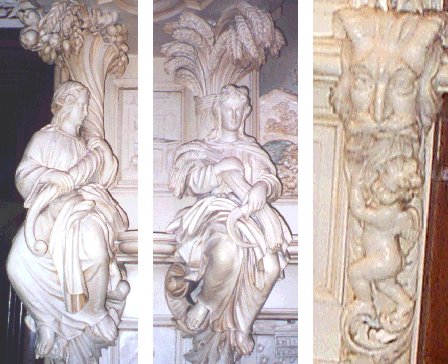
The figures represent judgement and temptation. They do not have a direct connection with the poem.

The above picture is not taken from the same site. However it serves to re-enforce this particular theme. The cornucopia or horn of plenty is employed by both Judaic and Freemasonic stonework. However, in the case of Freemasonry, it should more accurately be described as the cup of Babylon. In this regard it is normally associated with a partially naked woman. The sexual theme is further enhanced above because the fruit emanates from her groin. This is elaborated upon in another site under section devil in art.
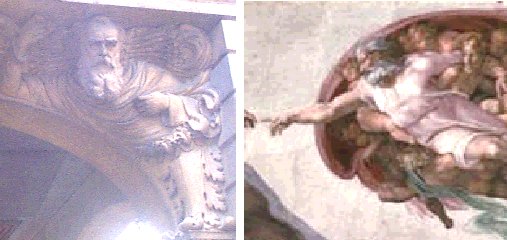
Situated adjacent to the above sculpture of Babylon and around the corner is the harvester holding a bundle of wheat. Notice that the opposite theme is further emphasised in this case with the harvester being male.
However there is another figure presented along side the harvester which reminded me of Michael Angelo's Sistine Chapel, which it is probably supposed to imitate. It is a clear depiction of dualism, Equal and opposite forces. One is God and the other is Babylon.
The Babylonian theme is continued in Hotel with a knight passively walking away from the ‘whore’ with her breasts exposed. This is reminiscent of the depiction in Rosslyn of the man guiding the woman from the devil. However it is also consistent with the idea of a non-aggressive stance concerning evil. It appears his action results in her dropping her cup.
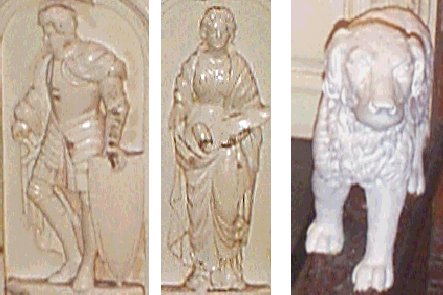
Both dogs, help and hold, are represented at the front of the fireplace. However they are not large black dogs as referred to in the poem. These refer to a fool repeating his folly like a dog eating its own vomit and interfering in some ones affairs in anger which is likened to grabbing a dog by the ears. Both are biblical and are found in proverbs.
Interestingly the devils mouth is held shut by cherubs. Perhaps it alludes to the representation of the underlying message.
I could expand this theme in great detail but it is summarised by the following picture which is behind the person as they leave the building and greets them as they enter.
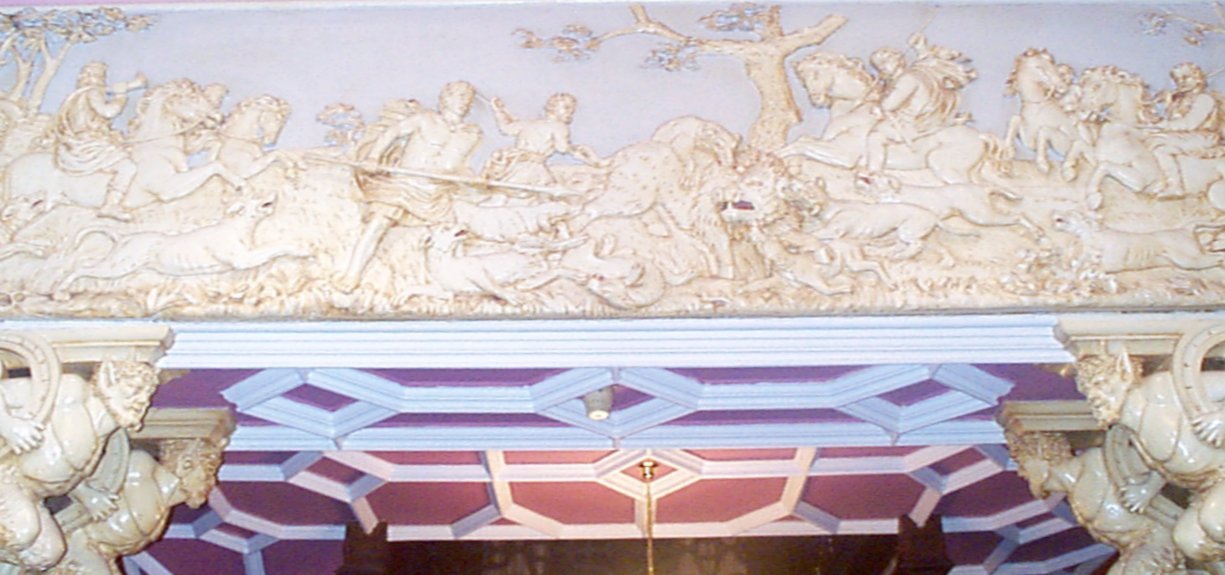
The above battle scene would appear to be superficially similar to the apocalyptic portrayal of Armageddon and the defeat of the biblical beast. However the details concerning the appearance of the beast are not accurate. It does appear to have the body of a leopard but that is the extent of the similarity.
These inconsistencies are in complete agreement with the theme of this article. Superficially similar it imitates biblical text but the under lying message is entirely different.
It probably alludes to the defeat of something else. In terms of Satanism, this enemy would be Christianity. The numerous depictions of dogs are used because the symbol of a dog represents an act of provocation and the encouragement of folly or anger. The associated section discusses this in more depth.
For the people who wish to recognise a Satanic theme it is blatantly presented to them. Yet, at the same time, an opposing and underlying message is displayed and is probably supposed to exploit the religious ignorance of the viewer.
Such techniques are used in Freemasonry. Yet a master ‘Free-mason’ may consider himself as being one with ‘eyes to see and ears to hear’, a common Biblical term which has been adopted by Freemasonry. It would be almost worthy of laughter if it weren’t so sad. Freemasonry is dependent upon the religious ignorance of its initiates.
