
Slight of Prudence.
Previously I had mentioned that the seven virtues and the seven sins had curiously been mixed up. Firstly I will quote this section in whole, from the tourist brochure, because it is particularly revealing. It describes the writings of an extremely prominent individual regarding Rosslyn Chapel. I do not know personally if he is a Freemason, however I strongly suspect he is considering the prominent position the family has had in the past with Freemasonry.
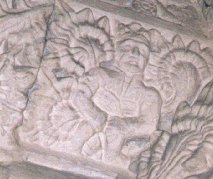
‘In the right hand corner, where Apprentice Pillar and architrave meet, you will see a figure of a crowned king, believed to be King Darius. [picture shown below]
 |
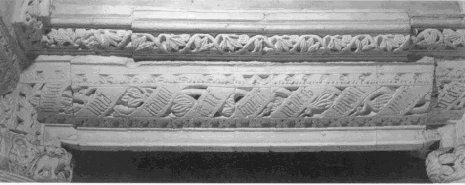
On the architrave which joins the Apprentice pillar to the south wall, running above the stairs to the sacristy, is an inscription in Lombardic letters. It reads: Forte est vinu. Fortior est rex. Fortiores sunt mulieres: sup om vincit veritas, meaning ‘Wine is strong. The King is stronger. Women are stronger still: but truth conquers all.’ (1 Esdras 3: 10-12) They are three lines written as a trial of wisdom by the youths who formed King Darius’ bodyguard and placed under the king’s pillow while he slept. On awaking, the king invited the three young men to justify their words.
 |
Zerubabbel’s observations about women and truth were adjudged the wisest and as a reward he was granted permission by the king to lead the Jews back to Jerusalem, in order to undertake the rebuilding of the temple.
Turn around with your back to the inscription and face down the aisle. On the architrave above you are a series of carvings on individual stone sections. On this side you will see the seven virtues. Starting from the left, we have first, as an introduction, a cardinal bishop with a crozier in one hand and a bible in the other. Then, from left to right:
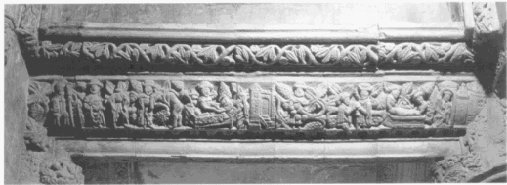
1. Helping the needy
2. Clothing the naked
3. Looking after the sick
4. Visiting those in prison (if you look closely you will see the face of the prisoner at the barred window)
5. Avarice (misplaced from the seven deadly sins) – a man with bags of money clasped to his chest
6. Feeding the hungry
7. Burying the dead
Then the reward for virtue, St Peter waiting at the gates of heaven with a key in his hand.
Walk along the aisle, turn around, and on the opposite side of the same architrave you will see the seven deadly sins. Starting from the left, there is a bishop with a staff in his hand as the introduction, then from left to right:
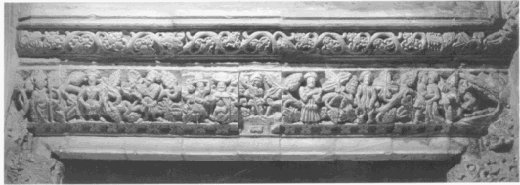
1. Pride – a Pharisee with puffed out chest
2. Gluttony – a man with a pitcher to his mouth
3. Charity (misplaced from the seven virtues)
4. Anger – a man with an axe in his right hand and a club in his left
5. Envy – a man with his hands across his chest surrounded by bunches of grapes
6. Sloth – a man with a bag dragging on the ground
7. Lust – the sinful lovers
And finally the punishment for sin, the devil emerging from a monsters mouth, symbolizing hell, and stretching out a triple hook towards the whole group.
The most likely explanation for the reversal of Avarice and Charity is that when the stones of the architrave were carved in the workshop, the two scenes were carved on the wrong sides of their common stone. The geometry of the stone was such that it could not be included in the architrave the right way around, so the mason built it the wrong way and hoped no - one would notice.
The conventional representation in Britain of the seven deadly sins is in the form of a tree or wheel, and their representation here in the form of a procession is exceptional, although there are many examples in France. As such, it is likely to have been the inspiration for the celebrated poem, ‘Dance of the Sevin Deidly Synnis’, which was written by the Scottish poet William Dunbar in about 1491, shortly after the death of the Chapels founder.’
End quote.
Notice anything odd about it?
I don’t read whichever language it is carved in, therefore I cannot translate the passage which is supposedly carved in stone.
However I can look up a biblical reference which is rather misleading. 1 Esdras 3: 10-12. The reference quoted reads as follows, from the Douay version
‘10 And when the masons laid the foundations of the temple of the Lord the priests stood in their ornaments with trumpets: and the Levites the sons of Asaph with cymbals, to praise God by the hands of David king of Israel.
11 And they sung together hymns, and praise to the Lord: because he is good; for his very mercy endureth forever towards Israel. And all the people shouted with a great shout, praising the Lord, because the foundations of the temple of the Lord were laid.
12 But many of the priests and the levites, and the chief of the fathers and the ancients that had seen the former temple, when they had the foundations of this temple before their eyes, wept with a loud voice. And many shouting for joy lifted up their voice.’
It’s an apparently misleading reference, which happens to overlap with masons in the Douay Version of the bible. The translation is not readily validated by picking up any version of the bible.
The passage referred to remains a subject of indecision. It does not appear in the Catholic Douay Version. It does not appear in the King James Version. It is described as apocryphal. The apocrypha is usually considered as being books of the Old Testament which are accepted as being authentic by the Roman Catholic Church but not by the Protestant Church. Yet this passage is truly apocryphal. It is not recognised by Protestant or Catholic authorities as being genuine.
It is important to place it in context. The actual engraving is not a biblical quotation.The apochryphal 1 Esdras 3:10-12 describes how the first body guard considered wine the strongest. The second bodyguard considered kings strongest. The third, Zorobabel, considered women strongest but truth carried away the victory. Wine, kings and women were considered strong only in the sense of inducing a man to evil. Zorobabel continues his explanation and as a summary in 1 Esdras 4:37 states that wine, kings and women are all wicked and truth is always victorious.
Its usage in the chapel is a further demonstration of the presentation of an alternative message and the superficial imitation of biblical text.The brochure gives the impression that it is an accepted quotation of biblical text. It is not.
It is logical that a building which has, self proclaimed, links with Freemasonry should display an unauthentic biblical sentence. Superficially it appears to celebrate the feminine. Freemasonry has several connections with the ‘feminine’ Babylon and Rosslyn Chapel displays numerous representations of her.
The passage itself specifically focuses upon the character of Zorobabel. Zorobabel is closely associated with the vision of the flying scroll, the curse of the earth. The immoral imitation of biblical text. The horned Moses, holding the Ten Commandments in one hand and a scroll in the other and which was jocularly referred to in a pro masonic book illustrates this principle.

Combine this with the fact that the engraved passage pre-dates the Protestant Reformation. It implies that the construction of Rosslyn Chapel was not in accordance with church teaching. The passage remains contrary to official church teachings today. This would further explain why Rosslyn has such a rich and complicated history and why its designation as a place of worship has been confused throughout history. It was recognised as being at odds with the Church on a number of occassions in its past.
I do not recognize the language of the engraving but I was at least curious and wanted to verify the literal translation. It appears in a number of the sections that the writing is nothing more than a string of interlinked M’s.
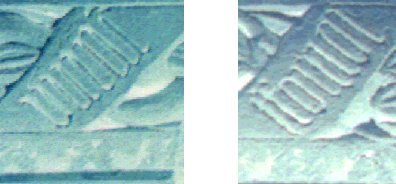
First of all, it would appear to cast suspicion on the validity of the translation. Secondly, a very popular book drew attention to such a symbolic M and its significance to Freemasonry. They attributed it as being as per the sign of Virgo. As such it represents a female virginal aspect of the zodiac. In the middle ages this was considered as being an occult symbol and not a harmless horoscope in the funny sections of the newspapers as it is today.
The biblical character which satisfies this description is Babylon. Associated with Babylon was astrology and the zodiac and she biblically describes herself as a lady and as a virgin in Isaiah 47. Therefore, the use of the sign of virgo is logical.
Babylon also features directly in Freemasonic initiations, the bare legged sons of the Babylonian widow who may be lowered onto her female skeleton within a grave.
I returned to the chapel and obtained a new series of photographs, shown below.
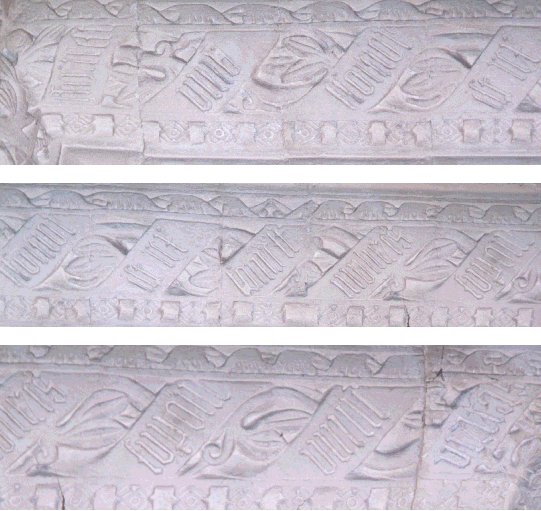
The text is not readily identifiable with the Latin translation provided.
The Lombardic text is described in the Oxford dictionary as relating to a style of Italian architecture from the 7th century to the 13th century. It is also described as a form of handwriting particular to a school of painters, represented especially by Leonardo Da Vinci, Mantegna and Luini which flourished at Milan and other Lombard cities during the 15th and 16th centuries. This period would have brought it in line with the foundation of the Chapel in 1446. One reference in the above attributes the writing as being broken lombardic.
I am not an interpreter but I did note that the sixth phrase from the left, nine phrases in all, contained a symbol which closely resembled the zodiacal symbol of Virgo. It is contained in a word which could be viewed as mulieres or women and this would be appropriate. Babylon is usually described in a female sense such as the biblical Harlot.
Notice that there is an extra symbol between the E and the R in the word. In , for example, Italian ecclesiastical script or 14th century German alphabet, there is an additional character normally placed between the letters R and S, example shown below. Here the character has been placed before the R & S. In the spirit of broken writing I attempted to fill the gaps, first in blue then in red.
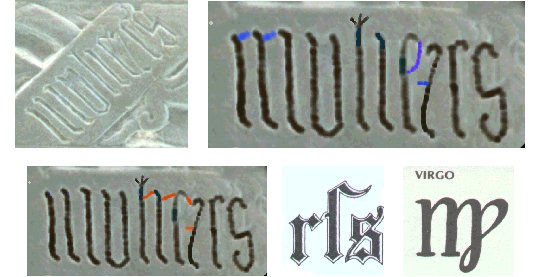
I am not a linguist or translator. However, my initial purpose of verifying what was stated to have been carved in stone was validated. It is not obvious or readily verifiable to the casual observer.
The quotation from the brochure goes on to discuss The Seven Virtues and the Seven Deadly Sins.
None of the Seven Virtues are named accurately. They are Faith, Hope, Charity, Temperance, Prudence, Fortitude and Justice. Six of the seven represented in stone are acts of Charity. The misplaced Avarice is obviously opposite to Charity and by inclusion is probably supposed to negate the others.
The features named are generally consistent with the Days of Judgement in Mathew 25:35 & 36. ‘For I was hungry and you gave me to eat; I was thirsty and you gave me to drink; I was a stranger and you took me in; Naked, and you covered me; sick and you visited me; I was in prison, and you came to me.’ Avarice just happens to be stuck in the middle of these.
Conversely, the Seven Deadly Sins are accurately named, with the exception of Charity which has been misplaced. The devil comes out of the same mouth which issues the Rosslyn vegetation to consume all of the group, including Charity.
In themselves the inaccurate listing of the seven virtues and sins is imitative. Superficially similar the list breaks down upon closer inspection.
The description of why avarice and charity have been mixed up is interesting. The figures being carved on the wrong sides of the common stone which because of its geometry could not be fitted the correct way around. Considering the detailed planning required for the rest of the chapel this is entirely illogical. Besides this, which is the wrong side of a symmetrical stone?
A most significant point is at the very beginning of the quotation. It says that there is a figure of a ‘crowned king’ where the apprentice pillar and architrave meet. This figure is present but there is a far more prominent and relevant illustration in the same immediate vicinity.
It can be seen directly below the architrave which bears the engraving.The second photograph in this section shows it in the bottom left hand corner.
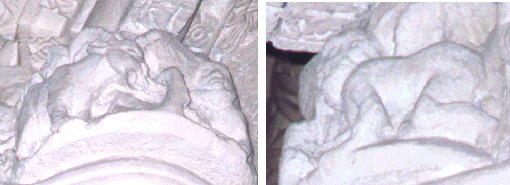
It depicts a man brought to his knees, naked, with something which has issued from the goats mouth wrapped around his neck. The goat holds this issue in its mouth like a leash.The goat is a common satanic symbol. The engraving suggests an oral and crippling attack.
Regarding the quotation in general. Notice how the reader is invited to pay considerable attention to the engraving of a man in prison. The typical reader may pay attention to this but miss the other significant points. Does this merely serve as a distraction?
In my opinion the quotation from the brochure, like Freemasonry itself, has all the trappings of a confidence trick. It relies upon the religious ignorance of the passing tourist.
Like a guilty schoolboy on a dare, miss leading information is presented but at the same time an attempt is made to divert attention away from the bigger issues.
While it may demonstrate and capitalise upon a degree of religious ignorance on the part of the tourist it demonstrates the nature of ‘The Craft’.
But why? Why draw attention in a subtle manner to a dubious biblical issue. Why include sign posts throughout the Freemasonic initiations which hint at an alternative and sinister source of allegiance.
It represents a display of a supposedly secret Freemasonic mechanism which may be recognized by those with ‘eyes to see’.
The guide brochure openly associates the chapel and its previous patrons with Freemasonry. This connection is capitalised upon and is used it to attract tourist attention. Therefore, Rosslyn must also render itself open to detailed scrutiny and criticism by those interested in discovering the truth about Freemasonry.
Rosslyn presents a hidden message. This message is hidden among miss-information. This is the essence of the occult and consistent with its definition - hidden. This is also the essence of Rosslyn, miss-information and the ‘rich complexity of its history and architecture’.
The purpose of this article is to present and illustrate a theory, not detail. The Freemasons may not all be particularly intelligent people, but their message has to be simple and recognizable by those who wish to see it.
