Dualism and Imitative and Opposite
It is likely that the depiction of Moses with horns stems from Exodus 34:35. The Douay Version describes his face as being ‘horned’.
However the Douay Version was not created until around 1600 and so the carvings must relate to Catholic text prior to this date. Horned in this sense means shining and sending out rays of light like horns after receiving the Ten Commandments. The King James Version supports this interpretation.
It should be remembered that the chapel was constructed a couple of centuries before the Protestant Reformation. Including such a figure in the chapel at that time would have been heretical. Heretical in the sense that it was in opposition to church teachings.

Was the intention to address and highlight the imitative and opposite theme itself? A carved illustration of immoral spin doctoring? Notice that he holds a scroll in his left hand.
Throughout the interior of Rosslyn are depictions of dualism.
It is not simply dualism between obvious and accepted aspects of good and evil. It is dualism between ‘angels’ holding scrolls or books. The obvious interpretation of the carvings is that they relate to the differing interpretations of biblical text.
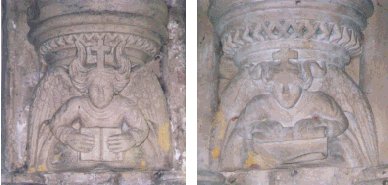
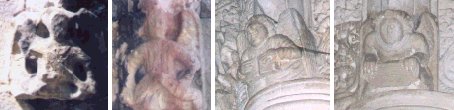
These are not isolated to one or two depictions. It represents one of the dominant themes of Rosslyn. They are positioned within the chapel such that they are physically opposing each other, on either side of a window for example. In themselves such depictions are imitative and opposite. Imitative in that both are represented as angels, opposite in that they present opposing messages to each other. However it is wondered if some of these representations are supposed to be fallen angels. Refer to the image below underneath two dragons and having pointed wings.
They could be regarded as the representation of a healthy difference of opinion regarding biblical scripture. However it must be appreciated that the chapel and the carvings were created under the rule of the Catholic Church. While there was a certain degree of latitude in such matters, at that time it was very limited.

The carvings were created prior to the Protestant Reformation and cannot be a reference to the same in any way.
There is a biblical precedent for this mentioned previously in this article.
Contained within Rosslyn is specific reference to the character of Zorobabel, the builder of the Second Temple. He features in the only biblical written reference contained within the Chapel which is carved in stone.
Zorobabel is closely associated with a particular vision regarding a flying scroll. It was described as the curse of the earth. The immoral imitation of biblical text.
With this in mind, the depiction of Moses with horns becomes clear. It is an illustration and application of the above process. He has horns representing the devil, he holds the ten commandments in his right hand. He holds a scroll in his left hand, the left hand being commonly associated with evil.
Rosslyn as a whole represents dualism with a particular emphasis upon evil. Hence there are over one hundred of carvings of the Green Man. Numerous carvings of death. Numerous carvings representing the male and female aspects of the devil. The vine issued from the serpents mouth is everywhere.
The extent of this mechanism can be summarised with one illustration.
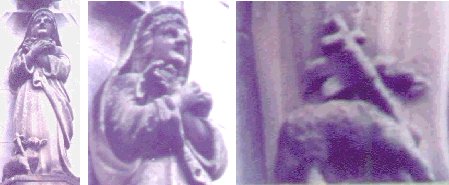
Above the western entrance of the Chapel, towards the south side is a statue which shows a woman holding what appears to be a ‘leaf’, or something which resembles parts of the ‘ Rosslyn vine’, to her breast. She has a lamb and a flag at her feet.
The lamb and the flag are the usual depiction of the Lamb of God – Jesus Christ.
It is highly unusual, indeed virtually blasphemous, that a representation of Jesus Christ would be placed at the feet of anything in, or associated with, a chapel dedicated to Him.