 |
|
|
|
|
|
|
|
|
|
|
|
|
|
|
|
|
|
|
|
|
|
|
|
|
|
|
|
|
|
|
|
|
|
|
|
|
|
|
|
|
|
|
|
|
|
|
|
|
|
The Warrior-Popes of History |
|
|
| The popes, as vicars of the Prince of Peace, have for the most part been men of peace. Yet, even Christ Himself was once driven to violence when the sacred was being defiled and like the good shepherd King David, who prefigured Christ, sometimes it is necessary to fight off the lions who threaten the flock. It could be said that the very first pope, St Peter, was a warrior-pope when he drew his sword and attacked one of the men who came to take his beloved master to His execution. They have always been the exception rather than the rule, but throughout Church history there have been a number of warrior-popes who picked up sword and lance to defend the Church and Christ's sheep. |
|
|
| In the earliest days, surrounded by the might of pagan Rome, it would have been futile to resist and the Christians did not, going willingly to their deaths as Christ had done before them. Yet, the time for battle would come. Factions battled factions in the chaotic days of Rome following the imperial collapse, with the popes often caught in the middle. The formation of the Holy Roman Empire under Charlemagne was a great help, but there were still barbarians, rivalry with the Byzantine emperor and the growing threat to the south of Islam. It was during the reign of Pope Sergius II that the Saracens sacked Rome, though this was not quite the accomplishment that it had been in the past. Pope John VIII also defended Rome against the Saracens but later had the tragic distinction of being the first pope to be assassinated. |
|
|
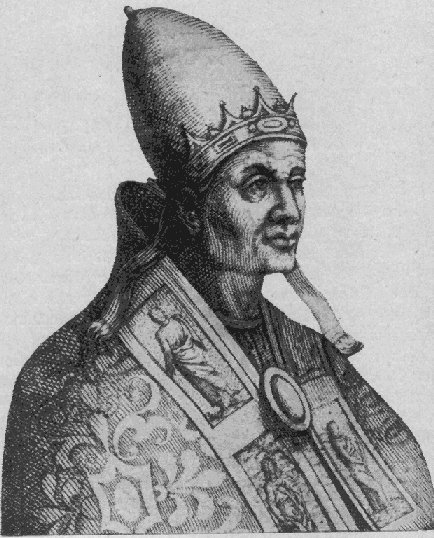
| In the times that followed Rome saw considerable conflict, though the popes had little to do with it, the whole era coming to resemble more of a mafia family feud as the city was dominated by the schemes of Marozia and her family and offspring. After a short respite another wave of unrest followed as the rival Crescentii and Tusculani families fought for control. In 1012 this brought a true warrior-pope to the throne in the person of Benedict VIII. Dressed in armor and at the head of his troops he battled across papal Italy, fought the Muslims at sea in 1016 and later joined with the German Emperor Henry II to stop a Byzantine invasion of the Italian peninsula. |
|
|
 |
|
|
|
 |
|
|
Pope Benedict VIII |
|
|
|
|
Pope Leo IX |
|
|
|
|
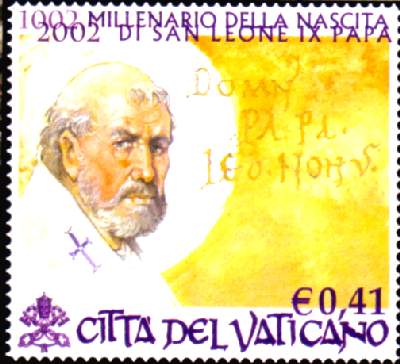
| The feuding of Italian families stopped when a succession of Germans were elected to the See of Peter, one of whom was Pope Leo IX. Known as a talented and upright reformer, Leo was also a brave soldier and commanded a gallant but doomed expedition to defend southern Italy against a Norman invasion. Leo IX was captured in battle and returned to Rome only a short time before his death. Not long after he had the honor of being the first pope canonized in almost 170 years. A period of some needed restoration followed, though as conflict with the Germans increased, so also did friendship with the previously hostile Normans. |
|
|
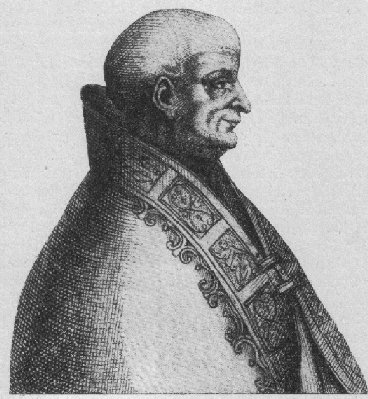
| Attempts by the secular authorities to dominate the spiritual authorities came to a head in the "investiture dispute". This controversy reached such heights that at one point Emperor Henry IV had to wait barefoot in the snow for three days at Canossa before Pope Gregory VII would receive him. Nevertheless, the contest between Pope and Emperor was to continue for some time. Not long after, in 1096, Blessed Pope Urban II called the First Crusade to retake Jerusalem, the first of a series of wars which were to play a big part in the history of Christendom and the papacy. At home though, conflict still raged in southern Italy, focused now on the person of the Norman King Roger II of Sicily. Pope Lucius II, who came to the Throne of Peter in 1144, negotiated Roger's neutrality so he would have a free hand to deal with a rebellion by Roman secularists attempting to circumvent his authority with a restored Roman Senate. Lucius II donned his armor and led the attack against the Capitol. Severely wounded in the clash he died on February 15, 1145, the only pope to die as a result of wounds sustained in battle. |
|
|
|
 |
|
|
|
 |
|
|
|
Pope Boniface VIII |
|
|
|
|
Pope Lucius II |
|
|
|
|
|
| In the years that followed, military conflict was seldom far away, even if the pope did not personally take part. Some examples are the civil strife in Rome which lasted until the reign of Pope Hadrian IV and the Crusades, which continued, including the Albigensian Crusade launched by Pope Innocent III. In the 13th Century Pope Gregory IX along with the Lombard League fought successfully against the often heretical Emperor Frederick II. When the conflict was renewed, Gregory died before he could see it through and a number of his successors had to continue to wrestle with the problem of the overly ambitious emperor. Some time later, Pope Gregory X had considerable success as a peacemaker, ending the east-west schism, bringing some peace to the Guelf and Ghibelline factions and had planned to launch a new crusade but was prevented by his death in 1276. |
|
|
| From 1297-1298 family squabbles brought new violence to Italy as the imperious Pope Boniface VIII launched a "crusade" against the Colonna family who had been trying to undermine his throne and slander his papacy. Defeated by Boniface, the Colonnas fled to France where they enlisted the King there on their side and the struggle continued, though more so with words than swords. Boniface VIII issued his famous encyclical Unam Sanctam which stated that submission to the Pope was essential for salvation and the French responded with lurid tales of the Pope's wickedness provided by the Colonnas. Not long after came the era of what the Italians called the "Babylonian Captivity" when the Popes tired of the feuding in Rome and went on an extended holiday in the papal enclave of Avignon in southern France. |
|
|
| During the Avignon Papacy violence continued to rage across Italy and in France as the Hundred Years War continued. Pope Clement VI tried, without much success, to use papal military forces to stop the feuding in Italy. However, he was a compassionate man as well and had the Jews protected when others were blaming them for the spread of the Black Death which was sweeping Europe. Clement's successor, Pope Innocent VI, also tried to impose peace on Italy, sending the Spaniard Cardinal Gil de Albornoz to command his army, which succeeded in bringing law and order to much of the Papal States. France remained in chaos though and Innocent was forced to heavily fortify Avignon, fighting off bandits and marauders as well as bribing others to leave peacefully. |
|
|
| Pope Gregory XI, a nephew of Clement VI, also sent troops to pacify central Italy, an effort made more difficult by a revolt in Florence. However, the situation improved enough for Gregory to take the advice of St Catherine of Siena and return the papacy to Rome in 1376. Yet, controversy and tragedy soon followed when papal troops carried out a massacre at Cesena In 1379. Gregory was blamed for the savagery and his reign ended on a very gloomy note. Gregory had predicted terrible trouble for the future of the Church on his deathbed and sadly he was all too correct when the scandal of the "Great Schism" broke out with the election of his successor, Pope Urban VI in 1378. War soon erupted between the forces of Urban VI and the anti-pope Clement VII. Urban was later besieged as Nocera by King Charles of Naples. The Pope escaped, leaving Naples to be taken by Clement, while he proceeded to put down a rebellion in Rome. |
|
| Urban was succeeded by Boniface IX who spent ten years fighting to restore papal control over Naples. He also won few friends by appointing all Roman senators, dealing somewhat high-handedly with the Germans and for setting a new low for widespread simony, raising taxes and selling indulgences. The Church was thus in the difficult position of having an anti-pope who was more upright and likeable than the legitimate pope. Troubles were, however, slowly winding down, though few would have guessed it when the next valid pope, Innocent XII, was forced to flee Rome when a mob attacked the Vatican and during the reign of Gregory XII Christendom saw the schism expand to include three claimants to the Throne of Peter. However, thankfully, the divisions ended there. The next pope, Martin V, had to use military force to take back the Papal States from the lawlessness which had seized them during the schism. Restoration followed but the Colonna family incited another rebellion against Pope Eugene III which led to further military action on the part of the papacy. |
|
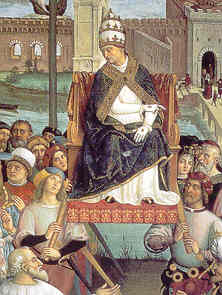
| Pope Nicholas V saw the fall of Constantinople to the Muslim Turks and his call for a crusade went unanswered and the 29 papal galleys he mustered arrived too late to aid the besieged city. Nicholas was followed by the Borgia Pope Calixtus III who also attempted to organize a crusade, which came to nothing, though the small papal fleet did rule the Turkish coast for a time. Calixtus was followed by the fiery and well written Pope Pius II, a worldly man who had been a noted author before reforming and taking holy orders. He worked to fortify Rome and zealously preached for a crusade against the Turks. The major powers refused to help and eventually Pius II took up the cross himself and was determined to lead the crusade in person, but died in 1464 before anything could come of it. |
|
|
|
 |
|
 |
|
|
Pope Pius II |
|
|
|
Pope Julius II |
|
|
|
| Fruitless calls for a crusade became rather commonplace in the succeeding years and the era of the Renaissance was well underway. In the reign of Sixtus IV there was further infighting among the Italians and the Turks were able to land in Italy itself, ended only by the death of Sultan Mehmet in 1481. Corruptions rose up again, particularly nepotism among the major Italian families. In 1492 the most infamous (though effective) Renaissance Pope, Alexander VI, came to the throne. Known for his extravagance, nepotism and total disregard for his vow of chastity, Alexander VI was not a military man, though he was an able administrator. However, his illegitimate son Cesare de Borgia, who was for a time bishop of several sees and a cardinal, was quite adept at making war. He fought across central Italy, leading papal armies to quell Church lands as though they were private property of the Borgias. In fact, he was the inspiration for Machiavelli's "The Prince". It was though, in 1503 that the most famous warrior-pope came to the throne and that was Pope Julius II. |
|
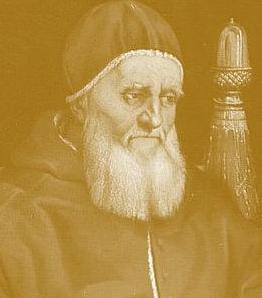
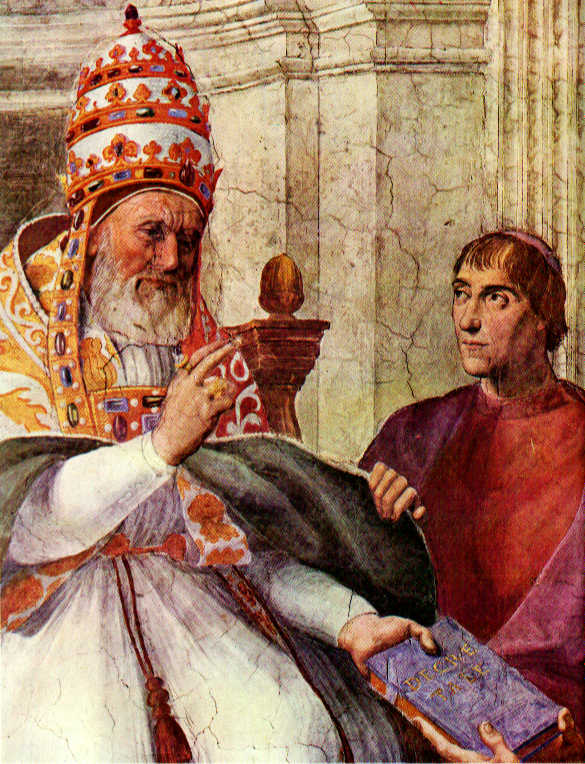
| Cardinal Giuliano della Rovere who took the name Julius II, remains the warrior pope remembered before all others. Elected in a conclave that lasted only a few hours, his combativeness soon earned him the nickname "Julius the Terrible" though it is important to understand that the sense in which the word "terrible" was used was one we would better understand as something like an unstoppable force of nature rather than someone who was cruel or ruthless. The Borgias had left the Italian peninsula divided, rebellious and with Church land being used to benefit private owners. Pope Julius II donned his armor, mounted his warhorse and with his entourage of cardinals trailing after him quite reluctantly, and he launched a military offensive to take back central Italy for the Church. |
|
|
 |
|
|
|
 |
|
|
Pope Julius II |
|
|
|
|
Papal Swiss Guards |
|
|
|
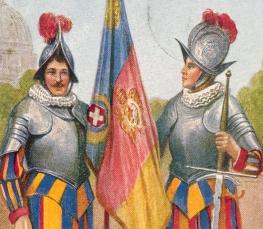
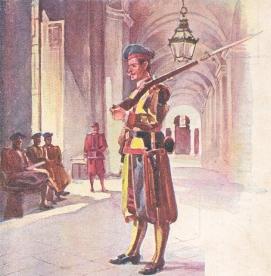
| During his many campaigns Julius II drove Cesare Borgia out of Italy, restored the Papal States, forced an alliance with Venice and Spain and then began an offensive against the French in northern Italy. The King of France, Louis XII, tried to have Julius deposed, but the warrior-pope outmatched him diplomatically as well, forming the Holy League and succeeded in driving the French completely out of Italy. His legacy was a secure Church and an empty treasury, but also a beautified city of Rome thanks to his great patronage of the arts, for Julius was a true "Renaissance Man" as good at artistic appreciation as he was at learning, love and war (he did have a few illegitimate children before his election to the papacy). It was also Julius II who granted the dispensation for Catherine of Aragon to marry the future King Henry VIII of England and it was Julius who hired the first Swiss mercenaries who became the Pontifical Swiss Guard, troops who continue to guard the Pope and the Vatican to this day. |
|
|
| Coming after Julius, Pope Leo X had the distinction of seeing Rome at her height of culture and glory, but also of presiding over the outbreak of the Protestant Revolt. Yet, Leo X did not think this latest heresy would be any more dangerous than the others that had risen and fallen in the past, and the action taken against the Protestants was done by the Holy Roman Emperor Charles V. Following the brief reign of the Dutch Pope Hadrian VI, Pope Clement VII saw the fury of Protestantism first hand when Imperial troops, mostly German Lutherans, sacked and brutalized the city of Rome. The Swiss Guard fought almost to the death and Clement VII was taken hostage for a time before reconciling with Charles V. Finally, as the Emperor had been urging, a Catholic Reformation was launched by Pope Paul III. |
|
|
| Militarily a time of relative peace ensued as the Church focused on reform and sending the Jesuits out to re-convert the Protestants who had broken away. That is not to say there was no conflict in this period of history, far from it, but it was mostly carried out by the Spanish and Austrians against the German and Dutch Protestants, as well as the French who continued to fight each other. The Muslims were also a major threat, even more so now since the Catholic world was more or less surrounded with Protestants to the north and the Turks to the south. To combat a planned Muslim invasion of Italy, the great Pope St Pius V formed an alliance of Catholic powers who contributed ships to a multi-national fleet to stop them. The fleet, which included papal galleys sent by Pius V, was commanded by Don John of Austria and won a miraculous victory over the Turks at Lepanto in 1571 after the Pope had commanded all Catholics to pray the rosary for deliverance. |
|
|
| His successor, Gregory XIII, also took no action himself, but actively supported Catholic arms across Europe as they battled the Protestants for the heart of Christendom. After him came the unstoppable Pope Sixtus V who brought law and order to Italy through the time honored method of fair and frequent executions for bandits. He also endorsed King Philip II of Spain's planned invasion of England by the Armada, which was ultimately thwarted. The wars of religion came and went, the worst being the Thirty Years War in Germany. Pope Urban VIII was the next to be involved in the petty squabbles of Italian rivalry which many had thought were thankfully passed, and which just as thankfully more or less died with him in 1644. It was a mark of how politically weak the Church was becoming when King Louis XIV seized the Papal enclaves in Avignon and Venaissin and Pope Alexander VII had no choice but to accept the loss in 1664 after finding no friends to come to his aid in the matter. Successive popes had to deal with the Muslim threat, but found few people willing to help when not directly threatened, and with the duplicity and ambition of King Louis XIV, against whom no one seemed capable of helping. |
|
| As time went on the most popes could do militarily was to approve or disapprove of the campaigns of others. Nor was the Papacy able to defend itself when preyed upon by the major powers as was proven when Imperial soldiers conquered Naples from Pope Clement XI, who was also later forced to give up the papal fiefdoms of Sardinia and Sicily, nor was he able to help Venice when they were attacked by the Muslim Turks. The days of being a major temporal as well as spiritual power seemed to have passed for the Church, though it was not until the reign of Pope Benedict XIV that the Papacy came to terms with the fact. However, the Papal States remained and as long as they did they would need soldiers to defend them, though the Popes recognized they could not expect to repel a determined invasion, nor would they lead them in person ever again. |
|
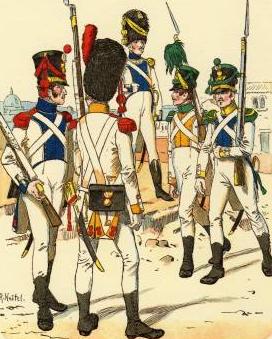
| The next major challenged came with the French Revolution and the subsequent invasion of Italy by Napoleon Bonaparte who overwhelmed the tiny papal army, seized Rome and took Pope Pius VI prisoner. Some wondered if the Catholic Church was about to fall when Pius VI died still in French captivity, but naturally the Church pressed on. Pope Pius VII was elected and after an attempt at reconciliation became one of Napoleon's most persistent adversaries and like his predecessor was ultimately taken prisoner and brought to France. However, Pius VII saw the end of Napoleon and was welcomed back to Rome with considerable fanfare, including his newly recruited soldiers who stood ready to take up their duties once again. |
|
|
|
 |
|
 |
|
|
|
|
Papal soldiers, 1816 |
|
Swiss Guard rifleman |
|
| Once again a period of peace ensued. The Congress of Vienna restored all territories to the princes of Italy, including the Pope, and the Church focused mostly on missionary work and asserting the rights of Catholics in countries where the growth of nationalism was proving oppressive. During the reign of Pope Gregory XVI, when many revolutions swept Europe, Rome was not immune though the weakness of the papal military meant that the Pope had to rely on Austrian troops to suppress the rebellion. An intractable conservative, Gregory XVI was succeeded by a supposed liberal, Blessed Pope Pius IX. Those who thought he would be friendly toward the causes of revolution and nationalism though, were soundly mistaken. |
|
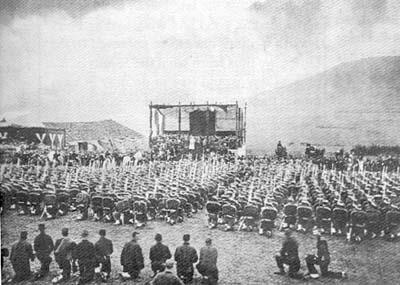
| Pius IX, the longest reigning pope after St Peter, was soon under attack by liberal revolutionaries and the Kingdom of Piedmont-Sardinia. Forced to confront such hostile forces he entrusted the newly created office of Minister of War to the former Belgian soldier Monsignor Xavier de Merode. Catholic volunteers were called from all over the world to defend the Papal States, men coming from such nations as Austria, Switzerland, France, Ireland and Canada. In command was General Christopher Lamoriciere, a French monarchist and cousin of Merode. When supported by French and Austrian forces, the Papal Army was successful in defending the area around Rome. However, after the outbreak of the Franco-Prussian War in 1870 France withdrew her forces and the small Papal Army was quickly overwhelmed by massive Italian forces. The Papal States are conquered and Pius IX withdrew behind the walls of the Vatican in protest, the start of almost 60 years of self-imposed exile. Although Pius IX, like most monarchs, did not lead his forces in the field, he was the last to have a standing army at his command. |
|
|
 |
|
 |
|
|
|
|
|
The Noble Guard |
|
|
Pius IX blessing his army of international volunteers |
|
|
|
|
|
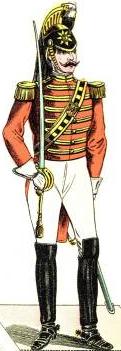
| With the fall of the Papal States the possibility of a warrior-pope was extinguished. The sole military forces remaining in the Vatican were the Noble, Palatine and Swiss Guards, of which the Noble Guard and the Palatine Guard were disbanded in 1970 by Pope Paul VI. However, that is not to say that there has been no papal connection to the military since that time. The jovial "Good Pope John" Blessed Pope John XXIII was a soldier, having been drafted into the Royal Italian Army in World War I where he served as a medic and a chaplain rising to the rank of sergeant before the end of the war. Pope John Paul II was under fire as a young man during World War II when Germany invaded Poland and once again as Pope in 1981 when he survived an assassination attempt in St Peter's Square. |
|
| Controversialists were quick to attempt to make an issue out of the past military service of Pope Benedict XVI. As a 16-year-old boy, Joseph Ratzinger was drafted along with other young boys into the German Air Force to serve in the anti-aircraft artillery corps. Their purpose was to guard important installations from Allied bombers, but Ratzinger never actually harmed anyone, working with a telephone rather than a field gun. He was subsequently drafted two more times, the first time to dig defenses against the Soviet offensive in Eastern Europe and the second time into the regular German army. However, his unit saw no action. In short, the supposed "controversy" about the Pope's service in the German military is much ado about nothing. |
|
|
| The case of warrior-popes in general should never be one that Catholics are made to feel ashamed of. The vast majority of pontiffs have been men of peace, and most of those who resorted to warfare would have much preferred peace and did so only as a last resort. The Church, Christ said, will endure forever, but since the Church does exist in time, every pope has had to deal with the circumstances and problems of his own time. In same cases, when violent forces and invading armies threatened the Church, it was necessary for the earthly leader of that Church to fight to defend it. The image the popes have to follow is the image of Christ, the good shepherd. The good shepherd cares for his flock, watches over them, sees that they are fed and kept strong, but when danger does arise it is also the role of the good shepherd to defend his flock and fight off the wolves. |
|