
The Saintly Hermit

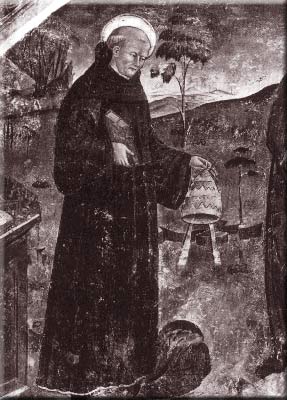


He was born Pietro del Morrone in 1209 or 10 in Molise, Italy in very humble surroundings. He was a peasant, the 11th of 12 children and always desired nothing more than to be of humble service to Christ. This led him to become a hermit at age 20, as well as later a priest after being ordained in Rome. In 1246 he joined the Benedictine Order in Faizola. Eventually he would found his own monastic order, the "Celestines". Throughout his long life he gained a reputation for holiness and for performing miracles. This naturally attracted great crowds and it was a constant struggle for Peter between wishing to serve God in isolated anonymity and the call to help people through the miraculous gifts God had given him. His sense of duty to the Church and his wish to live the life of a simple hermit would have a hard time being reconciled.
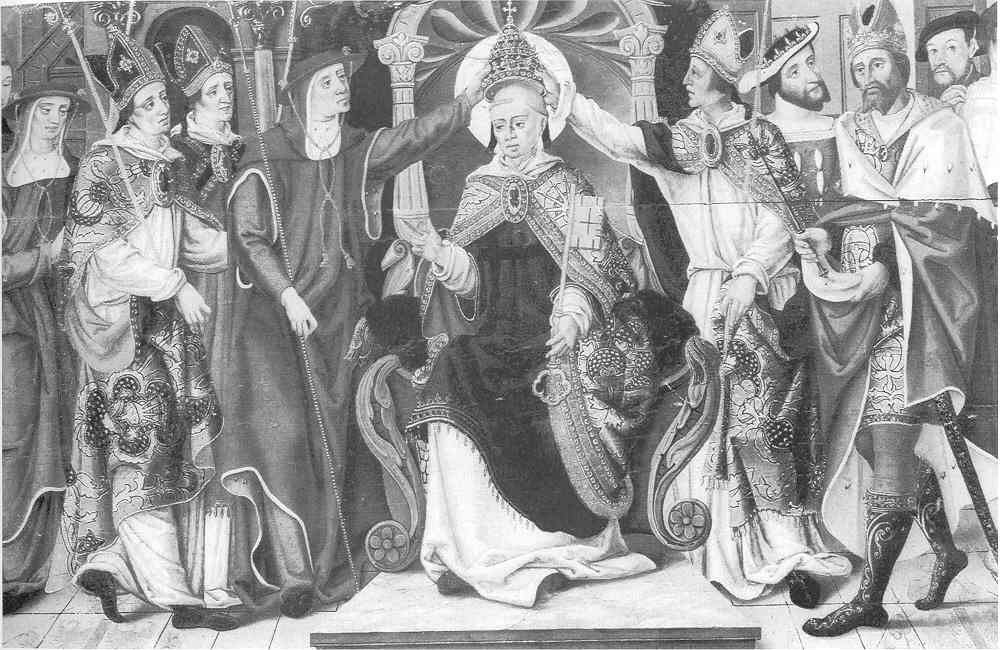
The Church, at this time, was going through a hard time. Pope Nicholas IV had died in 1292 and it seemed that no one could be found to succeed him. The Conclave went on for weeks; weeks turned to months and months turned to years and still no pope was chosen. The cardinals began to feud with each other and Peter Morrone was called to send a letter to them at Perugia warning them that they would face the wrath of God if they did not make a decision. It was as if all of the cardinals eyes were opened at once and to his great surprise, and even horror, the simple Benedictine hermit Peter Morrone was elected to the See of Peter. The 85-year-old man was overcome with anxiety at the thought of such a burden and for a time considered running away, but King Charles II of Sicily prevailed on the old man to accept God's will and escorted him to Aquila for his consecration. He had been elected on July 5, 1294 and took as his reigning name Celestine V though it had taken all the persuasive powers of the King of Sicily & Naples, the King of Hungary, the Archbishop of Lyons and his own devoted sense of duty to the Church that caused him to accept.
However, the reign of Pope Celestine V was not to be a happy one. King Charles II played on his innocence and influenced him to appoint his favorites to Church office, even going so far as to make him "guardian" of papal elections. There were soon growing fears that the Church would fall totally under the power of the Sicilian monarch. Celestine V was under no illusions about this and was the first to admit that he was out of his depth when it came to dealing with princes, policy and administration. He even lived in Naples rather than Rome because Charles had prevailed on him, in all "sincerity" the necessity of doing so. Celestine V could see that he was being used, but his holiness did not allow him the ability to scheme, distrust or think evil of anyone and after only 5 months and 9 days on the Papal Throne he abdicated on December 13, 1294.
The legal basis of his abdication had been worked out by Benedetto Cardinal Caetani who was quickly elected after him as Pope Boniface VIII. The new pontiff was everything that Pope Celestine V had not been, and one of the things he was very pragmatic about was the threat of enemies trying to unseat of in favor his still living predecessor Celestine V. As a result of this, he stopped Celestine from retreating to the remote mountains and confined him to a cell in Fumone castle. This may seem harsh, but as Celestine V himself said, "I wanted nothing in the world but a cell, and a cell they have given me". He died ten months later, amidst rumors of mistreatment and even poisoning. In truth, it was an infection which was probably worsened by his ascetic lifestyle that took his life on May 19, 1296. His great holiness and many miracles ensured that he would not be forgotten and he was canonized in 1313 by Pope Clement V.