 |
|
|
|
|
|
|
|
|
|
|
|
|
|
|
|
|
|
|
|
|
|
|
|
|
|
|
|
Popes and Caesars: The Emperors of Rome and the Early Roman Catholic Church |
|
|
 |
|
|
|
 |
|
|
|
|
|
| ����������� When one thinks of Christianity and imperial monarchy most would think of the Holy Roman Empire of the Germans or the colonial empires of the Christian kingdoms of Spain, France and Portugal. They think of Charlemagne and his successors but not very often does one think of the Catholic Church in terms of the original Roman Empire. Most are familiar with Sts Peter and Paul being martyred by the Emperor Nero who is alleged to have fiddled while Rome burned, but not a great deal beyond that is very widely known and of course Nero was only the fifth Emperor of Rome. Obviously there is a great deal of shared history with the Roman Catholic Church and the Roman Empire which contains some fascinated stories. |
|
| ����������� According to Christians, God does nothing mistakenly or by chance. Everything God does is done for a reason and the fact is that God the Son, that is Jesus Christ, came into the world during the reign of the first Roman Emperor: Augustus Caesar. Everyone knows the Christmas story of how Caesar Augustus ordered a census to be taken of the whole Roman Empire and this required every man to register in the city of his birth. As such, St Joseph and the Blessed Virgin Mary set out for Bethlehem; where Christ was born as foretold by the ancient prophets of Israel. However, Augustus probably never heard about Jesus, the prophecies or the bloodshed that forced the Holy Family to go into a temporary exile in Egypt. By pagan standards Augustus was a good emperor and he was deified after his death just as his uncle Julius Caesar had been. |
|
| ����������� When Christ reached adulthood and set out on his mission in the world it was during the reign of the Emperor Tiberius, the adopted heir of Augustus. The Gospel of St Luke says that St John the Baptist was called by God in the fifteenth year of the reign of Emperor Tiberius and he is referred to on several occasions. Although never very popular, Emperor Tiberius was an effective if ruthless leader. He declined flattering honors, maintained the Peace of Rome (Pax Romana) initiated by Augustus and he saved money. Not many Christians are aware of the fact that when Christ told the Jews, who questioned the righteousness of paying tribute to a pagan emperor, to give to Caesar what belonged to Caesar; the Caesar he was talking about was Tiberius. Likewise, when the Jewish authorities claimed that Jesus was no friend of Caesar because of his statement of kingship, Tiberius was the Caesar in question. Ironically enough, Tiberius spent the last 10 years of his life on the island of Capri surrounded by debauchery, perversions and a paranoid fear for his own safety and he had many put to death who did or were even suspected of challenging him. However, of the Christians, Tiberius ordered that they were not to be persecuted nor even accused in Roman society. Tiberius even, allegedly, tried to have Christ included among the pantheon of Roman gods but the Senate refused. He also recalled Pontius Pilate from Judea shortly before his death. |
|
| ����������� The apostles continued their work throughout the brief, nightmarish reign of Caligula and the more sound administration of the Emperor Claudius. His successor was the Emperor Nero, the last of the founding dynasty of the Roman Empire. During his reign Sts Peter and Paul both came to Rome and built up the Church there, gaining many converts, especially among the lower echelons of society. It remained, nonetheless, a very small and scattered group of believers. When Nero, in his unmatched arrogance, wanted to clear land to build a new palace he had a huge section of Rome burned and used the rather unknown minority of Christians as scapegoat for the disaster. He had Christians butchered wherever he found them, but this does not stand out a great deal in the history of the reign of Nero. St Peter was martyred as was St Paul and many others, but Nero had so many people of every variety in the Roman Empire terrorized most contemporary historians make no mention of his persecution of the Christians. They simply were not deemed important enough or numerous enough to warrant a great deal of attention. |
|
|
| ����������� Chaos followed the forced suicide of Nero and the first successor of St Peter, Pope St Linus, witnessed the life and death of a number of Roman Caesars. Perhaps the most dramatic historical act witnessed by Pope St Linus was the suppression of the Jewish Revolt and the destruction of Jerusalem by the Emperor Titus who brought back many captured treasures of the Jewish people and for whom a lavish triumph was held in Rome. This was, generally, a hard period for the Catholic Church, still in its infancy and there is not a great deal of detailed information that has survived. For some time it was believed that the early Pope St Clement I was a cousin of the Emperor Domitian, but this seems unlikely and St Clement I was martyred in the reign of Emperor Trajan. Some of the confusion may come from the fact that Clement was likely a freedman in the imperial household of Domitian. Incidentally, a popular legend in the Middle Ages was that Pope St Gregory the Great brought Emperor Trajan back from the dead and baptized him. This can at least be seen as an illustration of how intense was the faith of the people in the holiness of Gregory the Great as well as the lasting legacy of Caesar Trajan under whom the Roman Empire reached its peak of size and power. St Thomas Aquinas also listed the Emperor Trajan as one of the better pagans. |
|
| ����������� Pope St Sixtus I is known to have ruled the Church during the reign of the Emperor Hadrian and that Pope St Pius I lived during the reign of the Emperor Antoninus Pius. The reign of Antoninus Pius is known as the most peaceful and benevolent of all the Roman emperors and he is listed as the fourth of the five, so called, good emperors of Rome. There were martyrdoms during his reign and Antoninus was a devout pagan but he did not make any effort to persecute the Church and condemned any illegal attacks on the Christian community. More persecutions were to occur under the reign of his successor Emperor Marcus Aurelius, known as a thoughtful and stoic philosopher but also a rather fanatical and superstitious pagan. He came to the purple during the pontificate of Pope St Soter and Marcus Aurelius tended to blame lapses in the fortunes of Rome on the anger of her gods over Christians refusal to worship them. The successor of St Soter, Pope St Eleuterus, was fortunate enough that Emperor Marcus Aurelius did not institute the massive persecutions other Caesars did in Rome itself but many were martyred throughout the empire though Christianity continued to grow. |
|
|
| ����������� Marcus Aurelius did relent in his stronger opinions somewhat and probably the most famous event of his reign regarding the Christians came while on campaign in what is now Romania in one of the many wars that marked his time as Caesar. In 174, while fighting the Quadi, the Roman forces were parched for lack of water and near defeat. The XII Legion, made up of mostly Christians, prayed to God for deliverance and victory and a great thunderstorm erupted which replenished the Romans and terrified the Quadi. The Romans were victorious and the grateful Emperor Marcus Aurelius named the XII the Thundering Legion for their victory. Church leaders used the example of the Thundering Legion to shame the Emperor for his treatment of the Christians and he did relent somewhat at the end of his life. There are even reports that, despite his persecutions, Marcus Aurelius included Christ and the Patriarch Abraham among his personal pantheon. |
|
|
 |
|
|
The Emperor Commodus |
|
|
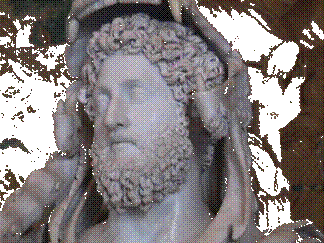
| ����������� Marcus Aurelius was succeeded by a man many consider one of the worst Roman Emperors, Commodus Caesar. The son of Marcus Aurelius, Emperor Commodus glorified himself in many ways and acted in a manner viewed by many as unbecoming of a Caesar. Many of the people liked him but the senatorial class viewed him as an enemy and the feeling was mutual. One of his oddities was his fondness for gladiatorial combat and he would appear dressed as Hercules and fight in the Coliseum in games that were of course staged to ensure his victory. However, Emperor Commodus, unlike his father, did not persecute Christians. One of his mistresses was a Christian named Marcia and she is credited with using her influence with Commodus to secure the release from prison of the future Pope St Calixtus I. His pontificate also saw the reigns of the Emperors Heliogabalus and Alexander Severus during whose reign he was martyred. |
|
| ����������� Following the death of Alexander Severus the system of Roman government built around the office of First Citizen, as built up by Augustus, began to deteriorate. After Alexander, at the prompting of the XXII Legion, Maximinus Thrax became Emperor of Rome, though he was a barbarian by birth and never actually set foot in the EternalCity. He was disliked by the Senate because of his peasant birth and he certainly won no friends among the Christian community as he sent many Church leaders into exile as slave laborers, including Pope St Pontian who had to abdicate the papacy before he was sent to Sardinia. After the brief reign of St Anterus the papal throne passed to St Fabian. Some claimed that Pope St Fabian baptized the Roman Emperor, Philip the Arab (so called because he was born in Syria), at the end of his life but this is widely doubted and most do not recognize Philip as the first Christian Emperor. He worshipped the pagan gods as all emperors had before him, but he was much kinder toward the Christians than either his predecessor or his successor. |
|
| ����������� After Philip the Arab came Decius Caesar. As emperor he singled out the Christians as scapegoats for all the problems in the Roman Empire and encouraged public hatred of the religion. Bloody persecutions ensued and St Fabian was martyred. Even a plague that swept the empire was blamed on the Christians; a punishment in pagan eyes for the Christian refusal to worship their native gods. A brief lull in the violence allowed for the election of Pope St Cornelius but he was quickly exiled and martyred himself by Emperor Trebonianus Gallus who continued the reign of terror into the pontificate of Pope St Lucius I. Trebonianus Gallus was eventually overthrown by an up and coming military commander, Emperor Aemilianus, but he lasted only three months. He was killed by his own men when challenged by another general, loyal to the dead Gallus, who became the next Caesar; Emperor Valerian. The persecution of the Church had lapsed during this time and this allowed for the election of Pope St Sixtus II. He would soon face one of the worst campaigns of cruelty the Christian faith had yet seen. |
|
| ����������� Emperor Valerian, for the usual reasons, went bloody again where the Church was concerned and in 258 ordered the immediate execution of all bishops, priests and deacons of the Church as well as anyone of any rank or social standing who refused to sacrifice to the pagan gods of Rome. Troops stormed in where Pope Sixtus II was saying mass and the saint willingly identified himself as the Bishop of Rome. The four deacons assisting him also stepped forward to accept martyrdom. They were all immediately beheaded on August 6, 258. Cyprian of Carthage and St Lawrence (a deacon of St Sixtus II) also suffered martyrdom during the persecution of Emperor Valerian. It may be that God inflicted some divine retribution on Caesar Valerian as in 260 he became the only Roman Caesar to be captured in battle. After being defeated by Emperor Shapur I of Persia Valerian was humiliated tortured, executed, skinned and then his remains were stuffed and kept as a trophy of the Persian emperor. |
|
|
| ����������� The Valerian persecution was so fierce that for almost a year the Holy See was vacant. That changed in 259 with the election of Pope St Dionysius whose pontificate saw the end of Valerian and the succession of the Emperor Gallienus who put a stop to the persecutions, allowed religious toleration and extended legal recognition to the Catholic Church. However, in secular matters, Gallienus was not an overwhelming success. Roman power was forced on to the defensive and a greater legal glorification of the imperial throne was undertaken. However, for the Church it was a welcome respite which lasted until 303 and enabled Pope St Dionysius to be the first Catholic Pope who did not die the death of a martyr. After Gallienus came Emperor Claudius II, who was deified after his death, who reigned only a short time but won a stunning victory over the Goths, shored up the defenses of Rome and maintained peace with the Church. |
|
| ����������� This interlude continued throughout the short reign of Emperor Quintillus but came to an end with the rise of the immensely successful Emperor Aurelian. In many ways he was a colossus and a man with good ideas about leadership. He reunited the Roman Empire, restored the old grandeur of Rome, enacted legal reforms and was the first to put forward the idea that Rome should be one empire with one god. Unfortunately for the Christians the one god he had in mind was the Roman sun god with himself acting as a sort of deputy. Coins struck during the reign of Aurelian bear the title of Dominus et Deus (lord and god). Pope St Felix I was martyred during the reign of Aurelian for his refusal, along with the other faithful Christians, to accept the religious policies of Aurelian. The next pope was also martyred by Aurelian but his successor, Pope St Caius, holds the distinction of being a relative of the Roman Emperor Diocletian. |
|
|
| ����������� Diocletian was brought up by the Emperor Galerius who was very much opposed to Christianity. His reign coincided with the election of Pope St Marcellinus. After a brief respite in which the Church grew and flourished, Emperor Galerius instituted a pagan revival that specifically targeted Christians around the year 302. He dismissed Christians from the Roman legions, confiscated Church property, destroyed Christian literature and forced any Christian who was taken to renounce the faith or suffer martyrdom. Yet, in spite of this, on the edges of the empire, Christianity continued to grow and it was during the pontificate of St Marcellinus that the Kingdom of Armenia became the first officially Christian nation in the world. The Emperor Diocletian also ruled during this time and gained a place in history as one of the most cruel and ruthless enemies of the Church and yet also one to whom the Church owes its style of organization. His division of the Roman Empire was later adopted by the Church and it is for that reason that the Catholic world is based on the unit of the diocese which is taken directly from Emperor Diocletian and his organization of the Roman Empire. |
|
| ����������� Following St Marcellinus was Pope St Marcellus I who was banished from Rome by the Emperor Maxentius in the midst of continued religious persecution. It must have seemed by many among the flock of the faithful that their tribulation would never end. Their had been periods of peace under certain emperors, but keeping the faith must have been immensely difficult in light of the long succession of Roman emperors who were at best indifferent and at worst openly hostile to the Christian religion. The two following popes also suffered under the heavy hand of Emperor Maxentius and the future must have seemed bleak indeed but all of that was to change toward the end of the reign of the next Bishop of Rome, Pope St Sylvester. For it was during the reign of St Sylvester that the fragmenting Roman Empire came under the rule of a new and dynamic Caesar, Emperor Constantine the Great. |
|
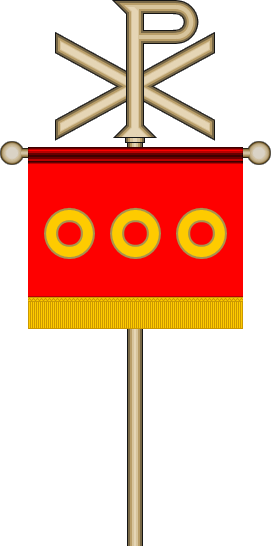
| ����������� Emperor Constantine was the son of a Christian mother, regarded by England as one of their own, St Helen of the Cross. Although a pagan of the national religion for most of his life, Constantine was hailed as emperor and secured his hold on power by his victory at the battle of the MilvianBridge. Constantine, tradition says, had a vision of the True Cross and the promise that under the sign of Christ he would conquer. After this, he had the Christian symbol placed on the shields and standards of his troops and as promised emerged victorious from the battle. He soon issued the Edict of Milan, the first legal document of religious toleration ordering that there be no further persecution of Christians in the Roman Empire and which specifically recognized the Roman Catholic Church as the one and only Christian organization existent. It is impossible to overstate his importance in the life of the Church, though he was a sinful and ruthless man in political matters. Catholics know that St Helen traveled to the Holy Land and recovered the True Cross along with other relics and that Emperor Constantine had built the Church of the Holy Sepulcher in Jerusalem and the old Basilica of St Peter in Rome on the Vatican Hill where St Peter was martyred at the Circus of Nero. Significantly, the Emperor Constantine also presided over the First Council of Nicaea which condemned the Arian heresy, articulated the doctrine of the Holy Trinity and established a fairly simple code to reflect exactly what doctrines all Christians were bound to believe. At the end of his life he was baptized by Pope St Sylvester and thus became the first Christian Emperor of Rome. It was, in so many ways, the dawning of a new day in the ancient world. |
|
| ����������� The son of Constantine the Great, Emperor Constantine II was the first Caesar to be raised in the Christian faith. He was Catholic and a benefactor of the great St Athanasius, but he ruled jointly with his brothers Constantius II and Constants. Emperor Constantius II was an adherent of the Arian heresy and Constantine II was eventually overthrown by his younger brother Constans. It was during the reign of Constantius II that Pope Liberius became Bishop of Rome and he was, significantly denied sainthood because of his actions and the painful divisions the Church suffered during the period. Exiled by Emperor Constantius II he later compromised himself with the Arian heresy though he returned to orthodox Catholicism before his death. Further suffering for the Church lay ahead, but thankfully there was light on the horizon and it was only a matter of time before the Church would triumph over paganism in the Roman Empire. A last frightening jolt came during the reign of Pope Liberius with the elevation of the Emperor Flavius Claudius Julius, known to Christians as Julian the Apostate who was the last pagan Roman Emperor. He had been forced to accept Arian Christianity as a youth and reacted in the way many do who are dragged into a religion. As soon as he came into his own he rejected it violently. He advocated religious freedom on the one hand while also undertaking a campaign to remove Christianity from imperial influence. His death in battle in 363 brought a return to Christianity and ended this last pagan backlash in Rome. |
|
|
|
 |
|
|
 |
|
|
 |
|
|
|
|
|
|
St Damasus, Emperor Theodosius and St Ambrose rebuking Theodosius |
|
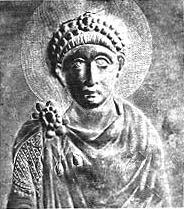
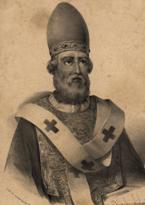
| ����������� After Liberius came the pontificate of Pope St Damasus whose reign saw a number of Roman emperors and which was to have a considerable impact on the Roman Catholic Church. Two short reigning Caesars followed Julian the Apostate before Gratian became Emperor of the Western Roman Empire in 375. It was Emperor Gratian who surrendered the title of Pontifex Maximus or Supreme Pontiff, which all the pagan Roman emperors had held since Julius Caesar. In 381 he surrendered this ancient title to Pope St Damasus. He also took down the famous Altar of Victory in the Roman Senate and forbid favors to the Vestal Virgins. This caused an uproar among the pagan elites of Rome, but ironically enough for a Christian monarch, after his death the pagan Senate deified him and so there was the odd situation of a Christian Emperor being referred to by his pagan subjects as the Divine Gratian after his death. Emperor Gratian was also precise in stating, at a time when as ever heresies were numerous, that true Christianity was that which was taught by the Bishop of Alexandria and most especially the Bishop of Rome. |
|
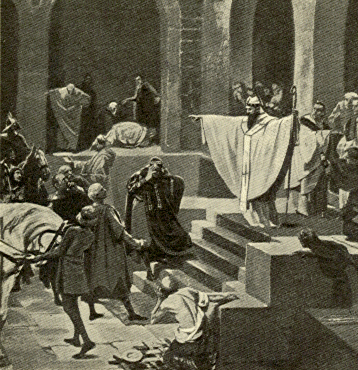
| ����������� While Gratian was Emperor of the West, a Spanish born Roman general named Theodosius became Emperor of the East. In time he would become known as Theodosius the Great and the last Roman Emperor to rule over both the east and the west. He was also a contemporary of Pope St Damasus as well as his one time secretary the great St Ambrose of Milan. At the outset, Theodosius had his differences with St Ambrose, but the holy bishop guided him with a firm but forgiving hand, once even forcing Theodosius, the Emperor of Rome, to make a public confession for a massacre that occurred on his watch and to humble himself and do penance before being allowed to receive communion. All of this only seems to have made Emperor Theodosius a better Christian and in 391 he made the Roman Empire officially Christian, outlawing pagan worship and stating that the religion of the people of Rome would be that, "which Holy Peter delivered to the Romans...and as the Pontiff Damasus manifestly observes it". Obviously this was a crucial step in the history of both Christianity and the Roman Empire. |
|
| ����������� Emperor Theodosius and Pope Damasus seemed to be good together. Saint Damasus was adamant that Rome was the Apostolic See and by virtue of the martyrdoms of Peter and Paul it was the See of Rome which was preeminent over all others. Interestingly enough, in the earliest life of the Church when written scriptures were few and far between, the primary argument for papal supremacy did not bother a great deal with Biblical quotes but used the simple defense of tradition. The Bishop of Rome was the leader of the Church simply because that is the way it had always been. However, as adamant as St Damasus was in emphasizing papal supremacy, he was also a man of great charm and persuasion. He was a very kind and genteel authoritarian and his papacy stands out for the fact that both the Roman Emperor and legendary Church figures like St Jerome clearly state that the Bishop of Rome is the supreme earthly head of the Church and that to be a Catholic is to be subject to the Roman Pontiff. In rather the same tradition as Emperor Constantine (the founder of Christendom in some ways) St Damasus was also helped by Emperor Theodosius who saw it as his imperial duty to uphold orthodoxy and fight heresy. In 381 he called the Council of Constantinople to deal with the still troublesome heresy of Arianism. |
|
| ����������� The successor of St Damasus was Pope St Siricius who protested against an execution by the Emperor Magnus Maximus, a usurper who was himself defeated and executed by Emperor Theodosius. After the reign of St Anastasius, St Innocent I became Supreme Pontiff, allegedly the son of his predecessor, and his papacy saw the crucial reign of Emperor Honorius. At this time the Roman Empire was under attack by barbarians from all angles and was kept alive largely thanks to the skill and energy of a half Vandal, half Roman general named Stilicho (a staunch Arian Christian) who fought constantly to keep the barbarians in check. Sadly, he was so successful he aroused the jealousy of lesser men with political influence who secured his downfall and eventual execution. This continuing decline resulted in the sacking of Rome itself by the Visigoths under King Alaric I in 410. Fortunately, Pope St Innocent I was away from the city at the time, being at Ravenna on business with Emperor Honorius. |
|
| ����������� The Visigoths spared Christian buildings in their pillaging (there were Arian Christians themselves) and after their departure St Innocent returned to Rome to undertake a charitable campaign to help the devastated city. Toward the end of his reign he also had the Pelagian heresy to deal with. The pontiffs who succeeded him also had to deal constantly with heresies and disagreements on everything from the Church calendar to Marian titles. As for Emperor Honorius, he was succeeded by Emperor Valentinian III whose reign saw many challenges and hardships, particularly from the most dangerous of the barbarian enemies of Rome; Attila the Hun. It was a period of horrible decline for the Western Roman Empire. Britain was abandoned to her fate, the Vandals seized North Africa and Gaul was ravaged by Attila. Foremost among the defenders of Rome was the general Flavius Aetius who defeated Attila at Chalons in 451. However, rather like Stilicho, his success was his undoing and Aetius was assassinated on orders from the Emperor. |
|
|
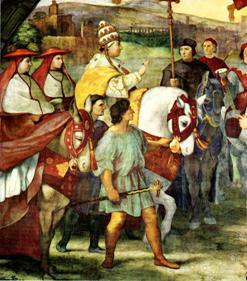
| ����������� When Attila the Hun marched on Rome itself there was nothing to confront him with. Earthly power having failed them, the Romans turned to Heavenly power and Pope St Leo the Great went personally to confront this most fearsome barbarian leader. The Pontiff met Attila near Mantua in 452 and somehow persuaded him to withdraw his attack and return to his own lands. It was a stunning and incomprehensible moment in history that is still speculated about to this day. Christian tradition says that Attila saw a terrifying vision in the sky above Pope Leo of the vengeance God would inflict on him if he continued his invasion. Other people have other theories, but the indisputable fact is that after meeting with the Pope the most successful and terrifying barbarian chieftain of them all simply gave up and went home. |
|
|
|
 |
|
|
Pope St Leo III rides out to confront Attila |
|
|
| ����������� The Church, as can be imagined, gained immeasurable prestige from this event and it is no wonder that even Emperor Valentinian III recognized, in law, the preeminence of the Bishop of Rome based on the right of inheritance as the Successors of St Peter, the Prince of the Apostles. As it happened, Emperor Valentinian was himself assassinated by former followers of General Aetius. He was succeeded by Petronius Maximus who was Emperor for less than a year in 455. Only a few days after his death, during the reign of Emperor Avitus (who was absent) the Vandals invaded and sacked Rome. Nothing could stop them, but thanks again to the efforts of Pope St Leo the Great; they did refrain from their usual scorched earth policy. Nonetheless, the sacking of Rome was indicative of the fact that the Empire was in its death throws and, in the west at least, did not have long to live. |
|
|
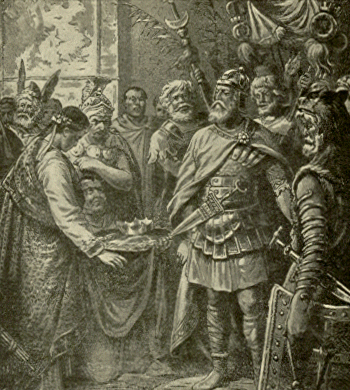
| ����������� St Leo the Great was succeeded by one of his closest assistants Pope Hilarus in 461. Not a man to be trifled with, he insisted on obedience within the Church and did not hesitate to confront Emperor Anthemius when he was teetering on the brink of heresy. He obtained from the Emperor a promise, at the tomb of St Peter, that he would not tolerate heretical or schismatic groups within the Empire. That Empire, though, was fading fast and the next pontificate, that of Pope Simplicius, witnessed the overthrow of the last Roman Emperor in the west, Emperor Romulus Augustulus. Oddly enough, the young Emperor was acted for by his father Orestes who had earlier been a lieutenant of Attila the Hun. He was replaced by the mutinous captain of his guard Odoacer, a heretical Christian but who nonetheless left Roman affairs mostly in the hands of the Pope, the only one willing or able to govern. The young Romulus spent the rest of his life living as a pensioner in a villa that was later converted to a monastery. |
|
|
|
 |
|
|
Emperor Romulus surrenders his crown to Odoacer |
|
| ����������� The Western Roman Empire was no more. Born of Augustus Caesar its creation coincided with the birth of Christ and the beginning of Christianity, yet while the Roman Catholic Church remained the Roman Empire went into history. There would not be another emperor in the west until Christmas Day of 800 when Pope St Leo III crowned the Frankish king Charlemagne Emperor of the Romans in the Basilica of St Peter; officially opening the era of the Holy Roman Empire though it never extended much beyond the German peoples throughout its long life. Of course, the Eastern Roman Empire remained but relations became troubled between the Pope and Church and secular leaders there almost immediately. Heretical beliefs were adopted without so much as a word to the Bishop of Rome, starting with the Monophysite heresy, and popes sometimes went for months after their consecration before being given the official approval of the Emperor of the East. The Great Schism followed a long time after and in time the Church witnessed the fall of the Eastern Roman Empire as well. Yet, even while the Roman Empire became a memory, echoes live on in the Roman Catholic Church even today. The vestments worn by the clergy are taken from the garb of Roman officials, the organization by diocese still remains, the official language of the Church is still Latin; the language of the Roman Empire, and the Pope is still titled as the Supreme Pontiff which is the oldest title in constant use in the world today. There were good times and a great many bad times in the history of the Church and the Roman Empire, yet Rome was, even at its worst, a beacon of light in an otherwise dark world and left a standard of culture, law and civilization that countless generations have tried to imitate ever since. Given that, Catholics should never be too offended when someone labels them as Roman. St Paul was proud of his Roman citizenship and Catholics today should be just as proud of our Roman heritage which was the vehicle God chose to spread the faith and the cradle of western civilization. |
|
|
| Pax Vobiscum |
|