 |
|
|
|
|
|
|
|
|
|
|
|
|
|
|
 |
|
 |
|
 |
|
|
|
|
|
|
|
|
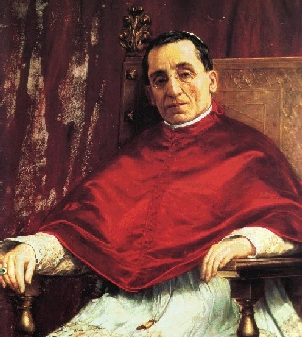
"Papa Della Chiesa" Pope Benedict XV |
|
|
|
r. 1914 - 1922 A.D. |
|
|
|
 |
|
|
|
|
With the newest pontiff taking the name of Benedict XVI, there has been a little more attention paid to the last Bishop of Rome of that name, Pope Benedict XV who reigned during the First World War. He reigned at a crucial time, not only in the context of a world at war, but in the context of a Church which was still in a state of siege in relation to the Italian state and was still recovering from the struggle of Pope St Pius X against the modernist influence. The man chosen to lead the Church at this time, did not look the part of the great hero, but proved in this way that God can accomplish great things with imperfect tool. When he was in the seminary the future pope, Giacomo della Chiesa, was so small and frail that he was nicknamed "Tiny" by his fellow students. Yet, it was this same man who, after being a Cardinal for only three months, was elected to the Throne of St Peter. |
|
|
The election of such a newly created cardinal was a clear indication that, particularly in the Europe of 1914, the Church needed someone with the ability to negotiate with surrounding countries and deal with the problems facing the world in a very practical way. Pope Benedict XV was an excellent choice for this job as he had already gained considerable experience as a papal diplomat during the reign of Pope Leo XIII when difficult negotiations were made with many governments, even anti-Catholic ones. |
|
|
|
Benedict himself, being the little, compassionate man that he was, stood in total horror of the effects of modern, industrialized warfare. Throughout the conflict, his entire energies were spent in the pursuit of an arranged, negotiated peace. To accomplish this, he adopted a strict policy of impartial neutrality. He refused to comment on any nation-specific charges of atrocities (a principle which would later embroil Pope Pius XII in unjustified controversy) but spoke out at length on the cruelty and inhumanity of the war as a whole, urging all nations to cease and come together in reconciliation. He proposed that all conquered lands be returned to their former owners and that each nation pay for its own reconstruction. Neither side was pleased with this, nor with his impartiality, calling him, alternately, the "Boche Pope" and "der Franzoesische Papst". A fairly good indication that his neutrality was genuine. |
|
|
It must also be remembered however, that at this time the Church was in a stand-off with Italy, which eventually became one of the warring powers. The Pope was still treated as a prisoner of the Vatican and still claimed (nominally at least) temporal authority over Rome and the Patrimony of St Peter. This was significant given that, hoping to gain papal favor, Germany offered to restore Rome to the Pope after the eventual defeat of Italy. Naturally, the Pope refused, sacrificing the possibility of regaining his country in order to remain faithful to his impartiality as universal pastor. It also meant that his fellow Italians were anxious to prevent the Pope from having any voice in international politics due to the lingering sense of guilt at what was a blatant invasion and conquest of the Papal States, which was the oldest country in Europe. |
|
|
Italy then, rightly so, was afraid that if the Pope became the arbiter of European peace, he might seek redress for the illegal seizure of his own country in the preceding century. Due to this, in one of the secret, under-handed agreements all too common at the time, Italy forced the other allied powers to agree, in 1915, that they would not deal or negotiate with the Pope in any way. Thus, the war went on until 1918 and afterwards Benedict XV was even denied representation at the peace conference of Versailles. |
|
|
|
Although greatly relieved that the war had ended, Pope Benedict XV showed considerable foresight in his great displeasure with the peace terms. He viewed the Treaty of Versailles as an un-Christian act of vengeance against Germany and could hardly have been pleased with the replacement of so many Catholic monarchs with anti-clerical, nationalistic, socialistic regimes. Ignored by the secular powers, Benedict XV, who had brought considerable diplomatic experience to the Papal Throne, was shut out of the peace process and his talents in this regard were wasted by the politicians of Europe. |
|
|
|
Yet, the Pope was determined still to come to the aid of his beleaguered flock. In fact, he all but emptied the Vatican treasury, giving some 82 million lire to aid the wounded, impoverished and homeless people left in the wake of the war. He also began trying to project a more open and friendly face of the Church and sent envoys across the continent to arrange concordats with the new governments to secure the future of the Church in Europe. In 1920 he even went so far as to officially allow other Catholic rulers to visit the King of Italy at the Quirinal Palace, which had been the official papal residence when the Popes were the temporal monarchs of Rome. He also allowed Catholics to participate in Italian politics once again, blessed the somewhat radical Catholic Partito Poplare, reconciled with France, which included the very popular and long awaited canonization of Saint Joan of Arc in 1920 as well as encouraging the growth of trade unions to secure the rights and fair treatment of workers. Sadly, not long after peace was finally secured in Europe, Pope Benedict XV died in 1922. |
|
|
The conditions which Pope Benedict XVI faces today are similar to those face by Papa Della Chiesa during and after World War I. Now as then, in fact even more so today, the Church is faced by a Europe that seems determined to deny her Christian roots and ignore the teachings of the Pope. Conflict in the world is still common and unity is in dire need, which Benedict XVI has promised to address. Surely the example of Pope Benedict XV will be an inspiration and source of strength for our current pontiff as he seeks to deal with the strife in the world, the creeping secularism and the attitude of indifference toward the Holy Church. |
|