
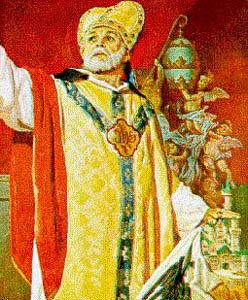
This was another case of God ensuring that the right man was in the right place at the right time, as the Church was in dire need of a strict, reforming pontiff like St Gregory VII when he was elected. Simony had become a widespread problem throughout the Church, there was a lack of education and a great deal of corruption as many bishops sought to enrich themselves and gain power through friendship with the local temporal authorities. Pope Gregory VII was determined to put a stop to that and took a firm hand in cleaning up the Church, no matter how difficult resistance might prove to be. And, it was considerable, as many of the worldy churchmen did not wish to lose their privelages. His struggle to reform the Church came to a head in the famous "Investiture Dispute" with the Holy Roman Emperor Henry IV.
The basics of the dispute was over whether or not it was the Pope or the Emperor who had final authority in nominating the bishops. The Emperor had come to wield considerable influence over the bishops in Germany and this alarmed Gregory VII, who knew that the spiritual authorities had to be free from secular influences and answerable to the Pope alone. There was also though a struggle within the Church behind all of this. St Gregory VII was cracking down on corruption and of course the corrupt clerics did not appreciate it. Ironically, Emperor Henry IV had at first agreed to support Gregory VII. However, the issue became too hot to handle when the Pope expelled any churchman who had purchased his position and ordered the return of all Church lands which had been sold in return for secular support. When the German bishops resisted this the Emperor supported them, seeing an opportunity to increase imperial control over the Church. However, in Pope Gregory VII they had found a man they should not have crossed.
The Pope issued many new reforms on how laymen were to join the priesthood and religious life and excommunicated anyone who interfered with these changes. He also called Henry IV to Rome to answer for his duplicity, but instead a rebellion was incited that drove the Pope from the city. Gregory was assited in this time of crisis by the powerful Countess Matilda of Canossa who never ceased fighting on behalf of the Pope and his authority. Any help was surely needed as the Emperor had called a synod of the German bishops who submissively bowed to imperial pressure and declared the Pope deposed; something they had absolutely no power to do of course, but which only proved how legitimate Gregory's concern was that the bishops saw themselves as servants of the Emperor rather than the Pope. So, in 1076 Pope Gregory VII took the ultimate step and excommunicated the Holy Roman Emperor and absolved his subjects of their allegiance to him. It was the first time in history that a Pope had ever excommunicated an Emperor.
The conflict was fierce, but it was to no avail, with right on his side it was St Gregory VII who had to emerge the victor. He had taken refuge in a castle of Countess Matilda's in Canossa where Henry IV came to repent in January of 1077. He shed all of his imperial regalia and stood barefoot in the snow for three days at the gate before being allowed in to humble himself before Gregory VII. He was forgiven, but the Emperor had been insincere, and as soon as his fortunes improved he was back to his old ways. Three years later Gregory VII excommunicated the Emperor again and this time went a step further and deposed him as well. This time, the Emperor went a step further and along with the German bishops elected Guibertus of Ravenna as an anti-pope against Gregory, taking the name Clement III. He also marched his German knights south and attacked and captured the Eternal City, driving out Gregory and putting Clement in his place. However, everyone knew this was completely wrong and soon Clement III was driven out of Rome as well.
Pope Gregory VII was aided in his troubles by Robert Guiscard and his Norman knights. However, this proved to be a double-edged sword as the Normans were so ill-behaved that the people rebelled and drove out the Normans as well as the Pope who died in Salerno in 1085. The struggle would go on for some time yet, but Gregory VII had taken a stand on reforming the Church, asserting the independence of the Church from the political authorities and had refused to be intimidated or back down. He was an inspiration and laid the groundwork for those who came after him to ultimately emerge successful in this struggle of Church reform and independence.