
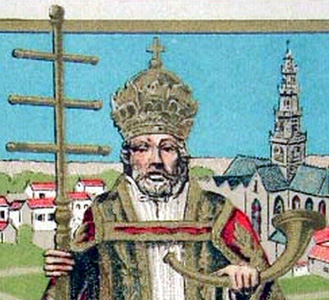
The image above is from a Belgian Holy Card. Pope St Cornelius is often shown with a horn, also oftentimes with cattle as he is the patron saint of herds. Because of this, he is also often taken as the patron saint of cowboys.
Everyone knows that the blood of the martyrs is the seed which grows and strengthens the Church, but systematic persecution can also cause problems of morality. Some Christians gave in to save themselves, others who were imprisoned, in light of the fact that they knew they would soon be dead, adopted the attitude that they might as well enjoy the time they had in any way possible since so little was left and confident that being executed for their faith would ensure them a place in Heaven. Dealing with sin was the number one topic for the Church when St Cornelius became Pope. A very intelligent, hard nosed presbyter named Novatian was so disgusted by the immorality around him that he declared that grave sins such as murder, adultery and apostasy could not be forgiven by any bishop on earth and that there was no hope of forgiveness before the final judgement of Christ. Those who had apostasized during the persecutions of Decius were of the most concern to the Church, and whether or not they could be forgiven was a major issue. Novatian said no.
Pope St Cornelius, of course, did not accept such a view, knowing that Christ had given the apostles the power to forgive the sins of all who would repent. St Cornelius was firm that no sin was too great for the power of Christ to forgive and that anyone who, with a sincere heart, repented and confessed their wrong doing would be absolved and their sins forgiven. St Cyprian of Carthage and St Dionysus both agreed with Pope Cornelius. Novatian refused to accept this and went into rebellion, setting himself up as a rival to St Cornelius. So it was that, along with the wrath of Emperor Decius, Pope Cornelius became the first Bishop of Rome to deal with the antics of an anti-pope. He convened a synod of 60 Italian bishops which reaffirmed St Cornelius as the legitimate pope. Novatian was forced to flee Rome, but his heretical followers remained and the Church had a foretaste of the sort of problems she would have to face time and time again in the future.
Details about the Church this early in her history, and in a time of such persecution are hard to come by, but thanks to the writings of St Cyprian in Carthage, North Africa, we know that the Church in Rome had roughly 155 clergymen and was able to support 1,500 widows, orphans and poor. The Pope's correspondence with St Cyprian on dealing with apostates also illustrates the primacy of the See of Rome from the very begining of the Church. In Rome itself though, troubles arose again when Trebonianus Gallus became Emperor and exiled Pope Cornelius to Civita Vecchia to punish not only himself, but the whole Christian community. The action was taken on the belief by the pagans that a plague which had broken out in Rome was caused by their gods' anger at the presence of the Christians who refused to worship them. Early Christians were often easy scapegoats in this way. Pope Saint Cornelius died shortly into his exile in June, 253 after reigning for about two years and three months. The Feast of Sts Cornelius and Cyprian is celebrated on September 16.
