 |
|
|
|
|
|
|
|
|
|
|
|
|
|
|
|
Catholicism and Classic Horror |
|
|
 |
|
| When Universal Pictures released the first modern horror films, namely Dracula and Frankenstein, the Catholic League of Decency was outspoken in its opposition on grounds that modern audiences would find so mild as to be merely laughable. However, quaint opposition aside, classic horror films, especially the original Dracula and Frankenstein films, were awash with Catholic symbolism and even values in some ways. From the basic fundamentals of the stories to the visuals of how the movies were shot there are subtle and not so subtle reminders of Catholicism everywhere. Starting, from the beginning, with Dracula, we have the story of an unholy resurrection; a common theme in classic horror based on the demonic effort to always mockingly mimic God and the sacred. Catholic references and symbolism abound in the film from the very beginning. |
|
| On the road to the inn in the opening scene we see Hungarian peasants cross themselves and pray to the Virgin Mary for protection against the supernatural evils that lurk in the mountains (when Dracula was filmed Transylvania had long been a province of Hungary and only recently awarded to Romania as a reward for joining the Allies in World War I, in 1931 Transylvania was still most associated with Hungary rather than Romania). At the inn, the innocent Mr. Renfield is given a crucifix as a reminder, the presenter says, of the mother faith, which will protect him. When Renfield reaches Castle Dracula and meets the infamous count the vampire quotes scripture to him, mentioning that the blood is the life; a reference to a verse in Deuteronomy. In this way the story as a whole plays into a very Catholic theme. Dracula must have blood to live, a demonic reverse of the need for mortals to drink the blood of Christ to achieve salvation and eternal life. |
|
| When Renfield reaches his room in the castle we see more Catholic symbolism. His crucifix causes Dracula to shy away, illustrating how the demonic is repelled by the sight of the sacred. Count Dracula also ceremoniously gives Renfield refreshments which are, interestingly, bread and wine. When Dracula makes his journey to England and first appears on the streets of London and claims his first foreign victims it is noteworthy how the Universal Dracula differs from the character imagined by Bram Stoker. In the original novel Count Dracula was a repulsive, even animalistic figure who anyone would find disgusting with pointed ears, clawed hands, beady eyes and wild hair. The Dracula we all think of though is the child of Bela Lugosi whose count is a suave and debonair demon. He, in a very Luciferian way, as the tempter, attracts rather than repels. His stylish dress and genteel manners belie the murderous evil that lurks below the surface. |
|
|
 |
|
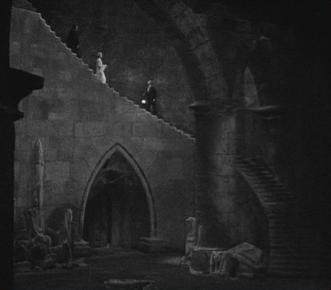
| The dwelling of Dracula in an old, abandoned abbey, has clear Christian references as does the figure of Professor Van Helsing played by Edward Van Sloan. Although a man of science, Van Helsing is a believer in the supernatural and warns that the best defense of the vampire is the reluctance of people to believe that he is real; something which could just as easily be applied to divine forces in general and the Devil in particular. Originally, Van Sloan ended Dracula with an appearance to warn that such strange things do happen. He later opened the Frankenstein film with a similar out of character appearance. The method by which Dracula is finally destroyed in the film also references his demonic mastery of the unholy resurrection; to pin the corpse of the vampire in his coffin to prevent him physically from ever rising again. As far as general moral lessons go, Dracula has more scares than depth with little to offer other than a general warning to believe in the impossible and not to dismiss the supernatural. |
|
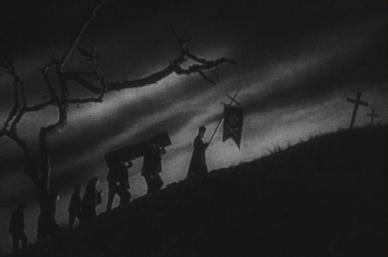
| Frankenstein is a very different story and, in comparison to the dime store novel Dracula, while possibly more frightening in pop culture, is a literary masterpiece. Frankenstein has a very clear and deep moral lesson behind it which is all the more fascinating in that it was produced in an atmosphere very much out of the mainstream, by Mary Shelly, who was living very much in violation of traditional moral norms. The basic moral lesson; a warning of what disasters befall a man who tries to take on the role of God, is one very familiar with modern Catholic teaching in regards to human cloning and embryonic stem cell research. The film itself opens with a very Catholic scene; a burial complete with weeping mourners, a deaths head banner, toning bell and priest praying solemnly in Latin. Dr. Henry Frankenstein, with his assistant Fritz (played by Dwight Fry who was also Renfield in Dracula) displays an allegory of his contempt for the sanctity of death by throwing dirt in the face of a statue of the Grim Reaper as the pair dig up the recently buried corpse to harvest parts for his creature. |
|
| The film quickly moves to a medical university from which Fritz attempts to steal a brain. He accidentally drops the "normal" brain and must instead make off with the "criminal" brain. This was not in the novel nor in any of the stage adaptations and has generated criticism from many film critics and historians. It does, of course, go against the grain of Catholic teaching in regards to free will as well as having since been scientifically debunked. It takes away from the innocence of the soon to be animated creature but the scene has generally been attributed to a need to explain certain things in the time constraints imposed by the motion picture. When considering the whole piece is does not really make sense since the creature is essentially an innocent and sympathetic character who is driven to violence by the fears and provocations of others. |
|
|
 |
|
|
| The creation scene in the old, abandoned watch tower must stand out as one of the most famous in the history of cinematic horror. The climax, however, with the frenzied, almost orgasmic scream of Frankenstein that the creature is alive and that he finally knows what it feels like to be God was originally censored and covered up by a thunder clap. However, in its original form it further emphasizes the wickedness of what Frankenstein is doing by tampering in the domain of God and the blasphemous arrogance of humanity trying to, like Lucifer in the Bible, exalt his throne above the stars of God and becoming like the Most High. Later, in the masterpiece sequel the Bride of Frankenstein, the doctor still clings to the idea that his goal was a benevolent one and possibly part of a divine plan. It brings to mind the old Irish proverb about the road to Hell being paved with good intentions. |
|
| In the original film Catholic symbolism is not often seen other than in the basic moral that was certainly emphasized in the novel which was subtitled The Modern Prometheus; a reference to the man who tried to steal fire from the gods and was punished for it. Frankenstein tries to play God and create a man in his own image (as spoken of in the opening by Edward Van Sloan) but can only create a monster, a creature without a soul, destined to be abhorred and tormented and who brings nothing but suffering and death on his human creator. In the Bride of Frankenstein, however, Catholic symbolism is positively rampant. The movie picks up where the first left off and still clings, loosely, to the original novel by Shelly. In both there is again, the image of the unholy resurrection. Much like Satan, those trying to become God can only manage to create a monstrous mockery of the real thing that brings damnation and the grave on those who dare. The Bride of Frankenstein also openly speaks of the sanctity of death, something not often dwelled upon, but certainly an important part of Catholic moral teaching. |
|
| The Bride of Frankenstein sets up the moral of the story by showing Mary Wollstonecraft, her lover Shelly and Lord Byron in a castle in Switzerland talking about the new horror tale. In the flashbacks of the original movie viewers see the funeral procession complete with death banners and priests. When we discover that the monster is still alive he is pursued again and finally captured and tied to a pole in a scene which clearly evokes memories of the crucifixion. This is done only to tweak the viewers as the monster is certainly not a Christ-like figure but rather a tormented figure to be pitied rather than admired. He suffers unjustly but his suffering achieves nothing other than a reminder to be kind and understanding to all, even the least of these our brethren. We are also introduced to Dr. Pretorius who is an obvious villain in contrast to the generally sympathetic and well meaning Henry Frankenstein. He is contemptuous of the sacred and in earlier versions of the script even more so than what made it to film a sometimes not-so-subtle homosexual who is intentionally heretical and blasphemous even down to his rather clerical garb. |
|
|
 |
|
 |
|
|
|
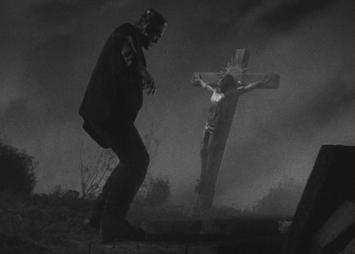
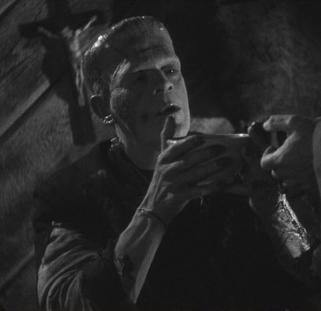
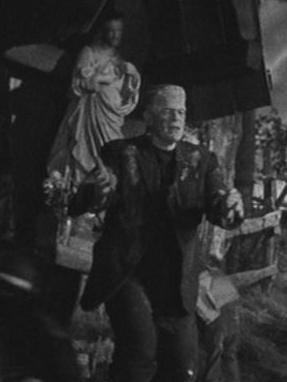
| When the monster escapes his captivity he finds refuge in the home of a blind hermit who is dressed like a monk and the audience hears Ave Maria playing in the background. The opening scene ends with a glowing crucifix displayed behind the monster as the hermit prays, thanking God for sending him a friend in his loneliness. As the hermit befriends and somewhat civilizes the monster, showing him compassion and humanity and teaching him to speak we see, just before his disastrous discovery by two hunters, a last supper scene in which the monster partakes of bread and wine. As he flees the monster comes upon a group of children who recoil from him in horror while conspicuously in the background is a roadside shrine featuring a large statue of Jesus Christ. There is at least something of a Christian message even in this, at least in a vague way, with the monster, an innocent, being persecuted simply because of the ignorance of his persecutors. As the monster flees his pursuers we also see him descend into a crypt with a large, stone crucifix in the background. |
|
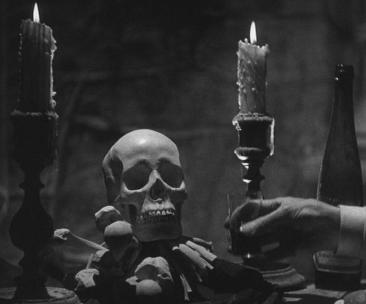
| It is therein that the monster meets Dr. Pretorius who had earlier proposed making a mate for the monster to Dr. Frankenstein. Pretorius, bringing to mind the ability of the Devil to quote scripture, speaks of how God created male and female. He also speaks condescendingly of Bible stories as though they are mere fables for the comfort of the simple minded. The flight of the creature was originally intended to be even more rich with religious symbolism. In earlier drafts the monster, fleeing through the cemetery, was to come upon a large crucifix and, seeing someone tormented as he had been, was to have tried to free the image of Christ from the cross but the proposed scene never made it past the censors. When the monster meets Pretorius in the crypt there is a setting of the Catholic symbols of vanity. The wicked doctor, smoking a cigar, blows smoke onto a skull to show his contempt for death and the sacredness of death. He has set up a sort of altar with a coffin decorated by bones, a skull and two large candlesticks. More a macabre than a religious scene it nonetheless brings to mind the need of Adam in the Garden of Eden for a companion and how man, alone, will always be unhappy without a wife. |
|
|
 |
|
| Interestingly enough, it is the new wife of Dr. Frankenstein which Pretorius uses to force his unwilling former pupil to create a wife for his original creature. By this time Frankenstein has realized the blasphemy of what he had done and resolved never to repeat his sacrilege again. The monster, however, allies with Pretorius out of his basic need for companionship and in a short but very memorable scene recreates the command to sit from the first film with the roles of master and creature reversed. With his beloved Elizabeth held hostage, Frankenstein is forced to create a female creature in collaboration with Pretorius only to have his original monster enraged when his would-be bride recoils at the sight of him. |
|
| This brings on the finale which includes a very sacrificial act by the creature who determines to destroy himself (and Pretorius) but sparing Frankenstein and Elizabeth. He tells them to go but commands Pretorius to stay with him on the grounds that they "belong dead". There were, perhaps, some Christian connotations even in that as it was an act of self-sacrifice though the suicidal nature of it may have more in common with ancient Judaism than Christianity such as the suicide of King Saul which was portrayed as a sacrificial act that in some way atoned for his sins in persecuting the youth God had anointed as his successor. In any event, the overall theme of the Frankenstein story is, at heart, a very Catholic one (despite the opposition of the Church to the film at the time). As the character of Mary Shelly relates in the opening scene of Bride of Frankenstein the goal was to tell a moral lesson of the terrible consequences of a man who tried to play God. |
|
| In the original novel a dying Frankenstein relates his story to an English sea captain who is obsessed with achieving fame and immortality by discovering an Arctic passage to the east and stumbles across the scientist who was in pursuit of his enraged creature. The moral of the story told to us, the story of his life Frankenstein told the sea captain, was that there are some secrets man was not meant to know and that it is arrogant presumption of the highest order to think that any mortal man can copy or improve on the divine creation of God. It is worth noting, at least in my mind, that the sequels which were somewhat less religious were never as grand or as powerful as the original works which did so. At least, though, with Frankenstein it was pretty much impossible to discard the basic Catholic moral of the story. Unfortunately, Dracula has become less and less religious as vampires become more popular. Dracula and other more modern and popular vampires are no longer repelled by sacred objects (most walk around in the sunlight now too) and in some cases even cause crucifixes to burst into flames when they pass. It is a sign of the times I suppose that whereas in the classic monster movies a crucifix could turn away a vampire we now depend on automatic weapons firing silver bullets (which I thought were for werewolves), but, oh well... |
|