
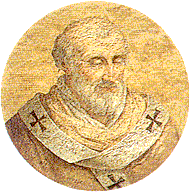
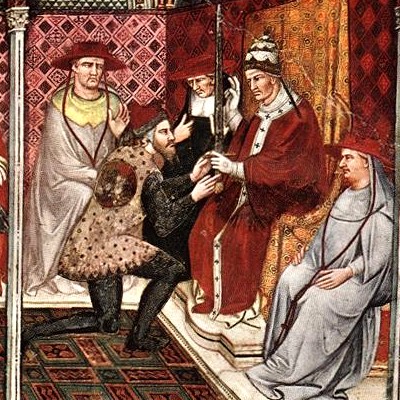

Because of this, the imperialist faction opposed his election but when the conclave ended clearly in his favor Otto of Wittelsbach paid a mob to break up the meeting and the imperialist cardinals elected the anti-pope Victor IV. So it was that from the very start Alexander III's primary source of trouble would be the German emperor, and this naturally fed the rivalry between the Ghibellines (who supported the Emperor) and the Guelphs (who supported the Pope). He had to be crowned in Nympha under the protection of the Normans. Emperor Frederick pretended to hold a council to end the division between Victor IV and Alexander III but he proved his bias by calling the imperialist Cardinal Octavian "Pope" Victor IV and referring to the actual Pope as Cardinal Bandinelli. Naturally, he found in favor of his own candidate and Pope Alexander III disavowed the proceedings, excommunicated the Emperor and absolved his subjects of their allegiance to him.
Emperor Frederick tried to invade Italy but was opposed by a coalition of Italian city-states known as the Lombard League, with the backing of Alexander III. The Pope also tried to enlist the aid of the Eastern Emperor, but to no avail. In 1176 the two sides met at the battle of Legnano from which the Guelphs emerged victorious and the following year the Emperor was forced to surrender in Venice and sign a treaty with Pope Alexander III. The claim that the Pope put his foot on the Emperor's neck is totally false, though later Lutheran propagandists made plentiful use of the rumor. Then there were the growing ranks of heretics such as the Waldensians and the Cathars (or Albigensians) who spread dissent and anti-Catholic doctrines. In these internal problems, the danger to the Pope actually benefited Alexander III on his travels as few things can encourage sympathy and loyalty than the image of the Pontiff being attacked by the powerful Emperor, especially in France when the threat to the Pope is from Germany. He also had to deal with the problems between St Thomas a Becket and King Henry II of England. He stood by the rights of the Church but warned Thomas to be respectful and conciliatory with the King. In effect, Alexander III had St Thomas' determination but with greater diplomatic skills and he ensured that no permanent damage was done to the Church in England because of the fight between the king and archbishop.
The crowning moment of Alexander III's papacy came when he called the Third Lateran Council in 1179 to deal with the spread of heresies throughout Christendom. Perhaps because of his own troubles, he issued clear instructions on the election of the pope as well as stressing religious education as the best way to combat the heretics who were able to grow only because of ignorance of true Church doctrine. Worn down by his many trials and hardships, but faithful to the end, Pope Alexander III died at Civita Castellana on August 30, 1181. His epitaph hailed him as, "the Light of the Clergy, the Ornament of the Church, the Father of his City and of the World".