-Lady Coventina
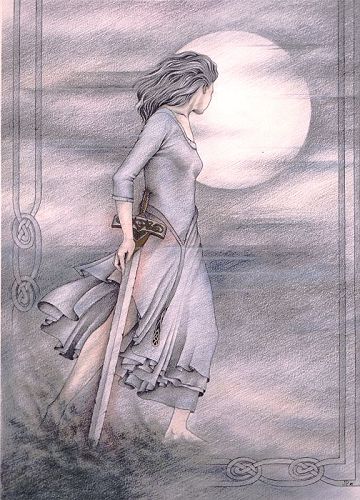
Notice the pictures surrounding this page dedicated to Her. They are not images of a wonton, lustful, revengful creature, out to destroy what gets in her way. 'Faye' means faery. Or fairy.
There are many versions of the Arthurian legions, and I prefer Mist Of Avalon, as they portay Morgan as a victim of circumstance and great benevolence. At the time of King Arthur, the Christian church was doing everything in its power to convert the Pagans. One way was to divert their attention away from the wisdom of the Faery faith.
So fairies in general, thanks to the talk of the church, became something to fear as little creatures of the devil. It is of no wonder that as time went on that Morgaine of the Faery received the reputation she does not deserve.
If you see her name spelled in differnet ways across the page it is because it has been spelled and pronounced many ways in history. How I call out to her depends on whether I am meditating or just speaking out loud to her...sometimes I just feel the name that she prefers depending on what I do.
Because there is SO much room for interpretation, this is just one of the many theories I have found on Morgaine
Characteristically famous for her dark role as Arthur�s mystifying and destructive half sister, Morgan Le Faye is a character developed from the mythical world of Celtic Otherworld women. Morgan Le Faye derives from the Celtic triple goddess, Morrigan, Mach and Bodhd, who is a compound of an archetypal female: mother, bride and hag. Being that Mor translates from Celtic to �sea�, her name indicates she is derived from the Sea Goddess, which connects her to the Lady of the Lake in the Arthurian Legend. However, she is also described as the Goddess of War or the Goddess of Death, suggesting Morgan Le Faye is an amalgamation of characters of the Otherworld.
It is said her father was Avallach, the famous King of Avalon, emphasising her status as a Lady of the Otherworld. She is said to have been the �leader� of a sisterhood of nine sorceresses. Her role as Goddess of Death is interesting and perhaps somewhat confusing to readers unaccustomed with Celtic mythology. Originally, the Celts did not consider death an object of fear, rather as the transitional stage through which to pass into the Otherworld, where they would carry out the rest of their life. Morgan Le Faye therefore was the goddess of this transitional stage, the lady who would take the individual through into the Otherworld. This is illustrated in her taking King Arthur to Avalon after his famous battle to heal.
In Arthurian Legend, however, she is presented as evil, reinforced even more so by the �Goddess of Death� label. As it was not always such, it appears that Medieval Christianity has played a large part in transforming her original function.
Brian Edward Rise, in �Encyclopaedia Mythica: Mythology, Folklore and Legend� describes how Christianity found many things about the character and status of Morgan Le Faye difficult to accept. The fact that Celtic Otherworld women were equivalent, if not superior, to men will have been inconceivable, and in addition her benevolent powers will have inevitably caused Christianity to alter her character, projecting an evil and sinister nature onto her in order to present her as a witch who exercises her sexuality as a form of destruction, seen intrinsically in her seduction of King Arthur to conceive his child.
However, no matter how much Medieval Christianity tried to alter her image to become a sorceress of black magic, they could not entirely escape from her origins as a benevolent Otherworld woman, exemplified in her arriving to take King Arthur to Avalon in order to heal him. She therefore remains, no matter how misinterpreted and corrupted her character, The Otherworld Lady of Avalon.
Bring to any body of water (ocean, pond,etc.) a drum and a piece of amber.
Standing is preferred. Drum to your hearts content facing the waters with love in your heart for Morgan.... life.... being a Witch. Throw the amber in the waters as an offering to her.
Finish by drumming passionately some more! (She loves that!)