Hey guys, I went to a really cool lecture all about course design for hunter, jumper and equitation courses. Okay so the text is boring, lol sorry.
Just an overview
For a horse, there is 12 feet in one stride, for a large pony you can use the same distances. Small ponies have a 10 foot stride and a medium pony has a 11 foot stride.
Things to take into account when course designing
Footing -> Deep footing means shorter strides
Is the arena flat or does it have a slope or any hills
Weather
Where are there distractions in the arena, like tents, judge booths, etc.
Level of the riders and horses
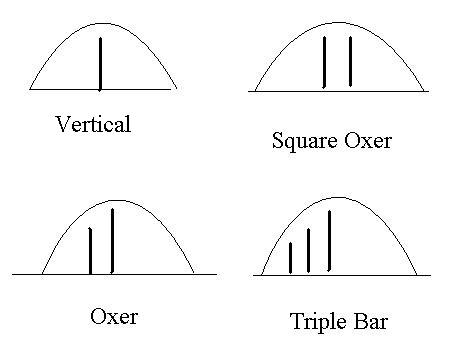
It is also important to know how a horse bascules or arcs over certain types of jumps. This is important when knowing how long a distance between two fences should be.
When jumping a vertical the horse arcs over the top of the fence, so the take off distance and the landing distance are the same. When jumping a square oxer, the arc is between the two fences and the distances of the take off spot and the landing spot are the same.
When jumping a oxer with a higher back bar, the horse arc is over the higher back bar. Therefore the take distance is shorter than the distance after the jump that the horse lands. The same goes for a triple bar, the arc should be over the last highest bar, so the take off distance will be shorter than the landing distance.
Generally horses have better form over an oxer because it makes the really jump a fence. So often course designers will use oxers to get to the horse to jump and show it's form.
Hunter Course Design and Judging
When judging hunter courses, almost everything is judged on the horse. It's movement, conformation, form over the fences, is how the judge chooses the winner of the class. A hunter rider job is to make the horse look it's best.
Some things to keep in mind when designing hunter courses
The course should be simple
Give the judge something to judge but not so hard that every horses has difficulties
The jumps should be 30-40 feet from the end of the ring to give room to use your corners and make nice turn
Low fences to start, usually a vertical for a first fence
Make the course flow, nice lines
Build even verticals like oxer because oxers make the horse jump better, use boxes to make the ground lines
Almost always have 8 fences
Ever jump is numbered
As the season progresses the courses should get more difficult, use of triple bars, 1-3 strides between fences
Equitation Course Design and Judging
When judging equitation classes, it's the rider that is being judged. There overall form, position, proper use of aids. Basically judging the best rider.
Some things to keep in mind when designing equitation courses that the courses are designed to test the riders skills and not that of the horse.
Your testing the riders ability
Have riders trot jumps
Canter jumps
Halt inbetween fences
Jumping fences without stirrups and reins
Usually have 8 fences as well
include roll backs
bending and broken lines
Medal Class Course Design and Judging
When judging medal class courses, the judge is judging the combination of horse and rider. It is essentially combining the equitation and hunter classes.
Some things to keep in mind when designing medal courses
Judging the horse and its abilities
Juding the rider and their abilities
juding the total package
Jumper Course Design
We all know the basis behind jumper courses, get around the fastest and leave all the jumps up. For ever rail you knock down you get 4 faults, 3 faults for a refusal (maximum of 2), faults for every amount of time you are over the time limit of the course.
Some things to keep in mind when designing jumper courses
it's supposed to be entertaining for the spectators
fun for the riders
challenging for the horses
you want it to be a learning experiance for both horse and rider
10 jumps in the first round
for a jump-off, no less that 6 jumps, and 2 different jumps (completely new for the jump-off)
Combinations of jumps
the flow of the jumps
first jump towards home, first jump an oxer-->to wake up both horse and rider
one lead change (at least)
spread out the jumps
turns
-->make the horse back of if it needs it
-->make the rider ride the turns
-->challenging and safe
for advanced riders, have harder distances and more difficult obsticles
its roughly 250 meters per minute, but course designer decides
good jumper courses are ridden like hunter courses, nice and steady....jump offs are ridden like a bat out of heck ;)
keep difficult jumps spread out
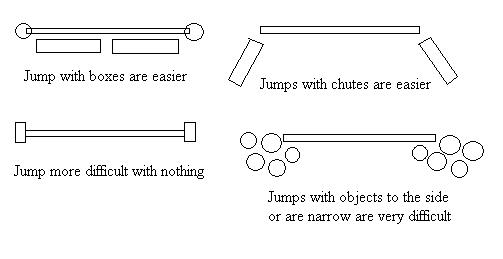
Types of difficult jumps:
Just of interest for people who are interested in doing course design. It's an apprentice-ship where you work with other professionals to learn everything. You write a test asking you questions about course design then if you pass you become a course designer. There are four levels of course designer beginner(essentially a learner's permit), recorder, senior, and international. These just determine what levels of show you can design courses for.
<