| UNIT TITLE: Earth’s Water |  |
| UNIT TITLE: Earth’s Water | |
Author: Kim Glavan
School: Haines Elementary
New Lenox, IL
THEME: Earth’s Water
BROAD CONCEPT: Water, is an essential natural resource and water’s physical properties affect Earth’s water supply.
GRADES: Third Grade
INTEGRATED SUBJECTS: Math, Writing, Social Studies, Reading and Science
UNIT GOALS AND PURPOSE:
1. Have the students understand how much water is available for people’s use.
2. Know where our fresh water comes from.
3. Describe the relationships between evaporation, condensation, and precipitation in the water cycle.
4. Explain the process of desalination.
5. Be able to state the three states of matter and how they are different
6. Where places obtain water that do not have rivers or lakes.
TIME FRAME: This unit will take about 15 days.
OBJECTIVES:
In this lesson, students will:
Brainstorming: Inspiration
Word Processing: MS Word, Apple Works
Spreadsheet (from the Science CD-ROM)
CD-ROM from Houghton Mifflin Science
Multimedia: Science Court and The Graph Club
STATE STANDARDS ADDRESSED BY THIS UNIT:
03LA03A01 The students will be able to construct sentences which demonstrate subject/verb agreement; appropriate capitalization and punctuation; correct spelling of appropriate, high-frequency words; and appropriate use of the eight parts of speech
03LA03C01 The students will be able to write for a variety of purposes including description, information, explanation, persuasion, and narration
03LA03C02 The students will be able to create media compositions or productions which convey meaning visually for a variety of purposes
03LA03B01 The students will be able to use prewriting strategies to generate and organize ideas
03LA03B02 The students will be able to demonstrate focus, organization, elaboration, and integration in written compositions
03PE22C01 The students will be able to identify sources and causes of environmental health risks
STUDENT ACTIVITIES WHICH WILL PROMOTE ENGAGED LEARNING:
Day 1 Lesson 1: The students will be predicting how much of the Earth is covered by water by getting into groups and coloring a pie shaped graph. Using a map and globe of the world, each group will try to determine how much of the Earth’s surface is water. The whole class will come together to learn the actual make up of the world.
Day 2 Tap prior knowledge. Ask the students what they know about the difference between ocean water and fresh water. Can we drink water from the ocean? Why? Is there more ocean water than fresh water? Use a map or globe. How much water are we able to use as fresh water? Demonstration: Fill the 1,000 ml beaker with water. Tell students this is all the water in the world. Ask students to tell you how much of the water in the beaker is fresh water that we can drink. Write their guesses on the board. Pour 30 ml of the water into the 100ml beaker. (Add slat to the remaining 970ml to represent salt water in all the oceans.) Tell the students that not even this 30ml of fresh water is available to us – 24ml of it is trapped glaciers and ice caps. Ask the students again to predict how much fresh water we can access. From the 100 ml beaker, pour six ml of water into the 10ml beaker. Tell students the 6ml is fresh water but that it is mostly unavailable to us as it’s underground. Finally, using an eyedropper, take one drop of water. Tell the students that this one drop is all the fresh water available to us in the world. 97% is salt water, 2% is water frozen in icecaps, glaciers, and icebergs, and 1% is fresh water for all the living things on Earth to use.
Day3 Hands-On Activity: Pass out an 8” cut out circle made from white tag board or cardboard. Have the students color the amount in green that represent salt water, white representing frozen water, and blue for the amount of fresh water. Label the parts accordingly. It will look like a pie graph. Using the Science CD-ROM, students begin by listing ways they use water. Then they predict how much of Earth is covered by water, by studying a circle graph. Students use a Water Meter probe to find out how much of Earth’s water is liquid or solid and how much is fresh water or salt water. After students record their results on the Spreadsheet, they explore how much fresh water is available for people’s use. Students finish by writing about a day without water.
Day 4 Lesson 2: Water Usage. Using Inspiration, chart the many different ways everyone in your class uses water. Have students record the ways and how much their family and themselves use water that day by recording it on the“ Water Usage Activity” sheet.
Day 5 The next day discuss their findings. Have the students write down the amount of water it takes to do certain things using the “Average usage chart”. Example: flushing a toilet uses 25 gals of water. You can find a chart on the following web site: www.louisvillewater.com/funzone/challenge/water.htm Using calculators, have them multiply the total daily usage by 7 to calculate the weekly usage of water. This will result in a family usage of water in their home.
In writing, as an extension, have the students write a persuasive paragraph on why the Earth’s fresh water should be used wisely. They could do this in Apple Works.
Day 6 Lesson 3: Read and discuss text pages from the science textbook. These pages talk about the Earth’s water and uses in the United States. Industry: 47% of water is used as a source of power and to make many products. Farming: 44% of water is used for livestock and to grow crops. In dry places, farmers must irrigate their fields. Towns and Homes: 9% of water is used to put out fires, treat sewage and clean streets. You use water every day. You use water when you bathe, cook, clean, and water plants.
Day 7 Lesson 4: Talk about the three states of matter: solid, liquid, and gas. How can you change the state of water? To change the state of water, you have to add or take away heat energy. Read text pages D14 – D15. Liquid- show that liquid takes the shape of the container by pouring it into different containers. Solid – show solids have a definite shape and cannot change shape (put a shoe into a jar to show it does not change shape). Gas – state of matter that has no definite shape and takes up no definite amount of space. Show different sizes of balloons blown up. Ask them what one substance can do all three.
Experiment: Water Ups and Downs
Procedure
1. Mold a pan-shaped cover from aluminum foil for a plastic jar. Make sure the cover fits tightly over the jar’s opening.
2. Remove the foil cover and place it off to one side.
3. Now add hot tap water to the jar until it is one-third full.
4. Put the foil cover back on the jar. Secure the cover with a rubber band. Quickly place a few ice cubes in the foil cover. Watch closely. Observe what happens on the underside of the foil. Record your observations.
1. You’ve made a model of Earth. The warm water represents a lake or an ocean. The air above it represents the air around Earth. The air high above Earth is cold. The ice on the foil cover cooled the air higher in the jar.
| Day 8 Lesson 5: Read pages D16 – D17 in science textbook about the water cycle. Practice with the diagram of the water cycle and science CD ROM. Through on-screen animation, students observe the water cycle and learn about its stages by clicking on labels and hearing audio clues. Then they drag and drop labels in the appropriate parts of the cycle. When all the parts of the cycle are labeled correctly, the animation begins. (Get a great water cycle picture from this web site: http://eduplace.com/kids/sla/3/dripdrop.html | 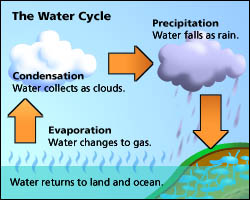 |
In reading, read the book Cloudy With a Chance of Meatballs. In groups of 4 or 5 students, they will make up their own story called: Cloudy With a Chance of ………. Possibly could be put into a slide show using KidPix.
In English, zerox parts of the original story Cloudy With a Chance of Meatballs and have the students underline the adjectives in blue, the nouns in red, and the verbs in green.
Day 9 Lesson 6: Desalination. Read pages D18 – D19 in text. Talk about desalination and how it works. Demonstrate by using a hot pot, food coloring, and a paper plate. Put a cup of colored water in the hot pot. Cover it with a white paper plate. Remind them that the water is blue from the coloring (or whatever color you choose). When the water starts to boil their should be droplets on the bottom of the paper plate. The color is white. Explain this is how desalination works but with salt water.
Day 10 and 11: Use the CD from Snyder Production called Science Court. You have to use the projector to show it on the big screen for the whole class. The class gets into groups of 4. It goes through a court case about a water incident and the groups have sheets that help them answer questions. It is a two-day project but very good.
Lesson 12: Where does our water come from? On pages D24 – D28 it talks about the different ways in different parts of the world, people get their water. Make a list together. In Alaska the people drive to a spring, in Africa they get their water from a well that is in the village, in Bermuda they have pipes on their houses that catch rain water and then goes into a tank under their home, and some have to walk many miles to get their water from wells at an oasis. Locate these places on the map and talk about why certain places use different methods to get their water. Discuss how we get our water. Talk about surface water, ground water, reservoirs, and aquifers. The following web sites show good pictures of well drillings and discuss the above vocabulary words. http://wwwga.usgs.gov/edu/earthgwwells.html http://www.groundwater.org/gwbasics/ABCs.htm There is a cool groundwater activity to do at the following web site. The students can build their own edible aquifer, learn about confining layers, contamination, recharge and water tables. http://www.groundwater.org/GWBasics/ABCs.htm Go to Kids Corner and activities.
Also if you go to the following site there are lesson plans and projects about water. http://www.epa.gov/ow/kids.html Click on education.
Day 13: Discuss why rivers are essential to the development of cities. Ask the class to us the map to find the river on which St. Louis is located (Mississippi). Have them name 3 other cities that are on this river. List reasons why the cities were built on the Mississippi. What are the advantages of living near a source of fresh water?
Have a person from your town come in and show the students where the town gets their water from and how.
SHARE YOUR IDEAS:
The students can get into groups of 3 and draw a diagram to show the route water follows to get to their home. Describe what has to be done in order for us to drink the water. They can use their books, encyclopedias, and the computer.
STUDENT AND TEACHER ROLES: The environment throughout this unit will
change. The students will sometimes be
working in groups or on their own to solve problems. There will be teacher guided lessons on the Internet, as well as
individual and partner work in the computer lab.
THE FOLLOWING BOOKS CONTAIN INFORMATION ABOUT THIS TOPIC:
Houghton Mifflin Science “Discovery Works” Earth’s Water
The Magic School Bus at the Waterworks by Joanna Cole
Cloudy with a Chance of Meatballs by Judi Barrett
Drip Drop Water’s Journey by Eve and Albert Stwertka
Water, Water Everywhere: A Book About The Water Cycle
(Discovery Readers)
The Magic School Bus Wet All Over: A Book about the water cycle
School Days magazine
November/December 2000 “The
Water Cycle”
FOR ADDITIONAL ONLINE INFORMATION AND MEDIA PERTAINING TO THIS UNIT, TEACHERS MAY WANT TO USE THE FOLLOWING INTERNET ARTICLES: (minimum 6 sites)
Title1: Water Cycle
URL1: http://www.medford.k12.wi.us/mash/aca/curricpages/BlackRiver/TheWaterCycle.htm
Description1: Tells you what a water cycle is, gives definitions, and
has a picture of a water cycle you can copy.
Title2: Groundwater ABCs
URL2: http://www.groundwater.org/gwbasics/ABCs.htm
Description2: Cool ground water activities, definitions, free things
to order, and a kids corner
Title3: U.S. EPA
URL3: http://www.epa.gov/region07/kids/xword.htm http://www.epa.gov/kids/students
Description3: crossword puzzle that can be printed out and the second
site has fun and interesting things about water
Title4: Highline Water District
URL4: http://www.highlinewater.org
Description4: There are many links to go to in order to find out more
information about water
Title5: U.S. Geological Survey’s Science for Schools
URL5: http://wwwga.usgs.gov/edu/
Description5: There are many topics to choose from. Great pictures!
Title6: Louisville Water Company
URL6: http://www.louisvillewater.com/home.htm
Description6: You can order free items and learn about their system
of making water.
RELEVANT
INFORMATION, STUDENTS WILL VISIT THE FOLLOWING WEB SITES:
Title1: Louisville Water Company
URL1: http://louisvillewater.com/home.htm
Purpose of Use1: Click on funzone. This will show you how they make drinking water and you can test your knowledge.
Description1: Learning activities about water
Title2: U.S. EPA
URL2: http://www.epa.gov/kids/
Purpose of Use2: Click on Explorers Club to do fun activities about the environment, recycling, air and plants and animals
Description2: Learning activities
Title3: Groundwater ABCs
URL3: http://www.groundwater.org/kidsCorner/kidscorner.htm
Purpose of Use3: Questions they can find out about groundwater
Description3: It lists 10 different sites they can go to to answer
questions and do activities.
Title4: U.S. Geological Survey’s Water Science for Schools
URL4: http://wwwga.usgs.gov/edu
Purpose of Use4: Click on activity center. There are plenty of activities and questions to find out and answer
Description4: Activity site
Title5: Houghton Mifflin Science Library Adventures
URL5: http://www.eduplace.com/kids/sla/3/dripdrop.html
Purpose of Use5: to read an article “Drip Drop, Water’s Journey” and understand how water gets to their home.
Description5: Grade 3 information about water
Title6: Highline Water District
URL6: http://www.highlinewater.org/kid’s1.htm
Purpose of Use6: To learn more about water
Description6: There are 5 places to go – About the water cycle, The
path that drinking water takes, fun water facts, doing your part, and hidden
word puzzle that can be printed out.
