|
 Caring for your contact lenses Caring for your contact lenses |
|
The first
contact lenses were fitted in the late 1880’s, which is over 100 years ago.
Since then people of all ages, having different types of vision problems
have made the decision to wear contact lenses instead of glasses, largely
due to the many advantages of contact lenses.
Contact
lenses can be divided into 2 main types - soft and rigid gas permeable. The
types of contact lenses available are made of different materials and they
each require specific care. Although contact lenses have many advantages
over glasses, they do require more care. An important consideration when
selecting the type of contact lens is how much time you are willing to
devote to their care. You could risk an eye infection as a result of lack of
attention to lens hygiene. However, with proper care and use, the chances of
developing eye problems can be minimized if not eliminated.
|
|
Where
the contact lens fits in? |
|
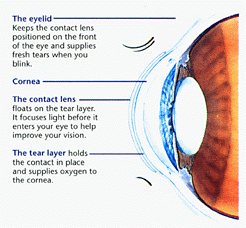
The
contact lens floats on the layer of tears that covers the cornea. It is held
in place by surface tension, the same force that lets a drop of water cling
to the side of a glass. As contact lens forms a barrier between the air and
the cornea, it blocks some of the cornea's oxygen supply. By blinking your
eyes, it helps overcome this problem. With each blink, tears wash behind the
contact lens, delivering fresh oxygen to the cornea. Blinking also helps
keep the contact lens moist and clean.
|
|
Types of
lenses |
|
Soft and
Rigid Gas Permeable (RGP) lenses are the 2 main types available.
Occasionally, hard lens is prescribed.
|
Soft Lenses |
|
Soft
lenses are made from a gel-like plastic that permits some oxygen to
pass through the lens to the cornea. This plastic absorbs water like a
sponge, keeping the lens flexible. They require a higher standard of
care as their hydrophilic nature causes more absorption of
contaminants, preservatives, tear proteins and grease. For soft
lenses, disinfection is essential. Soft lens wear carry a higher risk
of eye infection, the most common and serious being bacterial corneal
ulceration. Due to their fragility soft lenses are less durable. |
|
Rigid Gas Permeable Lenses (RGP) |
|
These are actually hard lenses, which allow oxygen to pass through to
the cornea. They are therefore more comfortable than the traditional
hard lenses. RGP lenses are much easier to care for than soft lenses
because they are rigid and easier to handle. Unlike soft lenses, RGP
lenses are made of material that doesn't contain water hence protein
and lipids from tears do not bind to RGP as readily as they do to soft
lenses. |
|
Disposable Contact Lenses |
|
These are lenses that are worn for a certain number of days and then
discarded. These lenses may be replaced daily, weekly or monthly.
Using disposable lenses means frequent replacement of contact lenses
and hence no discomfort from long term deposits. This in turn resulted
in a dramatic reduction in eye complications like lid allergies,
infections and red eyes as the wearer is always wearing clean, fresh
lenses. The daily disposables which are designed to be disposed of
after a single use obviates the requirement for lens care systems,
including the use of storage cases which are frequently contaminated
with bacteria, potentially harmful to the eye. However the wearer has
to carefully follow the schedule for throwing away the used lenses.
|
|
|
Know your
cleansing regime |
|
The
cleansing regime removes daily grease and grime, disinfects the lenses and
ensures that the optical quality remains at peak level. Hence the main
essential steps in contact lens care are :
-
cleaning
-
protein removal (for
non disposable lenses)
-
disinfecting
-
rinsing
Every time
contact lenses are removed, they must be cleaned, disinfected and rinsed
before wearing again. The correct use of contact lens solution is vital for
safe and trouble free lens wear. Each solution performs a specific function.
However, 'multi-purpose' solutions are also available now. Different types
of lenses require different cleaning solutions, so be sure to ask you
optometrist or eye practitioner what solutions to use with your lenses.
|
Cleaning solutions
|
|
Cleaning solutions prevent build up of tear proteins, cosmetic
deposits and environmental contaminants like dust. If lenses are not
cleaned regularly, these deposits can interfere with vision,
wettability and comfort. The process of disinfection will also be
affected if deposits are not removed.
There are 2 types of cleansers:-
(a)
Daily cleaners
usually contain a surfactant to loosen lipids and proteins and
solubilise oil films.
(b)
Enzyme cleaners
are
used to remove deposits that daily cleaners can’t. Enzyme cleaners are
only used periodically, usually once a week. They come as tablets that
must be dissolved in saline solution. They are also available as a
premixed solution in a bottle. The lenses are soaked in the enzyme
solution for an appropriate time length.
|
|
Disinfection
|
|
The
eye is normally protected from infection by the tough, outer
epithelial layer, the lids and tears. Contact lens wear may partially
disrupt normal tear flow and render the eye more susceptible to
infection. Lenses may also become contaminated with bacteria during
handling. If lenses are not disinfected properly, bacteria, fungi and
viruses can grow on the lenses and cause severe eye infections. Hence
it is essential that this procedure is carried out on a daily basis
after the lenses have been washed.
|
Hard and RGP Lenses - |
|
These lenses are normally disinfected by soaking overnight in an
antimicrobial solution. It is important to ensure that the
storage case should also be cleaned and disinfected. The storage
case must be rinsed and air- dried daily to prevent bacteria and
other contaminants getting attached to the case. Storage cases
are recommended to be replaced every 6 months. |
|
Soft Lenses |
|
There are 2 ways of disinfecting soft lenses, 'cold' and 'hot'.
Cold
disinfection
is disinfection using chemical solutions. It is usually carried
out by putting the lenses into the storage case and adding
disinfecting solution. The lenses are soaked for a recommended
amount of time. Sometimes, a neutralizer is added.
Heat
disinfection
is usually the method of choice for wearers who are sensitive to
antimicrobials. Preserved saline or preservative-free saline
(for those sensitive to preservative) is used as the boiling
solution. The lenses are put into their cases with this solution
and placed in a heating unit. Once the heating unit turns itself
off and the case is cool, the lenses can be worn again
Rinsing
Rinsing solutions consist of buffered isotonic solutions
containing sufficient preservative to prevent microbial growth
e.g. preserved saline. Unpreserved saline can be used but not
homemade saline or tap water as they can contain bacteria that
may cause an infection. This solution removes other solution
from the lenses and hence, are used to rinse lenses after
cleaning. They also prepare the lenses for wear.
Soaking & Storing
After cleaning and when you are not wearing your lenses, they
should be placed in fresh soaking solutions in the storage case.
This prevents hardening of any remaining contaminants. Soaking
also disinfects the lenses and maintains the correct hydration
of the lenses. For soft lenses, there must be sufficient soaking
solution otherwise the soft lens will dry and shrivel up. This
then can cause the lens to break. Saline solution can be added
to dried up soft lenses to rehydrate. Once the lenses have
returned to normal, check for rips or tears, clean it and
disinfect before wearing it again. If a RGP lens dries out,
clean it and rinse with fresh wetting solution before wearing.
|
|
Multi-purpose solutions |
|
This combine the major functions (cleaning, disinfection,
rinsing), which are essential to proper lens care in addition to
other functions like lubricating, protein removal and storing.
Multi-purpose solutions are particularly useful for contact lens
wearer who are unlikely to carry out the correct hygiene
procedures using separate solutions.
|
|
|
|
Cosmetics and contact
lenses |
-
Soft lenses should be
inserted before application of cosmetics to ensure residues are not
transferred to the lenses.
-
Avoid transfer of grease
to soft lenses by using oil-free moisturizers and applying hair care
products after lens insertion
-
Avoid glitter-type powders
as they can cause ‘rust’ spots on soft lenses.
-
Rigid lenses should be
inserted after application of cosmetics once loose particles have been
dusted from the eye area to prevent foreign body irritation.
-
Hairsprays should be used
before lens insertion otherwise wearer must keep the eyes shut while
spraying and leave the room afterwards.
-
Choose water-based,
hypoallergenic cosmetics as cream make-up may leave a film in your lenses.
-
Use pencil eyeliners
instead of liquid eyeliners, as they do not flake off and cause
irritation. Apply eyeliners only on the outside of and not on the lid
margin.
-
Use water-resistant
mascara instead of waterproof mascara to allow removal with water-based
products. Waterproof mascara which cannot be easily removed with water may
stain contact lenses
-
Avoid lash-extending
mascara, which has the fibres that can irritate eyes.
-
Lenses should be removed
before removing make-up.
-
Do not use hand creams or
lotions before handling lenses. They can leave a film in your lenses.
-
Keep false eyelash cement,
nail polish and remover, perfume and cologne away from lenses as they can
damage plastics.
|
EYE-DROPS, MEDICATION AND CONTACT LENSES |
-
Avoid touching
your contact lenses with any medicated creams
-
Comfort drops
are designed for use with contact lenses but those wearing soft
lenses must use preparations, which are preservative-free or contain
preservative compatible with their lens type.
-
Eye-drops for
allergies e.g. hay fever can be used by RGP lens wearers quite
safely but not for soft lens wearers as they contain a preservative
which can damage the soft lens. If these drops are necessary, the
soft lenses can only be inserted at least 15 minutes after
treatment.
-
Some eye-drops
e.g. Adrenalin, Fluorescein can stain soft lenses and cause damage.
A minimum of 30 minutes should be left between administration of
these eye-drops and the insertion of lenses.
-
Lens
discoloration can also occur in wearers on oral drugs like labetolol,
nitrofurantoin, phenolphthalein, rifampicin, sulphasalazine and
tetracycline.
|
Improper
contact lens care may be the cause of eye infections, including those that
can cause blindness.
Hence it is important to religiously follow the routine hygiene procedures
recommended by the eye-care professionals.
It
is also important not to mix and match the solutions without consulting the
eye-care professionals because in many cases, the problems are aggravated by
wearers, changing solutions due to incorrect advice from friends. Sometimes
despite best efforts, you may still develop eye problems as a result of
wearing contact lenses and
referral to the eye practitioner is then recommended. Regular "follow-up"
visits to the eye-care professionals are also recommended to maintain your
eye health.
|
