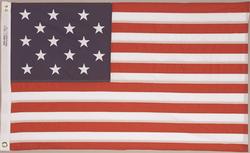
Colonel Armistead commissioned Mary Young Pickersgill, a local seamstress and
flag maker to make two flags for Fort McHenry in 1813 - a large flag and a
smaller one to fly in bad weather. She was paid $500 for both flags, the large
one being 30 x 42 feet, so it could be seen from a great distance. She was asked
to sew a flag with 15 stars and 15 stripes, the number of states then in the
Union.
Anticipating an attack on Fort McHenry by the British
during the War of 1812, Major Armistead asked that the flag be made extra large
so that it would be plainly visible to the English Fleet. He had also hoped the
large flag would lift the spirits of the Baltimoreans, allowing them to see this
flag fly in defiance of the British.
This flag was used as the garrison flag of Fort McHenry during the British siege
of the fort during the War of 1812. When Francis Scott Key saw
the flag from a ship eight miles down the Patapsco River on September 14, 1814,
the flag was still waving in the breeze after twenty-five hours of heavy
bombardment by the British. The British were very discouraged to see it still
there, but Key was inspired to write the poem that became the National Anthem.