Washington National Cathedral
(Officially know as the Cathedral Church of Saint Peter and Saint Paul)
The idea for a national cathedral is as old as Washington itself. In 1791, when Congress selected the site to be the capital of the United States, President George Washington commissioned Major Pierre l'Enfant to design an overall plan for the future seat of government.
Included in l'Enfant's plan was a church, "intended for national purposes, such as public prayer, thanksgiving, funeral orations, etc.,and assigned to the special use of no particular Sect of denomination, but equally open to all."
Largely through the efforts of Washington community leaders such as Riggs Bank President Charles C. Glover, plans for building Washington National Cathedral gained momentum. On January 6, 1893, Congress granted a charter to the Protestant Episcopal Cathedral Foundation of the District of Columbia, allowing it to establish a cathedral and institutions of higher learning. Signed by President Benjamin Harrison, this charter was the birth certificate of Washington National Cathedral.
After his consecration in 1896, the Reverend Dr. Henry Yates Satterlee, the first bishop of Washington, managed to secure land on Mount Saint Alban � the most commanding spot in the entire Washington area.
On September 29, 1907, the foundation stone was laid. President Theodore Roosevelt and the Bishop of London spoke to the crowd of ten thousand. The stone itself came from a field near Bethlehem and was inset into a larger piece of American granite. On it was the inscription: "The Word was made flesh, and dwelt among us" (John 1:14).
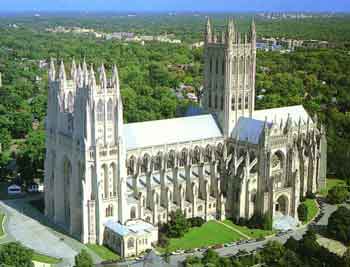
With the laying of the cathedral foundation stone, the grassy, tree � shaded Close became home to the longest � running construction site in the nation's capital. The first chapel, Bethlehem Chapel, was completed in 1912. Daily services have continued there ever since. Work on the building continued with few interruptions � construction was halted during the world wars. By 1964, the central tower was completed.
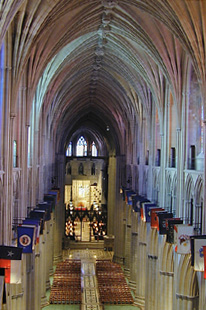
In 1972, the cathedral nave was enclosed as the north and south walls met at the west facade. The completed nave was dedicated in 1976 in a series of ceremonies attended by the Queen of England, the President of the United States, the Archbishop of Canterbury, and thousands of other worshippers.
Construction stopped in 1977 due to a shortage of funds. In 1980, work resumed, and the Pilgrim Observation Gallery was completed and opened to the public in 1982. Then in 1983, the final phase of construction began with the setting of the first stone for the west towers.
The completion of the west towers in September 1990 marked the end of eighty � three years of construction and the realization of a dream. Since the first services were held in Bethlehem Chapel, Washington National Cathedral has opened its doors to people of all faiths as they have gathered to worship and pray, to mourn the passing of world leaders, and to confront the pressing moral and social issues of the twentieth century. The Cathedral is the burial place of many notable people, including Woodrow Wilson, Helen Keller, her friend and teacher Annie Sullivan, Admiral George Dewey, Bishop Satterlee and the architects Henry Vaughan and Philip Frohman.
special thanks goes to Washington National Cathedral website http://www.cathedral.org