| Land Transportation |
Roads are constantly improved and upgraded to ease congestion and cut down travelling time. Presently, there are more than 3,000 kilometres of roads criss-crossing the island. There are eight expressways which are linked to minimise traffic congestion and the time taken to travel the island.
The eight expressways are:
 Pan Island Expressway (PIE)
East Coast Parkway (ECP)
Central Expressway (CTE)
Ayer Rajah Expressway (AYE)
Seletar Expressway (SLE)
Tampines Expressway (TPE)
Bukit Timah Expressway (BKE)
Kranji Expressway (KJE)
Pan Island Expressway (PIE)
East Coast Parkway (ECP)
Central Expressway (CTE)
Ayer Rajah Expressway (AYE)
Seletar Expressway (SLE)
Tampines Expressway (TPE)
Bukit Timah Expressway (BKE)
Kranji Expressway (KJE)
In addition to the expressways, viaducts, tunnels and flyovers have also been built.
In the 1960s and 1970s, many houses, industrial estates and schools were built. These developments led to an increase in traffic volume and longer travel distances. The land transport system then could not cope with the increasing traffic volume. This resulted in problem such as traffic congestion at the city center. Several measures were undertaken by the government to improve traffic flow by expanding the network of roads. In 1960, there were about 800 kilometres of roads, but by the end of 1970, the total length of roads had nearly doubled. The expressway network was also gradually developed.
Land Transport Authority (LTA)
The Land Transport Authority (LTA) is a statutory board under the Ministry of Transport, spearheading all land transport developments in Singapore.
The LTA was established on 1 September
1995. We were formed through the merger
of four public sector entities, namely:
To provide a quality, integrated and efficient land transport system which meets the needs and expectations of Singaporeans, supports economic and environmental goals and provides value for money.
We have adopted a multi-pronged strategy, comprising:
In addition to the MRT and LRT, public transport such as buses and taxi provide an easy, efficient and convenient way of traveling around the island. Another measure to improve traffic flow was to reorganize and improve the bus service network. In 1973, three bus companies were merged to form the Singapore Bus Service (SBS) so that bus routes would be better co-ordinated. To further improve the public transport system, the Trans-Island Bus service (TIBS) was formed in 1982 and other measures such as double-decker buses and the one-man operation system was introduced. To make public more attractive to commuters, Land Transport Authority (LTA) plans to introduce buses with better designs and features, and upgrade bus shelters and bus interchanges at Toa Payoh, Ang Mo Kio and other areas. Currently, there are about 17 000 taxis plying Singapore roads
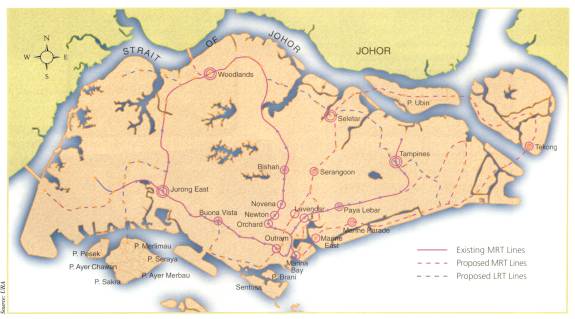
While the SBS and TIBS were able to provide affordable and reliable public transport to the people, there was a need to plan for future demand as the country continued to develop. In November 1987, The Mass Rapid Transit (MRT) system was introduced to Singaporeans. It is a system of transporting many people from one place to another in a relatively short time. It is also faster, smoother and more comfortable. Today, more than a million commuters travel on the MRT train daily.
The MRT system has 48 stations and three depots. These stations were built above or under the ground to enable commuters to get from one place to another quickly and easily. The two main lines are the East-West Line (Pasir Ris to Boon Lay) and the North- South Line (Marina Bay to Jurong East via Woodlands). The Woodlands Line started operating in February 1996.
The Bukit Panjang Light Rapid Transit (BPLRT) system is operated by the Singapore LRT Pte Ltd (SLRT). The $285-million Bukit Banjang LRT has 13 stations. It will take commuters only 27 minutes to make a round trip from Chao Chu Kang MRT station to Bukit Panjang station.
It features fourteen stations over a route of 7.8 kilometres, and provides a convenient feeder service for the residents in Bukit Panjang to the MRT System at Choa Chu Kang station. In addition, the Light Rapid Transit (LRT) system became fully operational in two more areas -Sengkang and Ponggol - in December 2002. This has further enhanced Singapore's public transport network.
Electric cars and Hybrid cars may soon become a common sight in Singapore. Electric cars are powered by an electric motor, while Hybrid cars use both an internal combustion engine and an electric motor.
In the future, the MRT and LRT system will be expanded so that it becomes the backbone of our public transport. Greater emphasis will be placed on integrating commuter services. It can be achieved by which when the MRT will be able to take us directly from the Singapore Cruise Centre at the World Trade Centre to the airport. And new towns such as Sengkang will have an integrated transport system serving the residents. The different modes of transport, which include buses, the MRT and the LRT, will be integrated for easy and efficient travel.
The Area Licensing Scheme was introduced to control the number of vehicles entering CBD between the peak hours of 7.30 am to 7.00 pm on weekdays and from 7.30 am to 2.30 pm on Saturdays and the eves of public holidays.
The Electronic Road Pricing Scheme (ERP) was introduced in April 1998 to limit the number of vehicles on certain roads during peak hours. It requires motorists to buy a CashCard and to install an in-vehicle unit. Road tolls are electronically deducted from their CashCard while travelling in the CBD and along the CTE, PIE and ECP.
The Vehicle Quota System implemented in 1990 is to limit vehicle ownership by regulating the number of vehicles sold monthly through issuing a restricted number of Certificates of Entitlement (COEs) each month.
The History of the Singaapore MRT/LRT