| Air Transportation |
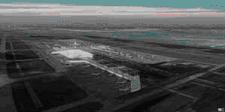
The Singapore Changi Airport is located at the eastern tip of Singapore, some twenty kilometers from the city center. More than half of Changi Airport�s total land was reclaimed from the sea. Completed in 1981, the airport consists of Teminal 1 and Terminal 2. Terminal 3, when completed in the year 2004, will add a capacity of Changi Airport to 64 million passengers a year, bringing the total capacity until the year 2020. The runway at Terminal 3 is designed to handle the new generation of large aircrafts, the A380.
With over 3,500 staff, Changi Airport is ready to serve the needs of our passengers with world class services and the modern and advanced facilities.
Having its vision of being the world's best airport and a global air hub, the airport has garnered many awards every year. Serving more than 60 airlines to over 145 cities, it is a major air hub in the Asia Pacific region. Details are paid in providing the best in facilities and services that every individual to the airport are given the royal treatment, making their stay at the airport, an enjoyable one.
More importantly, Changi Airport does what an airport should be doing best - providing speedy and hassle-free clearance. Arriving passengers take less than 30 minutes to clear immigration, claim their baggage and go through customs procedures. Departing passengers will also find similar conveniences while going through the departing process.
Terminal 2 boasts of some of the best facilities in the world. In May 1998, the world�s largest entertainment center in an airport was opened. In November that same year, the world�s first cactus garden, housing some 20 varieties of cacti native to North to South America, became available to passengers. In 2000, the e-hub was introduced and is now available in the Departure/Transit Lounge of Terminal 2.
The E-hub is a place where passengers can access the Internet though dial-up, Ethernet LAN cables, infrared ports and wireless LAN. With the introduction of Tru� Connect technology, an intelligent network server solution, passengers carrying laptops have free access to the Internet without the need for re-configuration to the settings in their laptops.
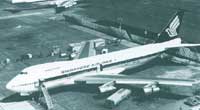
With its state-of-art facilities and quality service, Singapore Changi International Airport has consistently been voted the Best Airport in the World from 1988 to 2001 by business traveler and other international organisations. Since commencing operations on 1 July 1981, Singapore Changi Airport has been commended by the International Federation of Airline Pilots Association (IFALPA) for its safe and efficient air traffic services.
In the 1960s and 1970s, there was an increase in air passenger and cargo movement.
Paya Lebar Airport was expanded to cope with this.
However, in the late 1970s, it was found that any further expansion
would lead to a higher level of noise and air pollution in the area.
People living nearby would also have to be relocated to other areas of Singapore.
A new airport was therefore planned to be constructed at Changi,
as the capacity of Paya Labar was limited.
Since the 1980s, Singapore Changi Airport has constantly been improved
to meet the changing needs of its customers.
The use of automated and computerized systems ensures the smooth flow of goods
and the safety of passengers.
There is also a people-mover system called Changi Skytrain
and a baggage transfer system to facilitate movements between Terminal 1 and 2.
Singapore International Airline (SIA)
Singapore International Airline (SIA) is Singapore's national airline. It has the world�s most modern fleet of aeroplanes. SIA and its subsidiary airline, Silkair, fly to more than 100 cities in 50 countries.
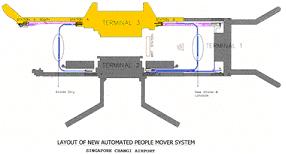
The Civil Aviation Authority of Singapore (CAAS) is installing a new S$135 million Automated People Mover System to make transfers between the three terminals convenient and seamless.The new Automated People Mover System will comprise of ten train services linking the three terminals through 6.5 kilometres of elevated train tracks. The new system will have a total of seven train stations: two stations in Terminal 1 and Terminal 2 respectively and three stations in Terminal 3. The new trains will come equipped with LCD screens in the cabins, giving flight information and other airport information. The cabins will also have more vertical stanchions and handholds, as well as designated areas for baggage trolleys, enhancing the convenience of users. There will also be plasma TV displays at the train stations to inform passengers of the arrival time of the next train. Work on the new Automated People Mover System will begin in December 2002 and is expected to be completed in 2006.
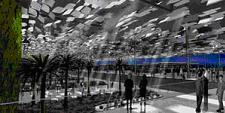
Singapore Changi Airport's Terminal 3 will have a flat but intriguing roof consisting of many
skylights allowing natural light into the terminal building.
The roof will limit the amount of direct sunlight into the building through the use of
louvres suspended above and below the skylights, filling Terminal 3 with diffused, ambient
light during the day. At night, artificial light bounced off the ceiling creates a soothing
and comfortable environment for passengers.
Terminal 3 and its associated works will cost S$1.5 billion. When opened in 2006,
Terminal 3 will add another 28 aerobridge gates to Changi Airport,
with up to eight that will be designed to handle the new generation of large aircraft.
Terminal 3
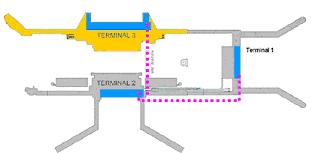
When Singapore Changi Airport's Terminal 3 opens in 2006, it will have a S$121 million state-of-the-art baggage handling system that will enhance Changi Airport's position as an aviation hub in the region. The fully-automated baggage system will include a high-speed inter-terminal baggage transfer system and an automated early bag storage facility. A key feature of the new baggage handling system is a high-speed inter-terminal baggage transfer system. Baggage of transfer passengers making connections at different terminals will be transported individually through underground tunnels at a speed of 7m/s. This means it will take only about three minutes for a bag to be transported from one terminal to the other.The baggage handling system will also have an automated early baggage storage system, where bags that are checked-in early or transfer bags with long connection times are stored. Besides allowing for automatic bag storage and retrieval, the system is also able to automatically update changes in flight itinerary of passengers and thus discharge the bags to the right connecting flights. The new baggage system will also have an integrated multi-level baggage security screening system to automatically screen bags. he baggage handling system in Terminal 3 will also be able to support the operations of new large aircraft, such as the Airbus A380. Of the eight baggage claim belts in Terminal 3's Arrival Hall, four are designed to support the new large aircraft. Work on the new baggage handling system will begin in the last quarter of 2003 and is expected to be completed in 2005.