 |
 |
 |
 |
|
|
|
|
|
|
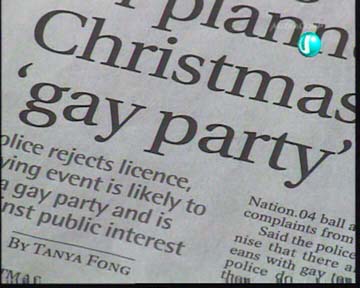
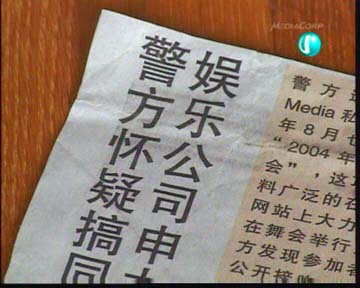
Male narrator: Last year, the authorities refused to issue a public entertainment licence when an application to hold a gay Christmas party was submitted. The reason given was that our society was still a conservative one. Moreover, it had been observed that homosexuals were indulging in public displays of intimacy. Therefore, the permit was denied. Homosexual groups have thus felt dissatisfied with the aforementioned decision.
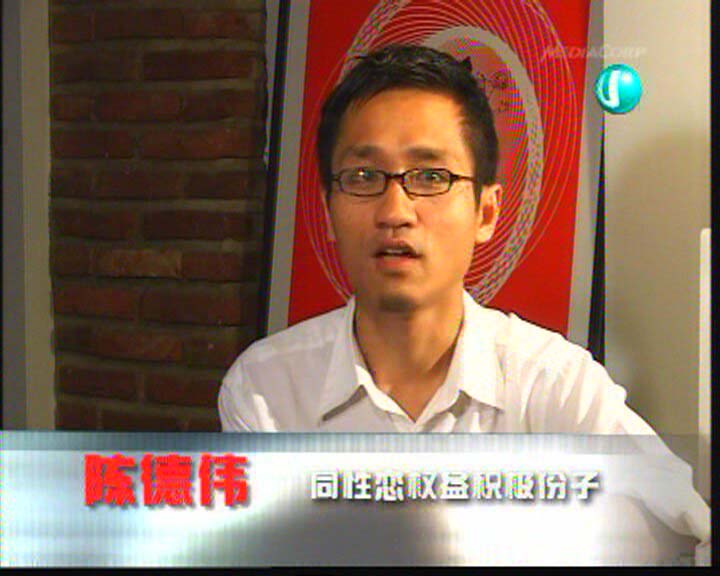
PLU's Charles Tan, gay rights activist: Looking at it from one aspect,
the event relied on ticketing sales for entry. If you are fearful that it may
offend the sensitivities of conservative people, they can easily stay away from
it. It presents no problem, isn't that true? Moreover, parties such as this have
been held for many years. None of them faced any problems. So, this sudden
refusal to issue a permit is somewhat of a contradiction. The explanation should
have been given from a legal viewpoint. There was no actual infringement of any
laws. It was only a party, meant to enable the clientele, the majority of whom
perhaps would have been homosexual, to have an enjoyable night out. That's the
only thing. It wouldn't have caused any disturbance to the average
man-in-the-street.
Male narrator: Toy Factory's Asstistant Artistic Director, Nelson Chia, also said that the position taken by the relevant authorities is not explicit.
 |
 |
Toy Factory's Nelson Chia: You say you don't approve of the holding of this party because Singapore, after all, is more of a conservative society. But you want to increase the amount of liberal space in this conservative society. You moreover encourage liberalisation. Then you approve of the existence of homosexual groups. You acknowledge their existence. This is tantamount to two heads speaking in different tongues. Homosexual groups are going to feel that actually... I also think that the situation is this...you are using a contradictory policy decision as a reason for them to accept, subsequently hoping that they will swallow it. Because this reason, I think, the minute everyone hears it, they immediately know that, "Eh, this isn't what you said in the first place!" So, can you come up with a more comprehensive reason to explain away this matter?
Male narrator: However, sociologists think that the authorities' actions were not taken from a position of discrimination. They, in fact, acted from a standpoint of the public interest.
 |
 |
 |
 |
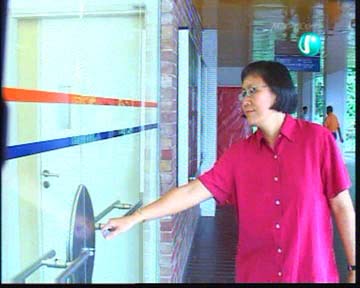
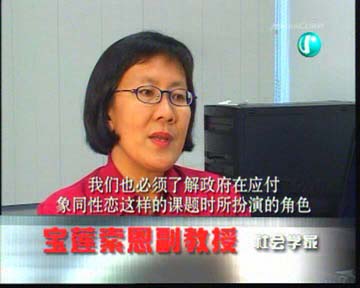
Sociologist Paulin Tay Straughan: (speaking in English) I think we also have to understand the role of the State. When we deal with issues like homosexuality, while on one hand, we expect the Government to, you know, to appreciate and embrace every single member of society, right?, and that is the right thing, right? Just because you're homosexual doesn't make you a lesser member, right? But at the same time, the Government is also mindful that everything it does is read as an initiative, right?, and there are members of the society who will expect the Government to be...they look towards the Government as some kind of, you know, moral authority, right?, you know, on what should be and what shouldn't be encouraged. So acceptance is one thing. Promoting is another thing. And these two need not be the same.
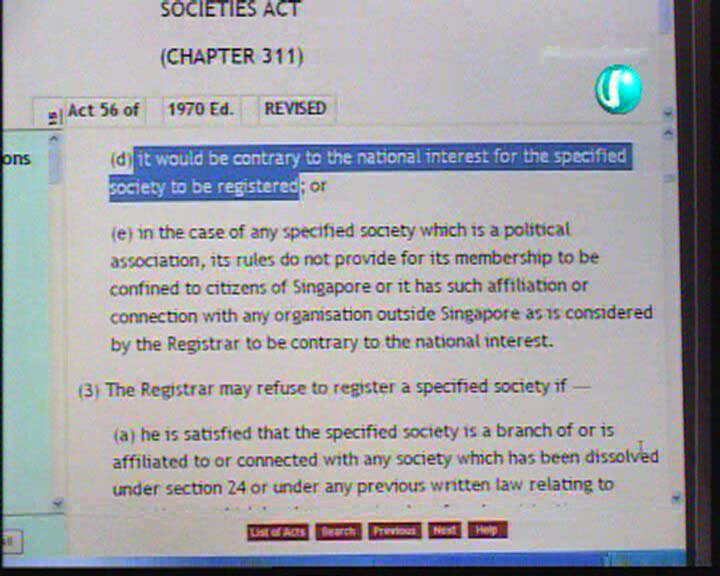
Male narrator: Under this 'accepting but not promoting' policy, gay
support groups have all along not been granted approval by the Registrar of
Societies. In 1997, one homosexual group planned to set up such an organisation.
However, the authorities, without providing any explanation, refused to approve
their registration. Seven years later, the same group again tried to get
registered. This time, the reason given for the denial of registration was that
the group would present a threat to the national interest.
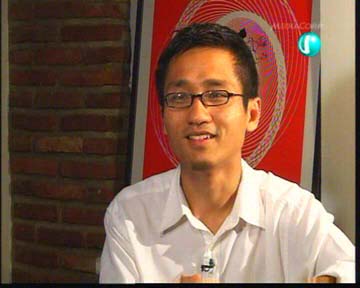
Charles Tan: Of course there is this feeling of there being a
contradiction. Moreover, the reason given was unpalatable. One the one hand, our
former Prime Minister, and the Government, has said that gays are tolerated,
isn't that right? So why is it that when we applied to set up a perfectly
reasonable and legitimate support group, it was no go? So, we feel like it's a
slap in the face.
 |
 |
 |
 |
Male narrator: After these incidents, gay rights activists are of the opinion that homosexuals here are being deprived of their rights. But sociologists feel that this is an exaggeration.
Sociologist Paulin Tay Straughan: I think that's over...that's overstating it, hmmh? I don't see it as a denial of gay rights. I think the people involved in promoting
gay rights should be very mindful that there are certain rights, you know, there
are certain privileges that you want to fight for because that means inclusion
into mainstream rights and privileges, you know, that other members of society
get. Things like employment and so forth, right? That you should not be denied a
job just because of your sexual tendencies. You should not be denied housing,
healthcare, education, just because, you know, of your sexual tendency. Bottom
line is if you want, if you ask the question, you know, "How well are we
accepting our gay members?", then, the question would be, "If you are gay and a
Singaporean, do you have access to everything available to your straight
friend?" And if the answer is yes, and I think the answer pretty much is yes,
then we're doing OK.
* * * Commercial break * * *
 |
 |
Male narrator: In Western countries, the majority of the homosexual cohort belong to the high income category of professionals. According to market research, because of the fact that they do not have the burden of family responsibilities, their spending power is especially strong. They vacation often, have a penchant for flaunting luxury goods and love entertainment, thus forming a powerful new market. Some have nicknamed this unique market the 'Pink Economy'. Some people think that the motive for Singapore changing its stance on homosexuals is its desire for capitalising on this market.
 |
 |
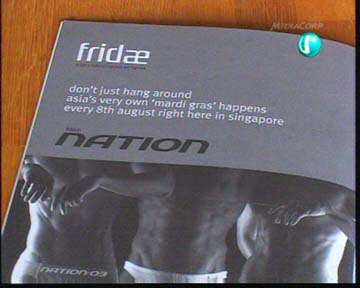
Male narrator: Reports have indicated that the local gay party extravaganza last year, Nation 04, attracted both from within our shores and overseas close to 8,000 participants, earning Singapore almost 10 million Sing dollars in tourist revenue.
 |
 |
Toy Factory's Nelson Chia: If you look at the sources of income for the Singapore economy as a whole, it really does not depend on the 'pink dollar'. Large-scale parties are held once, maybe twice, a year. Or take theatre for instance. The Government is actually not making anything from theatre productions, as far as the 'pink dollar' is concerned. So I think that from the point of view of the economy, they really do not rely on the 'pink dollar'.

Sociologist Paulin Tay Straughan: Particularly in Singapore, not
everything is determined by how much money you can make...because I think our
State still continues to value, and we continue to value, you know, the
Government's role as moral arbitrator, right? I think that these developments
come more because, as a society, we have progressed.
Male narrator: Some homosexuals feel that although the Government can
accept public information regarding gays, reports in the mainstream media are
still negative.
 |
 |
 |
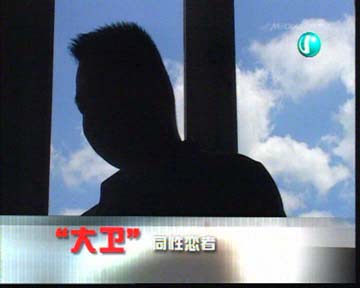 |
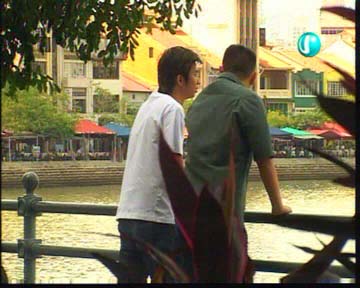
'David': Basically, as far as average Singaporeans are concerned, their acquaintance with homosexuals is too meagre. Moreover, they only read negative reports, like 'homosexuals are increasingly getting infected with AIDS' or that the lives they lead belong to the 'rabid party animal' category. Add to that the perception that their lives are full of sexual fun and games. There are absolutely no positive reports whatsoever. I feel that if this carries on, society will never change...because they will never really come into contact with, or discover that, homosexuals are actually very ordinary people. The people you see walking past you on the street every day may be homosexual, not only those who are up to strange things.
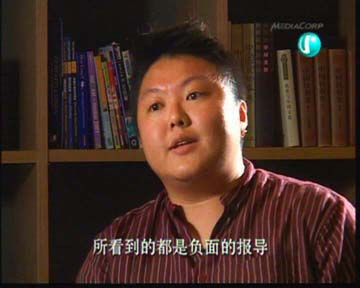
PLU's Eileena Lee: (speaking in English) There's a correlation between
homophobia and lack of visibility of anything about gay people - gay women, gay
men, or anything about sexual minorities. I'm talking about the media - as in
films, as in TV, as in newspapers. You hardly get to see any positive
information about sexual minorities. Or if you do, you get to see pretty much
negative stuff about sexual minorities, so, you know, naturally, people will
have this misconception of sexual minorities being very, you know, the deviant
sort.
 |
 |
Toy Factory's Nelson Chia: It's because now, there is still no kind of channel to enable the positive voice of homosexuals to emerge. Theatre, actually, is already one form of channel. But in the mainstream media, be it TV or newspapers, this kind of viewpoint is still not readily approved of... not readily approved of. So, often, voices of protest are heard. It appears, at the present time, to be decidedly unfair! If others are allowed to criticise you, you must be given the right to reply. I personally hope that in future, we will be able to listen to voices from both parties.

Sociologist Paulin Tay Straughan: No matter what we say, no matter what
how many doors the state opens, there are going to be people, ordinary good
folks, alright?, who are going to be fearful. I would encourage the gay
community, particularly those who are taking up leadership positions within
these communities, to make good use of these opportunities to promote a more
positive image, alright?, of what the community stands for. Showcase the
talents, showcase what, you know, this community can do for Singapore. Fight
wisely. Promote positive, wholesome images so that these people, in time to
come, will see a gay Singaporean is no different from a straight Singaporean.
 |
 |
 |
|