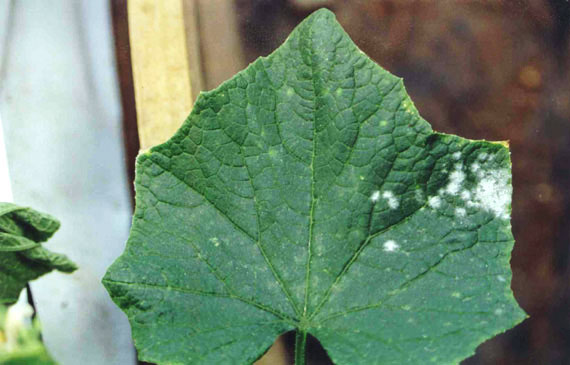
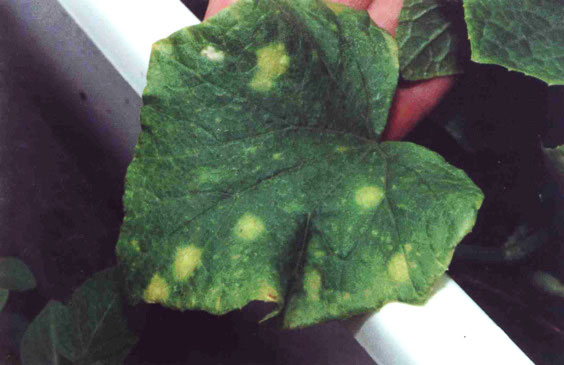
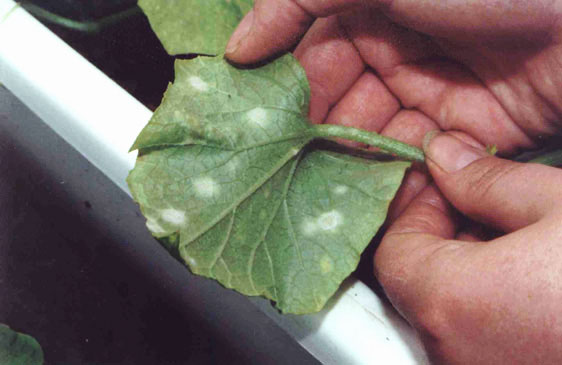
Powdery mildew is not difficult to control, so often the `low chemical' or `organic' methods are the best line of defence. The powdery mildew fungus is vulnerable to the action of sulphur throughout most of its life cycle. Sulphur works by `selective toxicity' that is, it is more toxic to the parasite than to the host. An effective sulphur application rate would be 110-220ml per 100 litres of water of a `suspension or wettable powder' product, when the fungus is first observed, followed by repeat applications two weeks later. Sulphur should not be applied to cantaloupes because they are sulphur sensitive. Cucumbers are somewhat sensitive to sulphur, gourds, pumpkins, squashes, watermelons and most other plant species are sulphur-tolerant. Sulphur dusts are less injurious than sprays, but also less effective than sprays since they do not result in as effective leaf coverage. Sulphur offers long lasting protection and is effective in the absence of moisture. The warmer the temperature, the greater the vaporisation of sulphur and since sulphur acts as a vapour one way of using it in a greenhouse is by painting it on greenhouse heating pipes during colder growing periods. During warmer growing periods, in greenhouses and other growing areas, sprays, dusts or aerosol bombs may be used. For the control of downy mildew, copper compounds are effective, but they should be used with caution, as repeated applications can cause crop damage
Many rose and cucumber growers achieve control or prevention of mildew disease with application of silica based dusts or sprays. Silica gives a protective coat over the leaf surface and thus prevents the mildew spores from germinating and infecting the plant tissue. Another low chemical method of control which has achieved some success for many growers is the use of sodium bicarbonate sprays (common baking soda). It has been proven that baking soda, mixed with a high quality detergent (as a sticking agent and surfactant), can give good control of mildew on a number of plant species. It is thought that the high pH of the spray which coats the leaves inhibits the growth of the mildew disease. The current recommendations are for 2 teaspoons of baking soda per litre of water, with a good `squirt' of a high quality liquid dishwashing detergent (or other wetting agent such as `coco-wet'), applied as a preventative spray will give reasonable control of mildew disease.
** Fungicides for Mildew Control
There are numerous fungicidal products for the control of mildew disease. The problem with `chemical' control is that many of the fungicides have caused the development of resistant strains of mildew disease. Sulphur dust or flowers of sulphur poses little or no risk of inducing resistant mildew stains. Others such as Benomyl can no longer be used because resistant strains are now very widespread. One of the chemical fungicides which is still effective against powdery mildew is `triforine', sold under the name of `Saprol'. Saprol is a systemic fungicide with both curative and protectant action against a range of fungal disease. This should be sprayed at the fist sign of infection (at a range of 150ml/100 litres of water), and repeated 10 days later. Powdery mildew can develop resistance to Saprol, so its use should be limited to 4 applications per season, and rotated with use of another fungicide such as sulphur based products. Other fungicide products which pose less risk to inducing resistance are those containing pyrazophos, and dinocap (these may go by various trade names including Afugan or Sabithane).
**NOTE: it is important to check with your local department of agriculture to see which fungicide products are registered for use on food crops in your area.